
In the six hundredth year of Noah’s life, in the second month, on the seventeenth day of the month, on that day all the fountains of the great deep burst open, and the sky’s windows opened.
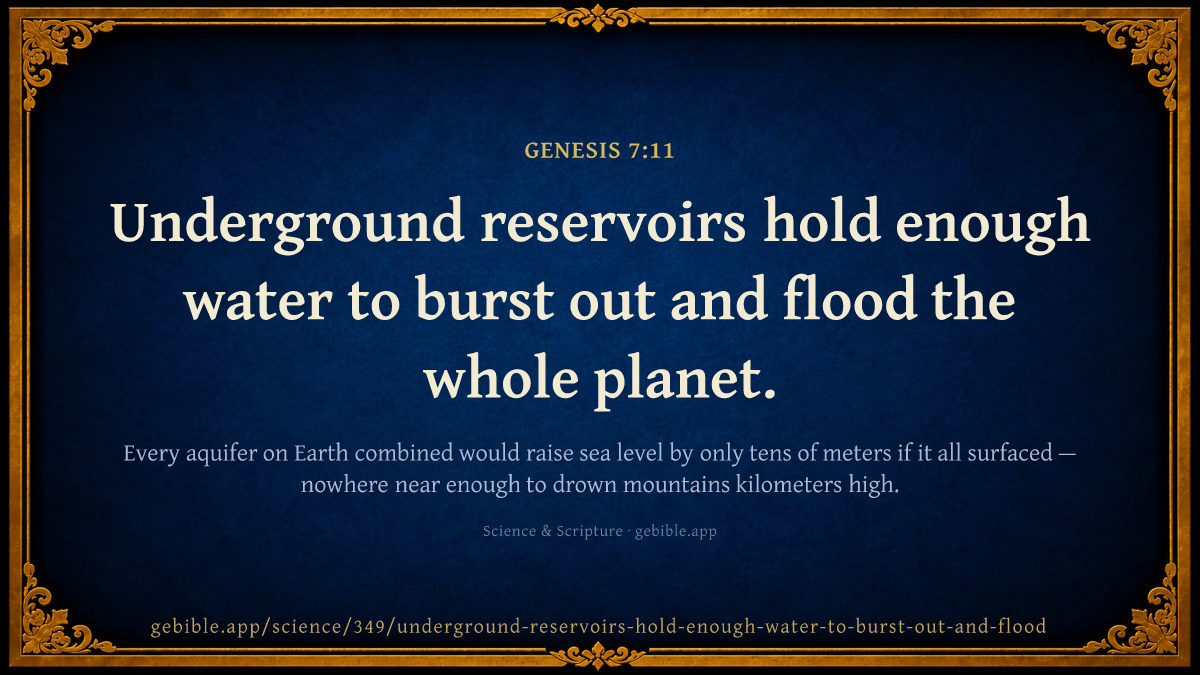
Underground reservoirs hold enough water to burst out and flood the whole planet.
Geology
25
passages in this field
Show this passage in
The cited passage
What current science says
Every aquifer on Earth combined would raise sea level by only tens of meters if it all surfaced — nowhere near enough to drown mountains kilometers high. There are no giant hollow caverns of water under the crust; the deep 'water' that exists is mostly locked inside minerals, not sloshing around. And the rock down there is under such crushing pressure it would collapse any cavern long before it could hold a planet's worth of water.
What the text says
This comes from Genesis 7:11. 'All the fountains of the great deep were broken up' — subterranean waters burst forth to help flood the entire earth.
Three honest ways to read this passage
-
As history
The text records how its authors understood the world with the knowledge they had. Read this way, a difference from modern science is a window into the ancient mind, not a failure.
-
As accommodation
The text speaks to its first audience in their own terms, to make a point that isn't mainly about physics or biology. Read this way, the scientific detail is the vehicle, not the cargo.
-
As contradiction
The text makes a claim about the physical world that modern findings dispute. Read this way, the difference is a genuine factual disagreement worth naming.
GEBible doesn't pick one of these for you. Each entry shows the passage, what it says, and what current science says — nothing more.