
Reuben went in the days of wheat harvest, and found mandrakes in the field, and brought them to his mother, Leah. Then Rachel said to Leah, “Please give me some of your son’s mandrakes.” Leah said to her, “Is it a small matter that you have taken away my husband? Would you take away my son’s mandrakes, also?” Rachel said, “Therefore he will lie with you tonight for your son’s mandrakes.” Jacob came from the field in the evening, and Leah went out to meet him, and said, “You must come in to me; for I have surely hired you with my son’s mandrakes.” He lay with her that night.
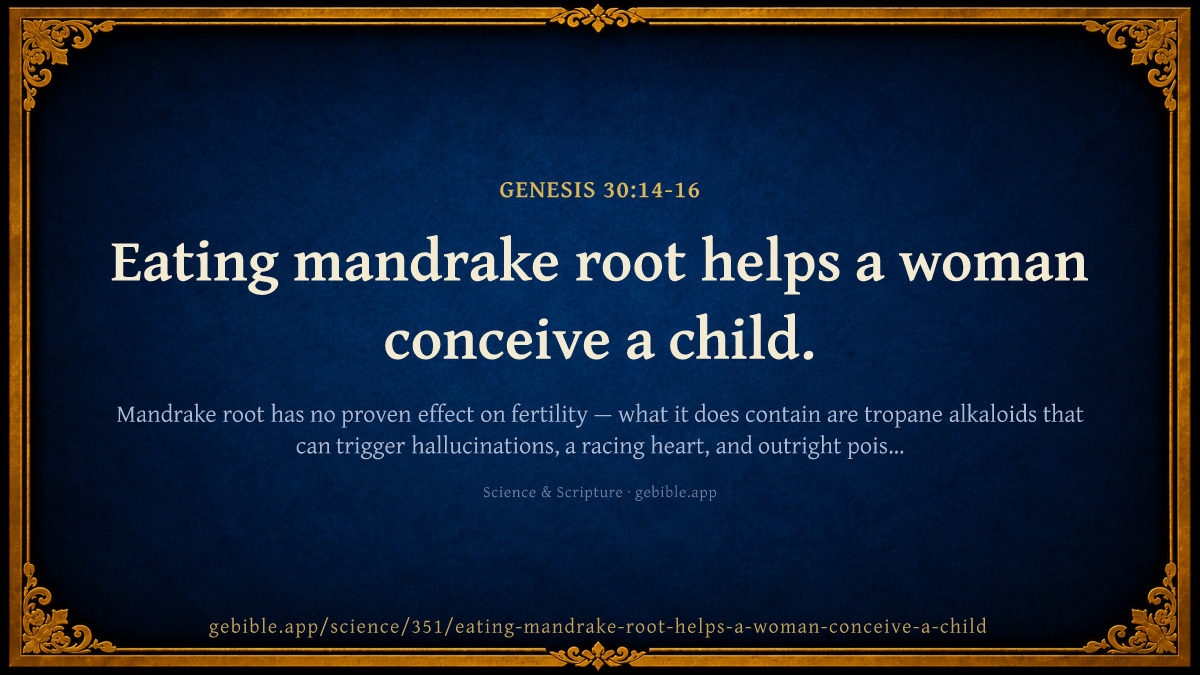
Eating mandrake root helps a woman conceive a child.
Medicine
97
passages in this field
Show this passage in
The cited passage
What current science says
Mandrake root has no proven effect on fertility — what it does contain are tropane alkaloids that can trigger hallucinations, a racing heart, and outright poisoning. Its 'fertility' reputation came from its forked, vaguely human-shaped root, not from any biology. Real infertility is treated with hormones and IVF.
What the text says
This comes from Genesis 30:14-16. Mandrakes are traded between Rachel and Leah as a remedy believed to bring about pregnancy.
Three honest ways to read this passage
-
As history
The text records how its authors understood the world with the knowledge they had. Read this way, a difference from modern science is a window into the ancient mind, not a failure.
-
As accommodation
The text speaks to its first audience in their own terms, to make a point that isn't mainly about physics or biology. Read this way, the scientific detail is the vehicle, not the cargo.
-
As contradiction
The text makes a claim about the physical world that modern findings dispute. Read this way, the difference is a genuine factual disagreement worth naming.
GEBible doesn't pick one of these for you. Each entry shows the passage, what it says, and what current science says — nothing more.