
He set another parable before them, saying, “The Kingdom of Heaven is like a grain of mustard seed, which a man took, and sowed in his field; which indeed is smaller than all seeds. But when it is grown, it is greater than the herbs, and becomes a tree, so that the birds of the air come and lodge in its branches.”
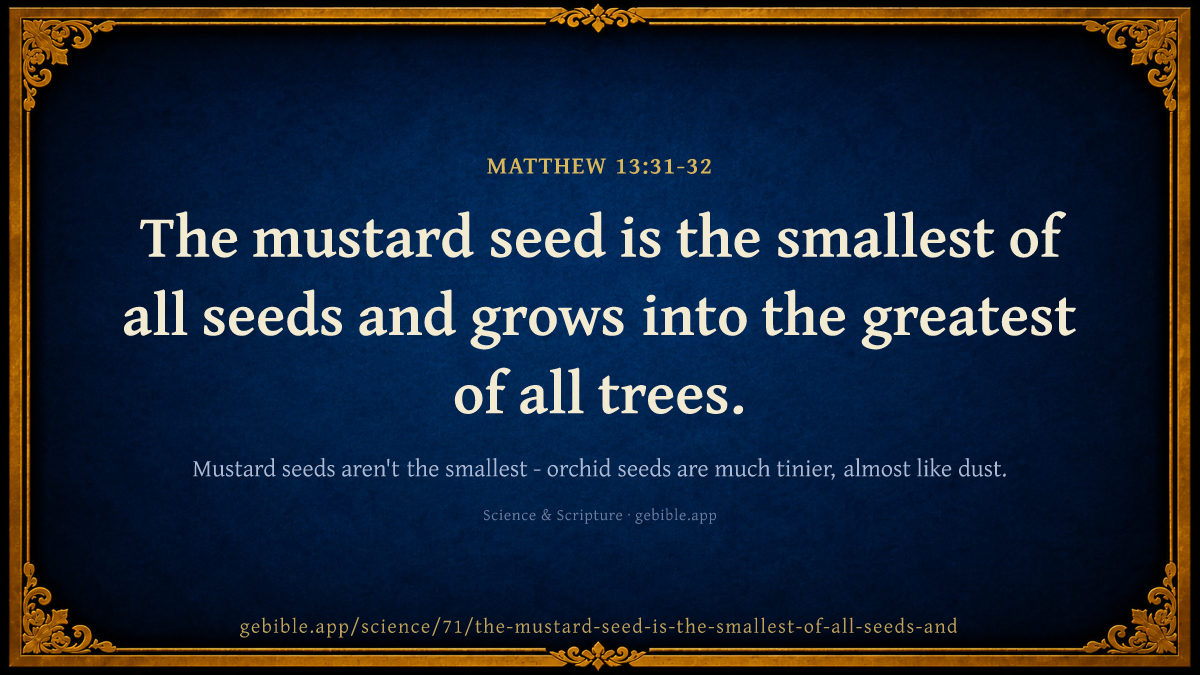
The mustard seed is the smallest of all seeds and grows into the greatest of all trees.
Botany
8
passages in this field
Show this passage in
The cited passage
What current science says
Mustard seeds aren't the smallest - orchid seeds are much tinier, almost like dust. Also, mustard plants are herbs or shrubs that grow only a few feet tall, not trees. Sequoias and redwoods are the greatest trees - they can grow over 300 feet tall.
What the text says
Matthew 13:31-32 has Jesus call the mustard seed 'the least of all seeds' that grows into 'the greatest among herbs' and becomes a tree - presenting it as the smallest of seeds that grows into the greatest of plants.
Three honest ways to read this passage
-
As history
The text records how its authors understood the world with the knowledge they had. Read this way, a difference from modern science is a window into the ancient mind, not a failure.
-
As accommodation
The text speaks to its first audience in their own terms, to make a point that isn't mainly about physics or biology. Read this way, the scientific detail is the vehicle, not the cargo.
-
As contradiction
The text makes a claim about the physical world that modern findings dispute. Read this way, the difference is a genuine factual disagreement worth naming.
GEBible doesn't pick one of these for you. Each entry shows the passage, what it says, and what current science says — nothing more.