
Most certainly I tell you, unless a grain of wheat falls into the earth and dies, it remains by itself alone. But if it dies, it bears much fruit.
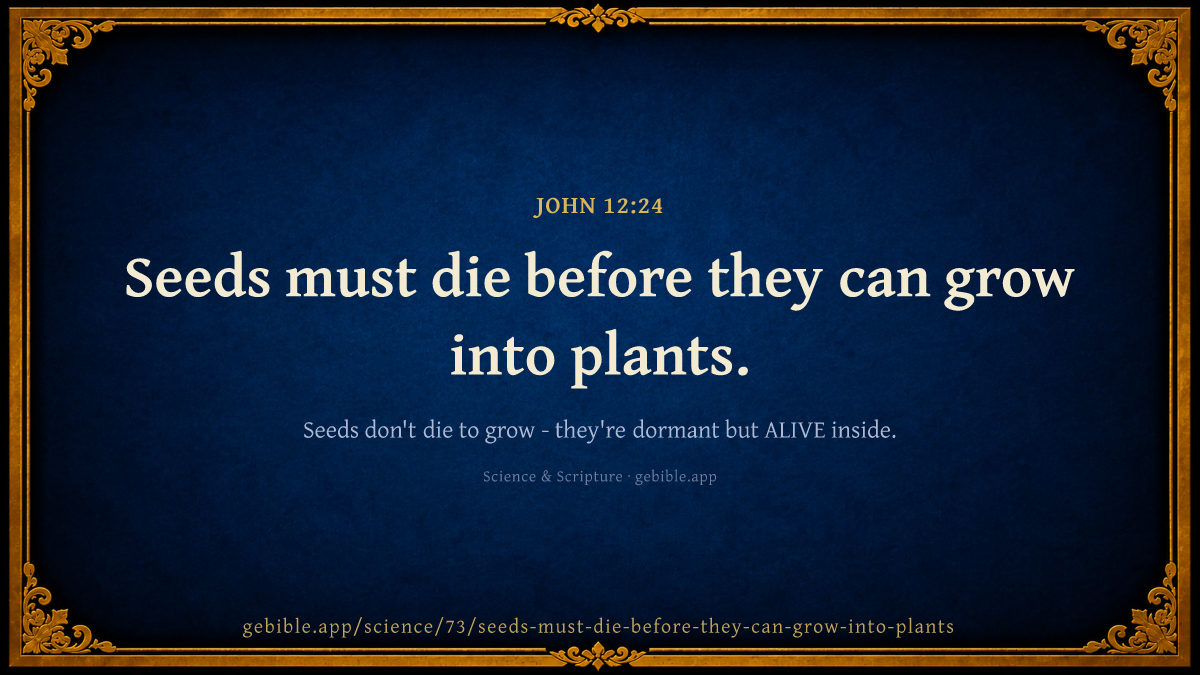
Seeds must die before they can grow into plants.
Botany
8
passages in this field
Show this passage in
The cited passage
What current science says
Seeds don't die to grow - they're dormant but ALIVE inside. A dead seed cannot germinate and will just rot. Seeds contain a tiny living embryo waiting for the right conditions (water, warmth, soil) to 'wake up' and start growing. Only living seeds can sprout.
What the text says
John 12:24 records Jesus saying, 'Except a corn of wheat fall into the ground and die, it abideth alone: but if it die, it bringeth forth much fruit' - depicting a seed as dying before it produces a new plant.
Three honest ways to read this passage
-
As history
The text records how its authors understood the world with the knowledge they had. Read this way, a difference from modern science is a window into the ancient mind, not a failure.
-
As accommodation
The text speaks to its first audience in their own terms, to make a point that isn't mainly about physics or biology. Read this way, the scientific detail is the vehicle, not the cargo.
-
As contradiction
The text makes a claim about the physical world that modern findings dispute. Read this way, the difference is a genuine factual disagreement worth naming.
GEBible doesn't pick one of these for you. Each entry shows the passage, what it says, and what current science says — nothing more.