
He himself sent out a dove to see if the waters were abated from the surface of the ground, but the dove found no place to rest her foot, and she returned into the ship to him, for the waters were on the surface of the whole earth. He put out his hand, and took her, and brought her to him into the ship. He waited yet another seven days; and again he sent the dove out of the ship. The dove came back to him at evening and, behold, in her mouth was a freshly plucked olive leaf. So Noah knew that the waters were abated from the earth.
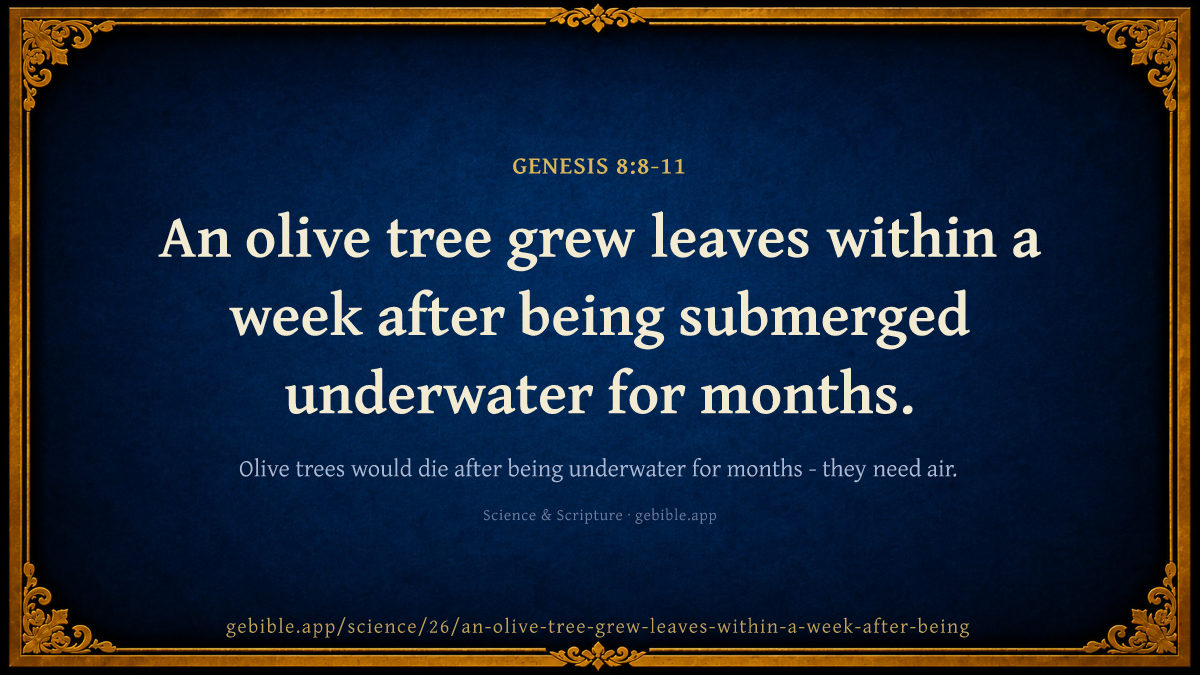
An olive tree grew leaves within a week after being submerged underwater for months.
Botany
8
passages in this field
Show this passage in
The cited passage
What current science says
Olive trees would die after being underwater for months - they need air. Even if seeds survived, they can't germinate and grow leaves in a week. Seeds need weeks or months to sprout. This detail reveals the story wasn't written by anyone familiar with botany.
What the text says
Genesis 8:8-11 describes Noah sending out a dove that finds no dry land, then sending it again seven days later, after which it returns with a freshly plucked olive leaf - implying an olive tree had survived months underwater and put out leaves within a week.
Three honest ways to read this passage
-
As history
The text records how its authors understood the world with the knowledge they had. Read this way, a difference from modern science is a window into the ancient mind, not a failure.
-
As accommodation
The text speaks to its first audience in their own terms, to make a point that isn't mainly about physics or biology. Read this way, the scientific detail is the vehicle, not the cargo.
-
As contradiction
The text makes a claim about the physical world that modern findings dispute. Read this way, the difference is a genuine factual disagreement worth naming.
GEBible doesn't pick one of these for you. Each entry shows the passage, what it says, and what current science says — nothing more.