
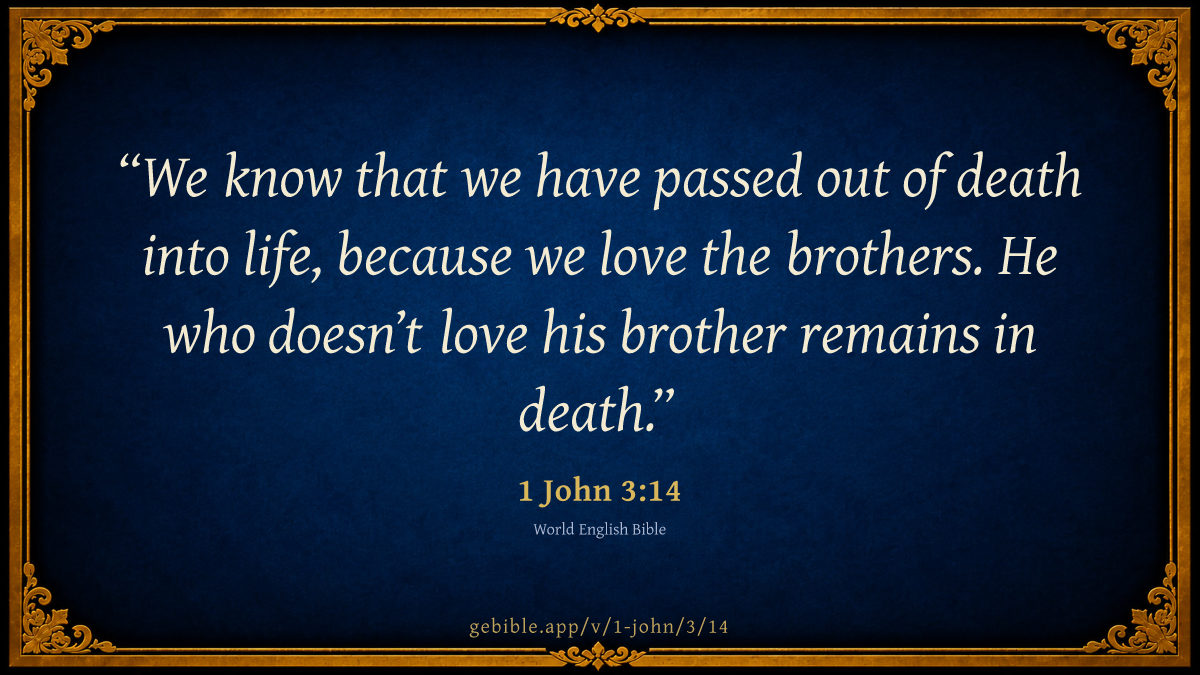
We know that we have passed out of death into life, because we love the brothers. He who doesn’t love his brother remains in death.
Parallel Translations
-
We know that we have passed out of death into life, because we love the brothers. He who doesn’t love his brother remains in death.
-
We knowe that we are translated from deeth vnto lyfe be cause we love the brethren. He that loveth not his brother abydeth in deeth.
-
We know that we are translated from death vnto life, because we loue the brethren: he that loueth not his brother, abideth in death.
Cross-references (30)
Passages linked to 1 John 3:14 in the Treasury of Scripture Knowledge, ordered by reader-vote popularity; verse text shown in World English Bible.
- John 13:35 By this everyone will know that you are my disciples, if you have love for one another.”
- 1 John 5:2 By this we know that we love the children of God, when we love God and keep his commandments.
- John 5:24 “Most certainly I tell you, he who hears my word and believes him who sent me has eternal life, and doesn’t come into judgment, but has passed out of death into life.
- 1 John 4:20-21 If a man says, “I love God,” and hates his brother, he is a liar; for he who doesn’t love his brother whom he has seen, how can he love God whom he has not seen? This commandment we have from him, that he who loves God should also love his brother.
- 1 Thessalonians 4:9 But concerning brotherly love, you have no need that one write to you. For you yourselves are taught by God to love one another,
- 1 John 4:7-8 Beloved, let’s love one another, for love is of God; and everyone who loves has been born of God, and knows God. He who doesn’t love doesn’t know God, for God is love.
- John 15:12 “This is my commandment, that you love one another, even as I have loved you.
- Hebrews 13:1 Let brotherly love continue.
- 1 Peter 1:22 Seeing you have purified your souls in your obedience to the truth through the Spirit in sincere brotherly affection, love one another from the heart fervently,
- Matthew 25:40 “The King will answer them, ‘Most certainly I tell you, because you did it to one of the least of these my brothers, you did it to me.’
- Ephesians 1:15 For this cause I also, having heard of the faith in the Lord Jesus which is among you, and the love which you have toward all the saints,
- Colossians 1:4 having heard of your faith in Christ Jesus and of the love which you have toward all the saints,
- 1 Peter 3:8 Finally, all of you be like-minded, compassionate, loving as brothers, tenderhearted, courteous,
- 1 John 3:23 This is his commandment, that we should believe in the name of his Son, Jesus Christ, and love one another, even as he commanded.
- 1 John 4:12 No one has seen God at any time. If we love one another, God remains in us, and his love has been perfected in us.
- John 15:17 “I command these things to you, that you may love one another.
- 1 John 2:9-11 He who says he is in the light and hates his brother is in the darkness even until now. He who loves his brother remains in the light, and there is no occasion for stumbling in him. But he who hates his brother is in the darkness, and walks in the darkness, and doesn’t know where he is going, because the darkness has blinded his eyes.
- 1 John 5:13 These things I have written to you who believe in the name of the Son of God, that you may know that you have eternal life, and that you may continue to believe in the name of the Son of God.
- 1 John 5:19-20 We know that we are of God, and the whole world lies in the power of the evil one. We know that the Son of God has come, and has given us an understanding, that we know him who is true, and we are in him who is true, in his Son Jesus Christ. This is the true God and eternal life.
- Psalms 16:3 As for the saints who are in the earth, they are the excellent ones in whom is all my delight.
- 2 Corinthians 5:1 For we know that if the earthly house of our tent is dissolved, we have a building from God, a house not made with hands, eternal, in the heavens.
- Ephesians 2:5 even when we were dead through our trespasses, made us alive together with Christ—by grace you have been saved—
- Hebrews 6:10-11 For God is not unrighteous, so as to forget your work and the labor of love which you showed toward his name, in that you served the saints, and still do serve them. We desire that each one of you may show the same diligence to the fullness of hope even to the end,
- 2 Peter 1:7 and in godliness brotherly affection; and in brotherly affection, love.
- 1 John 2:3 This is how we know that we know him: if we keep his commandments.
- Proverbs 21:16 The man who wanders out of the way of understanding shall rest in the assembly of the departed spirits.
- Luke 15:24 for this, my son, was dead, and is alive again. He was lost, and is found.’ Then they began to celebrate.
- Luke 15:32 But it was appropriate to celebrate and be glad, for this, your brother, was dead, and is alive again. He was lost, and is found.’ ”
- Galatians 5:22 But the fruit of the Spirit is love, joy, peace, patience, kindness, goodness, faith,
- Ephesians 2:1 You were made alive when you were dead in transgressions and sins,
Cross-references from openbible.info (CC BY 4.0)
Explain this verse (17 sources)
Historical commentary, presented as a primary source — not an endorsement.
Private notes
Saved on this device only — never synced or sent anywhere.
John Calvin 1540 · Public Domain 14 We know. He commends love to us by…
14 We know. He commends love to us by a remarkable eulogy, because it is an evidence of a transition from death to life. It hence follows that if we love the brethren we are blessed, but that we are miserable if we hate them. There is no one who does not wish to be freed and delivered from death. Those then who by cherishing hatred willingly give themselves up to death, must be extremely stupid and senseless. But when the Apostle says, that it is known by love that we have passed into life, he does not mean that man is his own deliverer, as though he could by loving the brethren rescue himself from death, and procure life for himself; for he does not here treat of the cause of salvation, but as love is the special fruit of the Spirit, it is also a sure symbol of regeneration. Then the Apostle draws an argument from the sign, and not from the cause. For as no one sincerely loves his brethren, except he is regenerated by the Spirit of God, he hence rightly concludes that the Spirit of God, who is life, dwells in all who love the brethren. But it would be preposterous for any one to infer hence, that life is obtained by love, since love is in order of time posterior to it.
The argument would be more plausible, were it said that love makes us more certain of life: then confidence as to salvation would recumb on works. But the answer to this is obvious; for though faith is confirmed by all the graces of God as aids, yet it ceases not to have its foundation in the mercy of God only. As for instance, when we enjoy the light, we are certain that the sun shines; if the sun shines on the place in which we are, we have a clearer view of it; but yet when the visible rays do not come to us, we are satisfied that the sun diffuses its brightness for our benefit. So when faith is founded on Christ, some things may happen to assist it, still it rests on Christ’s grace alone.
John Calvin's Commentaries (1540-1563) — public domain. Text from the Calvin Translation Society English edition (1840s-50s) via the Christian Classics Ethereal Library (ccel.org). Calvin's coverage is partial (roughly two-thirds of the Bible); uncommented books and verses are honest gaps, never fabricated. The 19th-century editor's footnotes and remarks are omitted so the notes are faithfully Calvin's own voice.
Geneva Bible translators 1599 · Public Domain The second reason: Because charity is a testimony that…
The second reason: Because charity is a testimony that we are translated from death to life: and therefore hatred towards the brethren is a testimony of death, and whosoever nourished it, doth as it were foster death in his bosom.
Love is a token that we are translated from death to life, for as such as by the effects the cause is known.
Geneva Bible (1599) marginal notes — public domain.
John Trapp 1656 · Public Domain 14 We know that we have passed from death…
14 We know that we have passed from death unto life, because we love the brethren. He that loveth not his brother abideth in death.
Ver. 14. We know that we have passed] Not we think, we hope, &c. If we would not have with the merchant an estate hanging upon ropes, fortunam rudentibus aptam, and depending upon uncertain winds, let us make sure work for our souls. This is a jewel that the cock on the dunghill meddles not with. Sensum electionis ad gloriam in hac vita nullum agnosco, saith Greevinchovius the Arminian, I know no such thing as assurance of heaven in this life. Papists allow us nothing beyond a conjectural confidence, unless by special revelation. Miserable comforters! They tell us that to taste though but with the tip of a rod (Jonathan-like) of this honey will hinder us in the chase of our lusts; but believe them not; for the joy of the Lord is our strength, Neh 8:10.
Read full note →
Because we love the brethren] This is to be seen in the natives of New England. The first appearance of grace in them is, their love and respect to those that are truly gracious.
John Trapp, A Commentary or Exposition upon All the Books of the Old and New Testament (1647–1656) — public domain. Text from a community e-Sword module.
Matthew Poole 1685 · Public Domain The notion of brother must not be understood so…
The notion of brother must not be understood so narrowly, as only to signify such as we have particular inclination to, as being of our own party and opinion, or kindred, or who have obliged us by special kindness; for to confine our love within such limits, were no argument of our having
passed from death unto life, or more than is to be found with the worst of men, Mat 5:46,47. Nor must it be understood exclusively, of the regenerateonly; but must be taken, first, more generally, in the natural sense, for all mankind, in the same latitude as neighbour in that summary of the second table: Thou shalt love thy neighbour as thyself; originally intended not to Jews, as such, but men; and therefore excludes not our enemies, by our Saviour’s interpretation, Mat 5:43,44. Secondly, in a more special (viz. the spiritual) sense, for such as are our brethren by regeneration, so the children with us of the same Father; i.e. whereas the blessed God himself is the primum amabile, the first object of love, all others (persons or things) ought to be loved proportionably to what prints or characters of the Divine excellency we find impressed upon them. Human nature hath resemblances in it of his spiritual, intelligent, immortal nature; regeneracy, of his holiness. And so he loves his creatures himself, severing their malignity, (where that is to be found), that is of themselves, from what of real good there is in them, which is from him. When therefore a correspondent frame of love is impressed upon us, and inwrought into our temper, his image, who is love, is renewed in us, which, in this noble part of it, the devil had so eminently defaced in the world, possessing the souls of men with mutual animosities and enmities against one another, but especially such as should be found to have upon them any impress of the most excellent kind of goodness, i.e. of true piety and holiness. And by this renovation of his image in us, whereby we are enabled to love others for his sake, and proportionably to what characters of him are upon them, we appear to be his children, Mat 5:45, begotten of him into a state of life, out of that death which is upon the rest of the world, Eph 2:1, and wherein every one still abides that thus loves not his brother.
Matthew Poole's English Annotations on the Holy Bible (1683–1685) — public domain. Text from a community e-Sword/MySword module.
William Burkitt 1703 · Public Domain Observe here, 1. Our apostle’s description of a carnal…
Observe here, 1. Our apostle’s description of a carnal unregenerate state; it is a state of spiritual death.
2. Of a Christian’s renewed state by the Spirit of Christ, it is a state of spiritual life; we are passed from death to life.
Read full note →
3. Here is the mark and token by which this translation from death to life may be known, namely, by love; for love being the great work of God’s renewing spirit on the soul, it is by the production of that, we come to the knowledge that we are changed from a Cainish corrupt state of death, into a state of holy life: Whatever grace men pretend unto, if they want this grace of love, they are yet dead in sin.
Observe, 4. The characteristical note of that love which will be an indubitable evidence of this our translation from death to life, it must be a love of the brethren; that is, of all Christians, as such; particularly it must be an extensive and universal love, that reaches all the children of God, all good men, of what judgment and opinion soever, otherwise it is the love of a party only, and a love for opinion sake, not for grace-sake, We give thanks since we heard of your love to all saints: Col 1:4 that is, to all of what nation and kingdom soever, of what estate and condition soever, of what judgment and opinion soever, though differing from you in some lesser things.
It must also be an holy love that will evidence our Christianity; though all men must be loved as men, yet the brethren must be loved for the likeness of God in them, we must love God’s holiness in holy persons: it is one thing to love the brethren, and another to love them as brethren, and because they are brethren; a gracious person may be loved only for carnal respects, and sinister ends; again, it must be active and operative, a costly and expensive love; that cheap love of some men, which will wish a poor Christian well, but will be at no pains, no cost, or expence, to help and succour him, because they love their money better than they do their brother, is the hypocrite’s love, not the saint’s. If a brother or a sister be naked, and we say unto him, Be thou clothed, &c. Jas 2:15 this is a cold sort of love, which will profit neither our brother nor ourselves.
From the whole learn, That the love of grace in another, is a good evidence of the life of grace in ourselves; unfeigned love to the children of God as such, is an undoubted evidence of our regeneration and adoption; We know that we are passed from, &c.
William Burkitt's Expository Notes on the New Testament (1700–1703) — public domain. Text from a community e-Sword module.
Matthew Henry 1710 · Public Domain The beloved apostle can scarcely touch upon the mention…
The beloved apostle can scarcely touch upon the mention of sacred love, but he must enlarge upon the enforcement of it, as here he does by divers arguments and incentives thereto; as,
I. That it is a mark of our evangelical justification, of our transition into a state of life: We know that we have passed from death to life, because we love the brethren, Jo1 3:14. We are by nature children of wrath and heirs of death. By the gospel (the gospel-covenant or promise) our state towards another world is altered and changed. We pass from death to life, from the guilt of death to the right of life; and this transition is made upon our believing in the Lord Jesus: He that believeth on the Son hath everlasting life, and he that believeth not hath the wrath of God abiding on him, Joh 3:36. Now this happy change of state we may come to be assured of: We know that we have passed from death to life; we may know it by the evidences of our faith in Christ, of which this love to our brethren is one, which leads us to characterize this love that is such a mark of our justified state. It is not a zeal for a party in the common religion, or an affection for, or an affectation of, those who are of the same denomination and subordinate sentiments with ourselves. But this love,
Read full note →
1. Supposes a general love to mankind: the law of Christian love, in the Christian community, is founded on the catholic law, in the society of mankind, Thou shalt love thy neighbour as thyself. Mankind are to be loved principally on these two accounts: - (1.) As the excellent work of God, made by him, and made in wonderful resemblance of him. The reason that God assigns for the certain punishment of a murderer is a reason against our hatred of any of the brethren of mankind, and consequently a reason for our love to them: for in the image of God made he man, Gen 9:6. (2.) As being, in some measure, beloved in Christ. The whole race of mankind - the gens humana, should be considered as being, in distinction from fallen angels, a redeemed nation; as having a divine Redeemer designed, prepared, and given for them. So God loved the world, even this world, that he gave his only-begotten Son, that whosoever believeth on him should not perish, but have everlasting life, Joh 3:16. A world so beloved of God should accordingly be loved by us. And this love will exert itself in earnest desires, and prayers, and attempts, for the conversion and salvation of the yet uncalled blinded world. My heart's desire and prayer for Israel are that they may be saved. And then this love will include all due love to enemies themselves.
2. It includes a peculiar love to the Christian society, to the catholic church, and that for the sake of her head, as being his body, as being redeemed, justified, and sanctified in and by him; and this love particularly acts and operates towards those of the catholic church that we have opportunity of being personally acquainted with or credibly informed of. They are not so much loved for their own sakes as for the sake of God and Christ, who have loved them. And it is God and Christ, or, if you will, the love of God and grace of Christ, that are beloved and valued in them and towards them. And so this is the issue of faith in Christ, and is thereupon a note of our passage from death to life.
II. The hatred of our brethren is, on the contrary, a sign of our deadly state, of our continuance under the legal sentence of death: He that loveth not his brother (his brother in Christ) abideth in death, Jo1 3:14. He yet stands under the curse and condemnation of the law. This the apostle argues by a clear syllogism: "You know that no murderer hath eternal life abiding in him; but he who hates his brother is a murderer; and therefore you cannot but know that he who hates his brother hath not eternal life abiding in him," Jo1 3:15. Or, he abideth in death, as it is expressed, Jo1 3:14, Whosoever hateth his brother is a murderer; for hatred of the person is, so far as it prevails, a hatred of life and welfare, and naturally tends to desire the extinction of it. Cain hated, and then slew, his brother. Hatred will shut up the bowels of compassion from the poor brethren, and will thereby expose them to the sorrows of death. And it has appeared that hatred of the brethren has in all ages dressed them up in ill names, odious characters, and calumnies, and exposed them to persecution and the sword. No wonder, then, that he who has a considerable acquaintance with the heart of man, or is taught by him who fully knows it, who knows the natural tendency and issue of vile and violent passions, and knows withal the fulness of the divine law, declares him who hates his brother to be a murderer. Now he who by the frame and disposition of his heart is a murderer cannot have eternal life abiding in him; for he who is such must needs be carnally-minded, and to be carnally-minded is death, Rom 8:6. The apostle, by the expression of having eternal life abiding in us, may seem to mean the possession of an internal principle of endless life, according to that of the Saviour, Whosoever drinketh of the water that I shall give him shall never thirst, shall never be totally destitute thereof; but the water that I shall give him shall be in him a well of water springing up into everlasting life, Joh 4:14. And thereupon some may be apt to surmise that the passing from death to life (Jo1 3:14) does not signify the relative change made in our justification of life, but the real change made in the regeneration to life; and accordingly that the abiding in death mentioned Jo1 3:14 is continuance in spiritual death, as it is usually called, or abiding in the corrupt deadly temper of nature. But as these passages more naturally denote the state of the person, whether adjudged to life or death, so the relative transition from death to life may well be proved or disproved by the possession or non-possession of the inward principle of eternal life, since washing from the guilt of sin is inseparably united with washing from the filth and power of sin. But you are washed, but you are sanctified, but you are justified, in the name of the Lord Jesus, and by the Spirit of our God, Co1 6:11.
III. The example of God and Christ should inflame our hearts with this holy love: Hereby perceive we the love of God, because he laid down his life for us; and we ought to lay down our lives for the brethren, Jo1 3:16. The great God has given his Son to the death for us. But since this apostle has declared that the Word was God, and that he became flesh for us, I see not why we may not interpret this of God the Word. Here is the love of God himself, of him who in his own person is God, though not the Father, that he assumed a life, that he might lay it down for us! Here is the condescension, the miracle, the mystery of divine love, that God would redeem the church with his own blood! Surely we should love those whom God hath loved, and so loved; and we shall certainly do so if we have any love for God.
IV. The apostle, having proposed this flaming constraining example of love, and motive to it, proceeds to show us what should be the temper and effect of this our Christian love. And, 1. It must be, in the highest degree, so fervent as to make us willing to suffer even to death for the good of the church, for the safety and salvation of the dear brethren: And we ought to lay down our lives for the brethren (Jo1 3:16), either in our ministrations and services to them (yea, and if I be offered upon the service and sacrifice of your faith, I joy and rejoice with you all - I shall congratulate your felicity, Phi 2:17), or in exposing ourselves to hazards, when called thereto, for the safety and preservation of those that are more serviceable to the glory of God and the edification of the church than we can be. Who have for my life laid down their own necks; unto whom not only I give thanks, but also all the churches of the Gentiles, Rom 16:4. How mortified should the Christian be to this life! How prepared to part with it! And how well assured of a better! 2. It must be, in the next degree, compassionate, liberal, and communicative to the necessities of the brethren: For whoso hath this world's good, and seeth his brother have need, and shutteth up his bowels of compassion from him, how dwelleth the love of God in him? Jo1 3:17. It pleases God that some of the Christian brethren should be poor, for the exercise of the charity and love of those that are rich. And it pleases the same God to give to some of the Christian brethren this world's good, that they may exercise their grace in communicating to the poor saints. And those who have this world's good must love a good God more, and their good brethren more, and be ready to distribute it for their sakes. It appears here that this love to the brethren is founded upon love to God, in that it is here called so by the apostle: How dwelleth the love of God in him? This love to the brethren is love to God in them; and where there is none of this love to them there is no true love to God at all. 3. I was going to intimate the third and lowest degree in the next verse; but the apostle has prevented me, by intimating that this last charitable communicative love, in persons of ability, is the lowest that can consist with the love of God. But there may be other fruits of this love; and therefore the apostle desires that in all it should be unfeigned and operative, as circumstances will allow: My little children (my dear children in Christ), let us not love in word, neither in tongue, but in deed and in truth, Jo1 3:18. Compliments and flatteries become not Christians; but the sincere expressions of sacred affection, and the services or labours of love, do. Then,
V. This love will evince our sincerity in religion, and give us hope towards God: And hereby we know that we are of the truth, and shall assure our hearts before him, Jo1 3:19. It is a great happiness to be assured of our integrity in religion. Those that are so assured may have holy boldness or confidence towards God; they may appeal to him from the censures and condemnation of the world. The way to arrive at the knowledge of our own truth and uprightness in Christianity, and to secure our inward peace, is to abound in love and in the works of love towards the Christian brethren.
Matthew Henry's Commentary on the Whole Bible (1708–1710) — public domain (CC PDM 1.0). Text via the HelloAO Bible API.
John Gill 1763 · Public Domain Whosoever hateth his brother is a murderer,.... A soul…
Whosoever hateth his brother is a murderer,.... A soul murderer, as the Ethiopic version renders it; not only of himself, for every sinner, by sinning, wrongs and destroys his own soul; but of his brother whom he hates: he is a murderer of him in his heart, even as he that lusts after a woman hath committed adultery with her in his heart, out of which arise murders, as well as adulteries; it is not only taking away life, but also causeless anger, malice, and hatred, that is a breach of the sixth command; see Mat 5:21;
and ye know that no murderer hath eternal life abiding in him; he has not the grace of life, or the beginning of eternal life in him; he has no meetness for it, being unregenerate; and no right unto it, being unrighteous; nor has he the earnest and pledge of it, being destitute of the Spirit of God; all which a regenerate man has, and has them abiding in him: not but that the sin of murder may be forgiven; a man guilty of it may truly repent, and have pardoning grace applied unto him, and enjoy eternal life, through the grace of the Spirit, and the blood and righteousness of Christ; but without these he is so far from having eternal life, that he is not only punishable with a corporeal death, according to the laws of God and man; but he is exposed unto, and will die the second, or an eternal death.
John Gill's Exposition of the Whole Bible (1746–1763) — public domain (CC PDM 1.0). Text via the HelloAO Bible API.
John Wesley 1765 · Public Domain We know - As if he had said, We…
We know - As if he had said, We ourselves could not love our brethren, unless we were passed from spiritual death to life, that is, born of God. He that loveth not his brother abideth in death - That is, is not born of God. And he that is not born of God, cannot love his brother.
John Wesley, Explanatory Notes Upon the Whole Bible (1754–1765) — public domain. Text via the GEBible commentary corpus.
Adam Clarke 1810 · Public Domain Verse 14. We know that we have passed from…
Verse 14. We know that we have passed from death unto life] Death and life are represented here as two distinct territories, states, or kingdoms, to either of which the inhabitants of either may be removed. This is implied in the term μεταβεβηκαμεν, from μετα, denoting change of place, and βαινω, I go. It is the same figure which St. Paul uses, Col 1:13: Who hath delivered us from the power of darkness, and translated us into the kingdom of the Son of his love. The believers to whom St. John writes had been once in the region and shadow of death, in the place where sin and death reigned, whose subjects they were; but they had left that kingdom of oppression, wretchedness, and wo, and had come over to the kingdom of life, whose king was the Prince and Author of life; where all was liberty, prosperity, and happiness; where life and love were universally prevalent, and death and hatred could not enter. We know, therefore, says the apostle, that we are passed over from the territory of death to the kingdom of life, because we love the brethren, which those who continue in the old kingdom-under the old covenant, can never do; for he that loveth not his brother abideth in death. He has never changed his original residence. He is still an unconverted, unrenewed sinner.
Adam Clarke's Commentary on the Bible (1810–1826) — public domain. Text from a community e-Sword/MySword module.
Albert Barnes 1834 · Public Domain We know that we have passed from death unto…
We know that we have passed from death unto life - From spiritual death (Notes, Eph 2:1) to spiritual life; that is, that we are true Christians.
Because we love the brethren - The sentiment here is, that it is an infallible evidence of true piety if we love the followers of Christ as such. See this sentiment illustrated in the notes at Joh 13:35. But how easy it would seem to be to apply such a test of piety as this! Who cannot judge accurately of his own feelings, and determine whether he loves a Christian because he bears the name and image of the Saviour - loves him the more just in proportion as he bears that image? Who cannot, if he chooses, look beyond the narrow bounds of his own sect, and determine whether he is pleased with the true Christian character wherever it may be found, and whether he would prefer to find his friends among those who bear the name and the image of the Son of God, than among the people of the world? The Saviour meant that his followers should be known by this badge of discipleship all over the world, Joh 13:34-35. John says, in carrying out the sentiment, that Christians, by this test, may know “among themselves” whether they have any true religion.
Read full note →
He that loveth not his brother abideth in death - He remains dead in sins; that is, he has never been converted. Compare the notes at 1Jo 3:6. As love to the Christian brotherhood is essential to true piety, it follows that he who has not that remains unconverted, or is in a state of spiritual death. He is by nature dead in sin, and unless he has evidence that he is brought out of that state, he “remains” or “abides” in it.
Albert Barnes' Notes on the Bible (1834–1885) — public domain. Text from a community e-Sword/MySword module.
Haydock's Catholic Bible Commentary 1859 · Public Domain We know that we have passed from death to…
We know that we have passed from death to life; i.e. from the death of sin to the life of grace: we know it by a moral certainty, when we experience in our heart a love of our neighbour. --- He that loveth not God and his neighbour, abideth in death. He that hateth his brother with a mortal hatred, or to a considerable degree, is a murderer. (Witham)
George Leo Haydock (1774–1849), Haydock's Catholic Family Bible and Commentary, 1859 edition — public domain. Excludes Psalms (Douay-Rheims chapter numbering differs from Protestant) and Deuterocanonical books (Catholic canon only).
Robert Jamieson, A. R. Fausset & David Brown 1871 · Public Domain We--emphatical; hated though we be by the world, we…
We--emphatical; hated though we be by the world, we know what the world knows not.
know--as an assured fact.
Read full note →
passed--changed our state. Col 1:13, "from the power of darkness . . . translated into the kingdom of His dear Son."
from death unto life--literally, "out of the death (which enthrals the unregenerate) into the life (of the regenerate)." A palpable coincidence of language and thought, the beloved disciple adopting his Lord's words.
because we love the brethren--the ground, not of our passing over out of death into life, but of our knowing that we have so. Love, on our part, is the evidence of our justification and regeneration, not the cause of them. "Let each go to his own heart; if he find there love to the brethren, let him feel assured that he has passed from death unto life. Let him not mind that his glory is only hidden; when the Lord shall come, then shall he appear in glory. For he has vital energy, but it is still wintertime; the root has vigor, but the branches are as it were dry; within there is marrow which is vigorous, within are leaves, within fruits, but they must wait for summer" [AUGUSTINE].
He that loveth not--Most of the oldest manuscripts omit "his brother," which makes the statement more general.
abideth--still.
in death--"in the (spiritual) death" (ending in eternal death) which is the state of all by nature. His want of love evidences that no saving change has passed over him.
Jamieson, Fausset & Brown — Commentary Critical and Explanatory on the Whole Bible (1871) — public domain (CC PDM 1.0). Text via the HelloAO Bible API.
Daniel D. Whedon 1874 · Public Domain 14. We know—As one of the tests. The fraternal…
14. We know—As one of the tests. The fraternal love, which Cain wanted and Abel possessed, is inherited by us; and thus we know we are on the side of life and not of death. Yet we belong with the good Abel not by natural descent; but, having been originally under death, we have passed therefrom unto life. So that our regeneration is also a resurrection.
Brethren—This oft-repeated word is used in no narrow, bigoted, or partisan sense, but designates all who are, with us, the sons of God, and hence the universal Church of the truly justified. The central element of this brotherhood and sonship is a divine love; verily divine since God himself is love, and is that love within the heart. Hence a consciousness of that love for the sons is proof of love for the common Father, God, 1Jn_5:1; and reciprocally the consciousness of our love to God is proof that we truly love the brethren, the sons of God, 1Jn_5:2. And this is no mere shallow emotional love, it is realistic, and is embodied in keeping God’s commandments, 1Jn_5:2. Hence these brethren are the truly good, and actually holy in the world; and this love is no gross affection, but transcendent and divine. It is a love on earth anticipating the love which constitutes heaven above.
Read full note →
Loveth not—As Cain did not. The loveless being, uninspired by any divine affection, has never made the transition to life, but abideth in death.
Death—The opposite of eternal life in 1Jn_2:25, as also in verse following.
Daniel D. Whedon (gen. ed.), Commentary on the Old and New Testaments (1874–1909) — public domain. Text from a community e-Sword module.
The Cambridge Bible for Schools and Colleges 1878 · Public Domain 14. Love means life and hate means death.
14. Love means life and hate means death.
We know] The pronoun is very emphatic: ‘the dark world which is full of devilish hate may think and do what it pleases about us; we know that we have left the atmosphere of death for one of life.’ This knowledge is part of our consciousness (οἴδαμεν) as Christians: comp. 1Jn_2:20-21; 1Jn_3:2; 1Jn_3:5. Cain hated and slew his brother: the world hates and would slay us. But for all that, it was Cain who passed from life into death, while his brother passed to eternal life, and through his sacrifice ‘he being dead yet speaketh’ (Heb_11:4). The same is the case between the world and Christians. Philo in a similar spirit points out that Cain really slew, not his brother, but himself.
Read full note →
have passed from death unto life] Better, have passed over out of death into life, have left an abode in the one region for an abode in the other: another reminiscence of the Gospel (Joh_5:24). The Greek perfect here has the common meaning of permanent result of past action: ‘we have passed into a new home and abide there.’ The metaphor is perhaps taken from the passage of the Red Sea (Exo_15:16), or of the Jordan.
because we love the brethren] This depends on ‘we know,’ not on ‘we have passed’: our love is the infallible sign that we have made the passage. The natural state of man is selfishness, which involves enmity to others, whose claims clash with those of self: to love others is proof that this natural state has been left. Life and love are two aspects of the same fact in the moral world, as life and growth in the physical: the one marks the state, the other the activity.
He that loveth not his brother] Omit ‘his brother’, which, though correct as an interpretation, is no part of the true text. Wiclif and the Rhemish, following the Vulgate, omit the addition.
abideth in death] Which implies that death is the original condition of all. The believer passes out of this by becoming a child of God and thereby of necessity loving God’s other children. He who does not love them shews that he is still in the old state of death.
The Cambridge Bible for Schools and Colleges (gen. ed. J. J. S. Perowne; Cambridge University Press, 1878–1918) — public domain. Text from a community e-Sword module.
The Pulpit Commentary 1880 · Public Domain We know that we have passed over out of…
We know that we have passed over out of death into life, (Joh_5:24) because, etc. "We" is emphatic; whatever the world may feel about us, we have certain knowledge (not ginwskomen, but hJmeiv oi]damen). The love of the brethren is the cause, not of the passing over, but of our knowing it. It proves that we have passed. And this test every one can apply to himself; "Do I, or do I not, find the love of the brethren within me?" A Christian can no more live without love than a plant can live without growth. He that loveth not abideth in death: he has not made the passage over. There is no accusative after "loveth," ton being a gloss. The statement is quite general; absence of love implies an atmosphere of death.
Love the evidence of life.
Read full note →
know that we have passed from death unto life," etc. To know our true character and condition in the sight of God is of the greatest importance. An earnest consideration of our text will help us to attain such knowledge. Notice
I THE GREAT CHANGE HERE SPOKEN OF. "We have passed out of death into life." Consider:
1. The state from which the Christian has passed. It is here spoken of as "death." The death is not physical, or intellectual, or social, but moral and spiritual. "Ye were dead through your trespasses and sins;" "alienated from the life of God." God is the Life of the soul. In union with him the soul lives; separated from him the soul dies. Sin separates from him. "Your iniquities have separated between you and your God;" "The soul that sinneth, it shall die." Sin is fatal to all that constitutes the life of the soul to truth and trust, to reverence and love, etc. A state of sin is a state of death.
2. The state upon which the Christian has entered. He has "passed out of death into life." He is united to God by faith in Jesus Christ, and thus participates in the Divine life. He has passed over from the sphere of the darkness into that of the light; from the dreary realm of death into the blessed kingdom of life. "He that heareth my word, and believeth him that sent me, hath eternal life, and cometh not into judgment, but hath passed out of death into life". (Joh_5:24) "If any man is in Christ, he is a newcreature: the old things are passed away; behold, they are become new"; (2Co_5:17) "And you, being dead through your trespasses he quickened together with him, having forgiven us all our trespasses". (Col_2:13) This great and blessed change is effected
(1) through the mediation of Jesus Christ; (Joh_6:40, 47 10:10 14:6)
(2) by the agency of the Holy Spirit; (Joh_3:5, Joh_3:6, Joh_3:8) and
(3) by the instrumentality of the sacred Word (Jam_1:18; 1Pe_1:23)
II THE EVIDENCE OF THIS GREAT CHANGE. "We know that we have passed out of death into life, because we love the brethren." There may he a reference in the term "brethren" to the common brotherhood of all men; but it seems to us that its chief meaning is the Christian brethren. The love spoken of is not simply natural affection, as the love of parent for child, child for parent, husband for wife, wife for husband, etc. Again, there may be certain social qualities in a Christian which are attractive to others, yet not distinctively Christian. He may be a useful man; in society he may be interesting and agreeable, and therefore he is admired and loved; but such love does not prove that they who exercise it "have passed out of death into life." Again, we may love Christians, not because they are Christians, but because they belong to our ecclesiastical party or share our theological opinions; but this affection is not to be taken as an evidence that we have experienced the great and saving change. The love of which St. John writes is a love of the brethren, not because they belong to us or to our party, but because they belong to the Lord Jesus. The affection which is a proof that we have passed from death unto life is a love of the brethren:
1. Because of their relation to Christ and God. They are one with Christ by faith and love. Through the Saviour they are children of the Divine Father. They are regarded by him with complacency. They are loved by him with the love of approbation. And they possess the filial spirit in relation to him. (Rom_8:14-16) If we love God we shall love them, because they are his. "Whosoever loveth him that begat loveth him also that is begotten of him". (1Jn_5:1) And such love is an evidence "that we have passed out of death into life.
2. Because of their resemblance to God in Christ. Our Lord and Saviour is the Supreme Revelation of God the Father to our race; and his character, "as he lived upon earth," as Hooper has said, "is like a perfect, many-sided crystal. Whichever way you look at it, it is without flaw. Whichever way you turn it, some new beauty of colour is reflected from the rays of light shining through it. The character of the Christian is like a crystal too, but a small one, full of cracks and flaws, which break up and disfigure the brilliant gleams reflected from the sunlight. The Christian must be like Christ, or he is nothing; but it is a likeness with a vast distance between the likeness of the infant to the strong man; the likeness of a feeble sapling to the full-grown giant oak." To love Christians because we discover in them this moral resemblance to God in Christ is an evidence "that we bare passed out of death into life.
1. If we have this holy, fraternal affection, let us draw from it the assurance which our text warrants. "We know that we have passed," etc.
2. Let us cultivate more and more of this Christian love. W.J.
The Pulpit Commentary (1880–1919), ed. H.D.M. Spence-Jones & Joseph S. Exell — public domain. Text from a community e-Sword module.
The Biblical Illustrator 1887 · Public Domain We know that we have passed from death unto…
1Jn_3:14
We know that we have passed from death unto life, because we love the brethren
Read full note →
Passing from death to life by love
I.
What we are to understand by death and life.
II. What we are to understand by the privilege of having passed from death to life.
1. This privilege implieth in it a change of covenant heads. The first Adam represented all his natural posterity. The second represented all given to Him by the Father.
2. This privilege implies a having passed from law death, to law life; or in other words, front a state of condemnation to a state of justification.
3. This privilege implies a having passed from spiritual death to spiritual life in regeneration; a having been released from the dominion and power of sin, to enjoy the happy reign and influence of grace. This change is not the product of nature, but wholly the work of God.
4. This privilege implies a coming or being taken into new relations--into a new covenant relation to God through Christ--taken into Gods family.
III. The fruit and evidence of this privilege, viz., love to the brethren.
1. Whom we are to understand by brethren.
(1) By brethren we are to understand generally every man and woman--all mankind. All are generally Gods offspring. All are sprung from one common root, Adam.
(2) But by brethren here we are specially to understand brethren in Christ, believers, those who belong to and have the image of Christ upon them. They are brethren by birth, by nature, by relation, and by love.
2. What love to the brethren is. In general it is a supernatural warmth, kindled in the hearts of believers to one another, begetting union of heart and soul, sympathy with, care for, and complacency and delight in and towards one another. Never before nor since was this more emphatically expressed than in the beautiful description in Act_4:32.
(1) The rule by which this love of the brethren is to be regulated and directed, is that of Gods Word. If our outward walk and conversation are to be regulated by it, sure no less is the exercise of the graces of the Spirit.
(2) This love of the brethren is not inconsistent with all that regard we owe to gospel truth and ordinances.
(3) Nor is this love to the brethren inconsistent with a proper regard to the maintenance of Church government and discipline--the reproofs, admonitions, and rebukes which the Lord in love has instituted, and appointed to be observed in His Church, and which He has promised to bless.
(4) Neither is this love to the brethren inconsistent with the discharge of all the duties of love they owe to one another--such as telling them of their faults, warning, admonishing, and testifying against their evils, as well as having compassion for, and exercising beneficence towards them.
3. Now this love of the brethren evidences an interest in the privilege of having passed from death to life. It is an immediate fruit of this privilege, and therefore a certain and infallible evidence of it.
(1) From its being an evidence of regeneration, in which the image of God is communicated--and love to the brethren is a prominent part of that image.
(2) From its being an undoubted evidence of justification. This supposeth and implieth access to God, by and through Jesus the Mediator; as well as access to a throne of grace.
(3) From its being an evidence of their having received the Spirit (Gal_5:22).
(4) From its being an evidence of their adoption (Rom_8:15).
(5) From its being an evidence of their union to Christ, and belonging to His mystical body; the members of which are all united to each other by bonds of the most endearing love and affection.
IV. The connection between the privilege and the fruit and evidence of it, viz., love to the brethren.
1. This connection is founded in the purpose and promise of God.
2. It is founded on the blood and righteousness of Christ.
3. In the intercession of Christ.
4. In the order of things.
V. The believers own knowledge of this, we know. John did not know this as an apostle, but as a believer; and this may be, and is known by believers.
1. From experience of what passeth in their own souls.
2. From its fruits. A tree is known by its fruits; and the fruits of this love are such as pity, sympathy, kindness, and compassion, forgiveness, benevolence, beneficence.
3. From the regard they pay to the authority and testimony of God in His Word--as in the text. This knowledge is not left to rest on the testimony of peoples own experience, but is based on the testimony of God in the Scriptures.
Improvement:
1. From this doctrine we may learn that, although love to the brethren has been called one of the lowest marks of grace, yet it is a real and decisive one, and is attended by the highest authority.
2. We may see that real Christians are united in the firmest bonds of mutual love and affection.
3. We may see how little of this love appears among professed Christians.
4. From this doctrine we may learn that sin has unhinged the moral frame--has introduced a breach between heaven and earth.
5. We may learn that Christ is the uniting bond of peace, reconciliation, love, and fellowship. (Alex. Dick.)
The world contrary to the Christian
Air and earth, fire and water, good and evil, light and darkness, are not more contrary the one to the other, than are the people of the world and the true members of the Church. Their views are contrary, the one class looking at the things of eternity merely in the light of time, the other looking at time in the light of eternity. Their tastes are contrary, the one being of the earth, earthy, the other spiritually minded. Their pursuits are contrary, the one walking according to the course of this world, the other walking with God. Their destiny shall be contrary these shall go away into everlasting punishment, and the righteous into life eternal.
I. We save passed from death unto life. Let it be carefully observed this is a change which is declared to have already taken place. We have passed. Whenever a sinner believes he is put in possession of everlasting life, that is, of the germ or beginning of it. The words are expressive, however, not merely of a change that is supposed to be past in point of time, but of one most blessed in its nature. What is so much shunned as death? And what is so prized and preserved as life?
1. Death is used in the Scriptures to express a state of condemnation, and life one of acceptance. In the one case there is a sentence of death, and in the other of acquittal.
2. Death is also used in the Scriptures to express a con dition of sinfulness or depravity, and life that of holiness. The sinner is pronounced to be dead; and is he not so? He has all the features of death upon him.
(1) There is insensibility. He is in sin, and ever committing it, but he does not seem to be conscious of it.
(2) There is inactivity. He possesses powers which he does not employ. On the other hand, it is the office of grace to make him alive to God, when it does effectually operate upon him this is the result. The sinner is made alive to God. You have seen the oak struck by the lightning of heaven. Its juices were dried up, and its branches withered away. You pronounced it dead. But the husbandman came: he lopped off the withered boughs. He manured its roots and watered its branches. The process of decay was arrested. Life was restored. It sent forth its foliage and bore its fruit as before. It was a resurrection. So it is with the sinner under the blight of sin, when he is visited by the grace of the Spirit. His decayed powers are animated with a new life. He puts forth the powers in active energy, which before were paralysed in spiritual death. He is passed from death unto life.
II. The evidence spoken of in the text, we know that we have passed from death unto life, because we love the brethren. Brotherly love is the proof of conversion here cited by the apostle.
1. There is the natural affection which binds us to those with whom we are allied according to the flesh. It is true there may be this love when there is no grace. In that case brotherly love is no proof of the great change of which we have spoken.
2. The evidence arising from the exercise of brotherly love towards the people of God is still more unequivocal. It may be sometimes difficult to distinguish between the natural and gracious affection in the case of those who are closely allied to us. But where we love the godly, simply because they are such, the proof is unequivocal. Its peculiarity is that, apart from other considerations, our love is attracted by their godliness.
3. Still, love is not to be confined to them. It is to be extended to all men. And as it is so we strengthen the evidence of our gracious state.
III. The assurance of our salvation, arising out of this evidence. We know that we have passed from death unto life, because we love the brethren. We may know it then. This is assumed. The term is the most expressive of certainty that could be used. It is not, we think or hope or desire, but we know. He ought to know it. It is not a privilege merely, but a duty. He ought to know it for the sake of his own holiness. He ought to know it for the honour of Christ. (J. Morgan, D. D.)
Love to the brethren a ground of assurance
I. The love of which the apostle speaks is peculiar in its origin. It is a very distinct thing from natural kindness and amiableness of disposition; from what we commonly call good nature. Nature cannot produce it. It is the special effect of the Spirits new creating power upon the soul.
II. It is peculiar, also, in its object. It is not the love of our fellow creatures generally, but the love of the brethren, in particular, on which St. John dwells so strongly as the evidence of a state of salvation. Not that the Christian by any means confines his benevolent regards to his fellow believers. But whilst he thus comprehends the whole human race in the circle of his affection, and prays for all, and is ready to benefit all, there is a still closer and more endearing bond of union by which he is attached to his fellow Christians. Their principles, taste, habits, and pursuits are congenial to his own.
III. Nor is the love of which we are speaking less distinct from that which sometimes assumes its name in its operation, than in its origin and object.
1. It is regular and consistent in its action. True charity is not an impulse, but a principle; not an act, but a habit; not a momentary or transient ebullition of feeling, but a fixed, steady, consistent motive of conduct, always ready to administer, as far as circumstances may allow, to the relief of ascertained distress, whether of soul or body.
2. It is self-denying. Its basis, like that of every other Christian grace, is humility. Pride, self-will, self-indulgence, are the bane of Christian society, and rend asunder the body of Christ. So true is it that if we would be Christs disciples we must deny ourselves.
3. It is active in its operation. It is an energetic principle. It is not the profession of kindness, but the reality. It is not by kind speeches and courteous expressions, but by beneficent actions chiefly, that we are to evidence the sincerity of our regard to others. (R. Davies.)
Brotherly love
There are many kinds of knowledge, but the most difficult is self-knowledge. It is remarkable that St. John much more frequently uses such expressions as these, We know that we are of God; We know that we are in Him; We know that we dwell in Him; We know that He abideth in us, than any other writer in the whole Bible. Let us look first at the thing which is to be known, and then at the sign by which we are to know it. A passing from death unto life. For this is Gods metaphor to express real conversion of heart. The idea conveyed in the words is of two states separated as by a gulf; and there is now, what one day there will not be, a transit from one over to the other. The one side is a land of death. There everything that is done is short and uncertain. It is a country of graves, and the joys of pleasure have no resurrection. On the opposite shore everything in it is essential light, because there is a new principle there; that principle is one which works forever and ever. The light grows brighter and brighter every day, whatever curse may pass over the bereaved earth. But this is not the only difference between the opposite states. The former, which we may call the original condition of every man, his native country lies far away, separate from the source of all true light, and in Gods language, is all chaos. There is no reality in it; while the other is brought under the very smile of Gods countenance. He moves and dwells there. Hence, it is peace, it is energy, it is fruit. Let us notice the contrast more clearly. Every man who inhabits the first state, is under actual condemnation of death. Every man who continues there is to die. But over every soul on the other side the word is gone forth, Deliver him from going down to the pit: I have found a ransom. Now of the manner in which the passage is effected from one shore to the other, it does not belong to my present subject to speak. Suffice it to say that the passage is a great historical fact. And the inquiry is, how may each of us best ascertain whether or not that transformation has taken place. We know that we have passed from death unto life, because we love the brethren. Some persons, however, will say that it is such an easy thing to love Christians. I wish I could believe, but I cannot, that I shall be safe to infer I am one of Gods Christians, because I admire and attach myself to the lovable and really pious character. Who are the brethren, and what is it to love them? The brethren are those who have the love of the Lord Jesus Christ in their hearts, even though there be much clinging to them that is unrefined, and unintellectual, and unpleasing--yea, even though there be much that is really very inconsistent in them. And this very comprehensiveness of a catholic spirit is a mark of a mind that has had to do with the largeness of an Almighty God. If you have passed from death unto life the friendships that you choose for yourselves, and the relationships that you form will be all made upon one principle--that you keep within the family of grace. Hence, it follows, that the conversation which you prefer is that which is the most spiritual; for how can you love the brethren, unless you really delight in their themes? So that the world of fashion, and the world of pleasure, and the world of commonplace, has become insipid, and there is only one atmosphere in which you love to breathe, and that is the atmosphere of Jesus Christ. (J. Vaughan, M. A.)
Christian love
Do you desire to know whether you may confidently, though humbly, cherish the good hope through grace that you are numbered among Christs people? Here is the way, We know that we have passed from death unto life, because we love the brethren. If that be right, then everything is right. It was the index that registered how everything else was; even as the pulse at the wrist can tell the skilled observer something as to how all the functions of material life are going on. More than this. Sometimes the index that registers a great thing is itself but a little thing. The tremendous pressure on the boiler of the locomotive is indicated by an ascending and descending drop of water in a little glass tube. The state of hundreds of solid miles of atmosphere is revealed to us by the movements of a slight pointer upon the dial of the barometer. But this testing pulse of the soul is not a little thing that indicates a great one; it is a great thing in itself. As love to God sums all our duty to God, so does love to our neighbour sum all our duty to man. Let us think whether St. John did not give this counsel so earnestly and so often because he knew that it was, and is, and always will be, a difficult thing to love the brethren. Yes, there are many feelings and tendencies in poor sinful human nature that must be held tightly in check, before Christian people will succeed in loving one another. Many human beings find it much easier to feel a general dislike to those with whom they come into anything like competition, than to feel anything like love towards them. Now let us think what it is that is really required of Christian people in these days, in this very artificial state of society, amid these separations of class from class, by this great gospel command, to love the brethren, love our neighbour as ourselves. Now, in interpreting such directions, we may take two things with us. One is, that Gods service is always a reasonable service; that there is never anything extravagant in what Christianity requires of us. Another is, that when God gives us a law, He always gives us one that is accordant with the nature and constitution of the souls He has given us. In the light of these things, we can see what is the love God requires us to bear to our fellow Christians and fellow creatures. St. John does not tell us that we are all to think exactly alike; nor to persuade ourselves that those things are of no consequence about which we cannot agree. That is not what is meant by gospel love towards all. No; it means, See a mans faults and failings, and bear with him. Hold your opinions strongly, yet agree to differ, without quarrelling. Be ready to help a poor overburdened creature to bear his burden; and a sympathetic word will go far here. Do not exaggerate the faults of your friends; rather try to see something good in them; and if you try hard, you may perhaps find a good deal. But besides that general kindliness, let us mark the little things in which Christians are found to fail in obedience to the law of love. You know it is very easy, and it sounds smart to dwell, in conversation, upon the faults and follies of the people you know; to exaggerate these, and dwell on them with weary iteration. Now, never have anything to do with that wretched ill set tattle. Do not join in it; do not listen to it. You know when the first Christians died the martyrs death, rather than offer sacrifice to idols, what was it they were called to do? Why, the whole thing was to take up a pinch of incense with their finger and thumb, and throw it into the fire on the altar of Jupiter or Minerva. But that little act signified that they apostatised from Christ, and so they died rather than do it. And even so, what an awful light is cast on little unkind sayings and doings, when we call to mind St. Johns solemn words, We know that we have passed from death unto life, because we love the brethren! Train yourselves to bring the whole force of your religion to bear upon this matter; the thing is vital. (A. K. H. Boyd, D. D.)
Love to the brethren a test of piety
I. The love to which St. John refers.
1. Love to Christians for the sake of their Christianity; or, love to the Church for the sake of Christ, the Head of the Church.
2. St. John does not speak of any partial affection we may entertain for individuals, or even classes of men, within the Church of Christ.
3. Nor is it enough that we love, however cordially, all Christians of our own Church or sect.
4. The love to the brethren, which is so sure a proof of our own safety, is not merely a universal love to the Church of Christ, but to the Church of Christ in its spiritual character.
II. How the love in question becomes the pledge of our own salvation.
1. It is, perhaps, the strongest of all proofs that we love God; and it affords a sort of demonstration that we do so, which, when considered, is conclusive to the weakest mind, or to the most hesitating faith.
2. It demands a constant sacrifice, and so constantly displays the strength of that Divine principle of faith which unites us to the Lord; for the love in question is not a mere sentiment of respect and admiration, but it is a bond of the closest union.
3. It exposes us to constant suffering for the sake of Christ; at least this was the case in the apostles days, and, in some degree, is so still, or else is the offence of the Cross ceased? (J. B. Marsden, M. A.)
Life proved by love
I. We know that we were dead.
1. We were without feeling when law and gospel were addressing us.
2. Without hunger and thirst after righteousness.
3. Without power of movement towards God in repentance.
4. Without the breath of prayer, or pulse of desire.
5. With signs of corruption; some of them most offensive.
II. We know that we have undergone a singular change.
1. The reverse of the natural change from life to death.
2. No more easy to describe than the death change would be.
3. This change varies in each case as to its outward phenomena, but it is essentially the same in all.
4. As a general rule its course is as follows--
(1) It commences with painful sensations.
(2) It leads to a sad discovery of our natural weakness.
(3) It is made manifest by personal faith in Jesus.
(4) It operates on the man by repentance and purification.
(5) It is continued by perseverance in sanctification.
(6) It is completed in joy, infinite, eternal.
5. The period of this change is an era to be looked back upon in time and through eternity with grateful praise.
III. We know that we live.
1. We know that we are not under condemnation.
2. We know that faith has given us new senses, grasping a new world, enjoying a realm of spiritual things.
3. We know that we have new hopes, fears, desires, delights, etc.
4. We know that we have been introduced into new surroundings and a new spiritual society: God, saints, angels, etc.
5. We know that we have new needs; such as heavenly breath, food, instruction, correction, etc.
6. We know that this life guarantees eternal bliss.
IV. We know that we live, because we love. We love the brethren.
1. For Christs sake.
2. For the truths sake.
3. For their own sake.
4. When the world hates them.
5. We love their company, their example, their exhortations.
6. We love them despite the drawbacks of infirmity, inferiority, etc. (C. H. Spurgeon.)
Christian love
Dr. Raymond told us the other night about those geysers flowing with boiling water. The ice and snow come down from the mountain tops, and then they pour down through subterranean channels, and in some strange places, but where no man knows, they are heated, and come bubbling to the surface of the earth again. We know they are warmed, but we know not how. And we do not need to wait until we find out how, before we believe that they are warm. And so the hearts that are cold and sensual and proud and selfish, whenever they are brought in contact with the heart of God through the Lord Jesus Christ, are warmed. They come into con tact with Him and become different men. The nation is a different nation, the civilisation is a different civilisation, the type of character is a different type of character. Christian character is not Hindu character. It is not African character. It is distinctively Christian character; a character warm with love, because it has been warmed in the secret places of the Most High. (L. Abbott, D. D.)
Loving the pictures of God
If you love an absent person, you will love their picture. What is that the sailors wife keeps so closely wrapped in a napkin, laid up in her best drawer among sweet smelling flowers? She takes it out morning and evening, and gazes at it through her tears. It is the picture of her absent husband. She loves it because it is like him. It has many imperfections, but still it is like him. Believers are the pictures of God in this world. The Spirit of Christ dwells in them. They walk as He walked. True, they are full of imperfections; still they are true copies. If you love Him, you will love them; you will make them your bosom friends. (R. M. McCheyne.)
Christian love an evidence of Christian life
As it would be impossible for the insect in its chrysalis state to observe the laws which are made for its transformed state--for the worm to know the laws which make the summer fly seek the sunshine and live upon the flower--as it must be born again and enter upon a new existence before it can keep the laws of that new existence; so only the new creature can keep this new commandment. (C. Stanford, D. D.)
He that loveth not his brother abideth in death--
Brotherly love wanting
I. He that loveth not his brother abideth in death. The very form of this statement demands attention. It charges as a crime the want of a grace and not merely the perpetration of evil.
1. The complaint is, he that loveth not his brother. He is devoid of the natural affection which close affinity should create. As for counting anyone a brother because he is a child of God, although he has no earthly relationship to him, he neither apprehends the idea, nor is sensible of any obligation upon him, arising out of it.
2. His condition is supposed to be the most deplorable. Death is the term that is used to describe it. It is descriptive at once of his guilt and depravity, and his insensibility to both. Mark the emphasis of the phrase, abideth in death. Such a one was and continues to be dead.
II. Whosoever hateth his brother is a murderer, and ye know that no murderer hath eternal life abiding in him. This statement is stronger than the former. That was negative, while this is positive. That consisted in withholding what was due, this in the infliction of evil. We are reminded in this comparative statement of the progress of sin. It is never stationary. The want of a grace will soon become the germ of a great sin. The man that loveth not his brother will soon learn to hate his brother. In finding out arguments to justify his neglect, he will not fail to dis cover reasons to inflame his hatred. The conclusion of the apostle respecting such a one is irresistible--Ye know that no murderer hath eternal life abiding in him. The two things are incompatible and cannot dwell together.
III. Hereby perceive we the love of God, because He laid down His life for us; and we ought to lay down our lives for the brethren. This is the strongest argument yet advanced. It is drawn from the conduct of God Himself, and from the obligation that rests on us to be followers of Him as dear children. (J. Morgan, D. D.)
The Biblical Illustrator, edited by Joseph S. Exell (c. 1880s–1900s) — public domain. Text from a community e-Sword module.
Tyndale Open Study Notes 2022 · CC BY-SA 4.0 3:14 Having love for our brothers and sisters who…
3:14 Having love for our brothers and sisters who are believers is tangible evidence that we have experienced rebirth in Christ and will have eternal life rather than death (i.e., condemnation; see Rom 6:23; Jas 5:20; Rev 21:8).
Tyndale Open Study Notes — © Tyndale Open Resources, licensed CC BY-SA 4.0. Text via the HelloAO Bible API.