
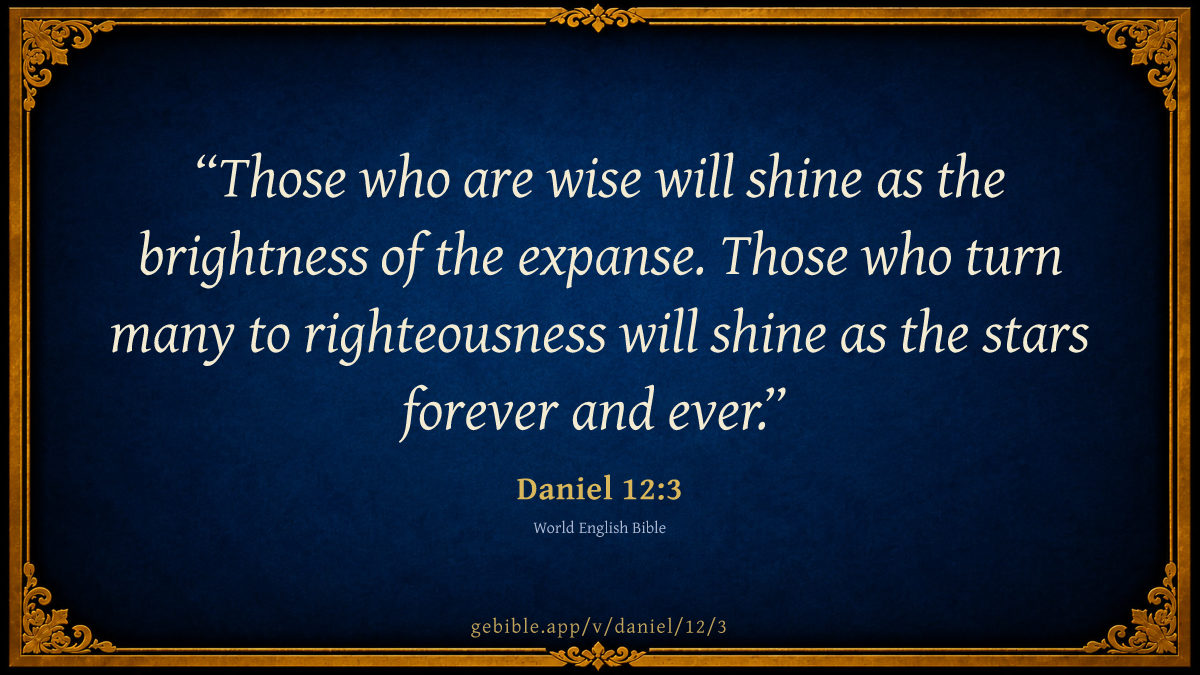
Those who are wise will shine as the brightness of the expanse. Those who turn many to righteousness will shine as the stars forever and ever.
Parallel Translations
-
Those who are wise will shine as the brightness of the expanse. Those who turn many to righteousness will shine as the stars forever and ever.
-
And they that be wise shall shine as the brightness of the firmament; and they that turn many to righteousness as the stars for ever and ever.
-
And they that are wise shall shine as the brightness of the firmament; and they that turn the many to righteousness as the stars for ever and ever.
Cross-references (21)
Passages linked to Daniel 12:3 in the Treasury of Scripture Knowledge, ordered by reader-vote popularity; verse text shown in World English Bible.
- Matthew 13:43 Then the righteous will shine like the sun in the Kingdom of their Father. He who has ears to hear, let him hear.
- Proverbs 4:18 But the path of the righteous is like the dawning light that shines more and more until the perfect day.
- James 5:19-20 Brothers, if any among you wanders from the truth and someone turns him back, let him know that he who turns a sinner from the error of his way will save a soul from death and will cover a multitude of sins.
- Daniel 11:33 “Those who are wise among the people will instruct many; yet they will fall by the sword and by flame, by captivity and by plunder, many days.
- Daniel 11:35 Some of those who are wise will fall, to refine them, and to purify, and to make them white, even to the time of the end; because it is yet for the time appointed.
- Proverbs 11:30 The fruit of the righteous is a tree of life. He who is wise wins souls.
- John 4:36 He who reaps receives wages and gathers fruit to eternal life; that both he who sows and he who reaps may rejoice together.
- Hebrews 5:12 For although by this time you should be teachers, you again need to have someone teach you the rudiments of the first principles of the revelations of God. You have come to need milk, and not solid food.
- Jeremiah 23:22 But if they had stood in my council, then they would have caused my people to hear my words, and would have turned them from their evil way, and from the evil of their doings.
- Luke 1:16-17 He will turn many of the children of Israel to the Lord their God. He will go before him in the spirit and power of Elijah, ‘to turn the hearts of the fathers to the children,’ and the disobedient to the wisdom of the just; to prepare a people prepared for the Lord.”
- John 5:35 He was the burning and shining lamp, and you were willing to rejoice for a while in his light.
- Philippians 2:16-17 holding up the word of life, that I may have something to boast in the day of Christ, that I didn’t run in vain nor labor in vain. Yes, and if I am poured out on the sacrifice and service of your faith, I rejoice, and rejoice with you all.
- 1 Corinthians 3:10 According to the grace of God which was given to me, as a wise master builder I laid a foundation, and another builds on it. But let each man be careful how he builds on it.
- 1 Corinthians 15:40-42 There are also celestial bodies and terrestrial bodies; but the glory of the celestial differs from that of the terrestrial. There is one glory of the sun, another glory of the moon, and another glory of the stars; for one star differs from another star in glory. So also is the resurrection of the dead. The body is sown perishable; it is raised imperishable.
- Ephesians 4:11 He gave some to be apostles; and some, prophets; and some, evangelists; and some, shepherds and teachers;
- Revelation 1:20 The mystery of the seven stars which you saw in my right hand, and the seven golden lamp stands is this: The seven stars are the angels of the seven assemblies. The seven lamp stands are seven assemblies.
- Matthew 24:45 “Who then is the faithful and wise servant, whom his lord has set over his household, to give them their food in due season?
- 1 Thessalonians 2:19-20 For what is our hope, or joy, or crown of rejoicing? Isn’t it even you, before our Lord Jesus at his coming? For you are our glory and our joy.
- 2 Peter 3:15 Regard the patience of our Lord as salvation; even as our beloved brother Paul also, according to the wisdom given to him, wrote to you,
- Matthew 19:28 Jesus said to them, “Most certainly I tell you that you who have followed me, in the regeneration when the Son of Man will sit on the throne of his glory, you also will sit on twelve thrones, judging the twelve tribes of Israel.
- Acts 13:1 Now in the assembly that was at Antioch there were some prophets and teachers: Barnabas, Simeon who was called Niger, Lucius of Cyrene, Manaen the foster brother of Herod the tetrarch, and Saul.
Cross-references from openbible.info (CC BY 4.0)
Explain this verse (18 sources)
Historical commentary, presented as a primary source — not an endorsement.
Private notes
Saved on this device only — never synced or sent anywhere.
John Calvin 1540 · Public Domain The word “prudent” means endued with intellect. Some take…
The word “prudent” means endued with intellect. Some take it transitively, and in this passage their opinion is probably correct, because the office of justifying will soon be assigned to these prudent ones. But the former sense suits chapter 11 better, and in verse 10 it will be put absolutely. Hence it means those who are endued with understanding. The angel here confirms what I have lately expressed concerning the final resurrection, and shews how we shall enjoy its fruits, because eternal glory is laid up for us in heaven. We ought not to complain of being treated unworthily, whenever we seem to suffer harshness at God’s hands, because we ought to be satisfied with the glory of heaven, and with the perpetual existence of that life which has been promised to us. He says then, the teachers, or those who excel in understanding, shall shine forth as the light of heaven If the word “teachers” is thought preferable, there will be a figure of speech, a part being put for the whole, and, therefore, I follow the usual explanation. He applies the phrase, “endued with understanding,” to those who do not depart from the true and pure knowledge of God, as will be afterwards explained more fully. For the angel contrasts the profane who proudly and contemptuously rage against God, and the faithful whose whole wisdom is to submit themselves to God, and to worship him with the purest affection of their minds. We shall say more on this subject to-morrow. But he now says, those who retained sincere piety should be like the light of the firmament; meaning, they shall be heirs of the kingdom of heaven, where they shall enjoy that glory which surpasses all the splendor of the world. No doubt, the angel here uses figures to explain what is incomprehensible, implying, nothing can possibly be found in the world which answers to the glory of the elect people.
And those who shall justify many shall be like stars, says he. He repeats the same thing in other words, and now speaks of stars, having formerly used the phrase, the brightness of the firmament, in the same sense; and instead of “those who are endued with understanding,” he says, those who shall have justified Without doubt, the angel here especially denotes the teachers of the truth, but in my opinion he embraces also all the pious worshippers of God. No one of God’s children ought to confine their attention privately to themselves, but as far as possible, every one ought to interest himself in the welfare of his brethren. God has deposited the teaching of his salvation with us, not for the purpose of our privately keeping it to ourselves, but of our pointing out the way of salvation to all mankind. This, therefore, is the common duty of the children of God, — to promote the salvation of their brethren. By this word “justifying,” the angel means, not that it is in the power of one man to justify another, but the property of God is here transferred to his ministers. Meanwhile, we are as clearly justified by any teaching which brings faith within our reach, as we are justified by the faith which springs from the teaching. Why is our justification ever ascribed to faith? Because our faith directs us to Christ in whom is the complete perfection of justification, and thus our justification may be ascribed equally to the faith taught and the doctrine which teaches it. And those who bring before us this teaching are the ministers of our justification. The assertion of the angel, in other words, is this, — The sons of God, who being devoted entirely to God and ruled by the spirit of prudence, point out the way of life to others, shall not only be saved themselves, but shall possess surpassing glory far beyond anything which exists in this world. This is the complete explanation. Hence, we gather the nature of true prudence to consist in submitting ourselves to God in simple teachableness, and in manifesting the additional quality of carefully promoting the salvation of our brethren. The effect of this our labor ought to increase our courage and alacrity. For how great is the honor conferred upon us by our Heavenly Father, when he wishes us to be the ministers of his righteousness? As James says, We preserve those about to perish if we bring them back into the right way. (James 5:19.) James calls us preservers, just as the angel calls us justifiers; neither the angel nor the apostle wish to detract from the glory of God, but by these forms of speech the Spirit represents us as ministers of justification and salvation, when we unite in the same bonds with ourselves all those who have need of our assistance and exertions. It follows next: —
John Calvin's Commentaries (1540-1563) — public domain. Text from the Calvin Translation Society English edition (1840s-50s) via the Christian Classics Ethereal Library (ccel.org). Calvin's coverage is partial (roughly two-thirds of the Bible); uncommented books and verses are honest gaps, never fabricated. The 19th-century editor's footnotes and remarks are omitted so the notes are faithfully Calvin's own voice.
Geneva Bible translators 1599 · Public Domain He chiefly meaneth the ministers of God’s word, and…
He chiefly meaneth the ministers of God’s word, and next all the faithful which instruct the ignorant, and bring them to the true knowledge of God.
Who have kept the true fear of God and his religion.
Geneva Bible (1599) marginal notes — public domain.
John Trapp 1656 · Public Domain Dan 12:3 And they that be wise shall shine…
Dan 12:3 And they that be wise shall shine as the brightness of the firmament; and they that turn many to righteousness as the stars for ever and ever.
Ver. 3. And they that be wise.] And in addition do what they can do to wisen others to salvation, as all wise ones will; for goodness is diffusive of itself, and would have others to share with it. Charity is no churl.
Read full note →
Shall shine as the brightness of the firmament.] A good amends for their present sufferings. {Dan 11:33 Rom 8:18} Solomon allowed little or no considerable reward to his workmen, {Son 8:12} but Christ doth. For they shall shine as the firmament; yea, as the stars; yea, as the sun in his strength; {Mat 13:43} yea, as Christ himself shineth, they shall appear with him in glory. {Col 3:4} Their souls shall shine through their bodies as the candle doth through the lantern; their bodies shall also be so lightsome and transparent, saith Aquinas, that all the veins, humours, nerves, and bowels shall be seen as in a glass; for so the light pierceth the firmament and stars. Let us therefore keep these bodies of ours clean and free of filth, that they may be fit vessels and receptacles of such a transcendent glory.
And they that turn many to righteousness.] Heb., That justify many; scil., Ministerially, as instmments in Christ’s hand; for "we preach Christ," yea, we give what we preach; "we give the knowledge of salvation for the remission of sins"; {Luk 1:17} we deliver men from hell; {Job 33:24} we save the souls of them that hear us. {1Ti 4:16}
As the stars for ever and ever.] What a glorious place is heaven then! Festinemus ad clarissimam patriam: corrigamus mores et moras, &c. What though Christ’s ministers be here slighted and slurred? they shall one day shine as stars, yea, the meanest of them, velut inter stellas luna minores. What then the Doctores seraphici?
John Trapp, A Commentary or Exposition upon All the Books of the Old and New Testament (1647–1656) — public domain. Text from a community e-Sword module.
Matthew Poole 1685 · Public Domain Here the faithful are called wise, i. e. to…
Here the faithful are called wise, i. e. to salvation, and so these two members include teachers, and disciples that are truly taught the way of salvation, i.e. such as are taught of God to learn Christ as the truth is in Jesus, Joh 6:45; Eph 4:21. They that teach true justification by the righteousness of Christ, imputed to faith, which is the sum of the gospel, and express it by righteous walking, they shall have high degrees of glory. By being diligent and faithful instruments in the Lord’s hand, by the word of God, and a holy example of the conversion of souls from an evil state, from an evil heart, and from an evil life unto God, they shall shine, not in fame for a long time, as Grotius lamely renders it, but for ever and ever in heavenly glory, as the words import.
Matthew Poole's English Annotations on the Holy Bible (1683–1685) — public domain. Text from a community e-Sword/MySword module.
John Gill 1763 · Public Domain And they that be wise shall shine as the…
And they that be wise shall shine as the brightness of the firmament,.... That are wise, not in things natural and civil, but in things spiritual; who are wise unto salvation; that are wise to know themselves, their state and condition by nature; their impurity and impotence; the insufficiency of their own righteousness; the exceeding sinfulness of sin, and the dangerous circumstances they are in; that are wise to know Christ, and him crucified; to believe in him, and trust in him for everlasting life and salvation: these at the resurrection shall shine, both in body and soul; their bodies shall be fashioned like to the glorious body of Christ; their souls shall be filled with perfect light and knowledge, and be completely holy, without any sin upon them; and this light and glory that will be upon both soul and body will be like the brightness of the heavens when the sun is risen; yea, it will be like the brightness and glory of the sun itself, as our Lord affirms; having, as it seems, respect to this passage, Mat 13:43. Some render it, "they that instruct" (i); or make others wise, and so restrain it to ministers of the word; but the more general sense is best; and, besides, they are more particularly described in the next clause:
and they that turn many to righteousness as the stars forever and ever; or, "that justify many" (k); that teach the doctrine of a sinner's free justification by the righteousness of Christ; that lead and direct souls sensible of sin, and of the weakness of their own righteousness, to the righteousness of Christ, as being that only which justifies before God; otherwise it is God alone that justifies men, by imputing the righteousness of his Son unto them: but these show men the way of justification, or that which God takes to justify sinners; and this being the principal doctrine of the GospeL, they are denominated from it; and no man deserves the name of a Gospel minister that does not preach it, though this is not all that they preach; they preach all other doctrines of the Gospel in connection with it, and also instruct men thus justified to live soberly, righteously, and godly: now, as these are stars in the church of Christ below, who receive their light from Christ the sun of righteousness, and communicate it to his people; so they will continue stars in the Millennium state, and appear exceeding glorious, having the glory of God and Christ upon them, and not only then, but to all eternity. These words are applied to the days of the Messiah by the Jews (l).
Read full note →
(i) "erudiunt", Munster; "erudientes", Junius & Tremellius; "qui alios instituerint", Grotius. (k) "justificantes", Pagninus, Montanus, Junius & Tremellius; "qui justificaverint", Calvin, Piscator. (l) Shemot Rabba sect. 15. fol. 102. 4.
John Gill's Exposition of the Whole Bible (1746–1763) — public domain (CC PDM 1.0). Text via the HelloAO Bible API.
Adam Clarke 1810 · Public Domain Verse 3. And they that be wise] Those who…
Verse 3. And they that be wise] Those who are thoroughly instructed in Christ's word and doctrine, shall shine - shall be eminently distinguished in the Christian Church by the holiness of their lives, and the purity of their creed.
And they that turn many to righteousness] They who, by preaching Christ crucified among their brethren, shall be the means of converting them to the Christian faith; shall be as the stars - bright luminaries in the Gospel kingdom of Jesus Christ. This also may be applied to the case of holy and useful men, particularly the faithful ministers of the Gospel, in the day of judgment. See the parallel texts in the margin, and the notes on them. (Jas 5:20; 1Co 15:41-42)
Adam Clarke's Commentary on the Bible (1810–1826) — public domain. Text from a community e-Sword/MySword module.
Joseph Benson 1811 · Public Domain Dan 12:3. They that be wise — Namely, that…
Dan 12:3. They that be wise — Namely, that are wise unto salvation through faith in Christ, that are truly godly and righteous, shall shine as the brightness of the firmament — Shall be clothed with glory and immortality; shall have bodies conformed to Christ’s glorious body; shall shine forth, says Jesus, as the sun in the kingdom of their Father, Mat 13:43; and especially those shall be thus glorious who are wise to win souls; who, being well instructed themselves in divine things, shall lay themselves out to instruct, reclaim, and save others; such shall shine as the stars — That is, with a splendour like that of the luminaries of heaven, for ever and ever — To all eternity. This seems chiefly to refer to the teachers of divine truth, and especially to those who confirm their doctrine by their sufferings and example: such shall undoubtedly receive a distinguished reward, though not procured by their own merit. The Judge of all the earth will certainly do right; and when he cometh, his reward is with him, to give to every man according as his work shall be, Rev 22:12. And as he hath given the fullest assurance that there is a reward for the righteous; so he hath assured us also that it will be augmented, in proportion as men have laboured to be more extensively useful, and to advance the real and best interests of their fellow-creatures, namely, their spiritual and eternal interests.
Joseph Benson's Commentary on the Old and New Testaments (1811–1818) — public domain. Text from a community e-Sword module.
Albert Barnes 1834 · Public Domain And they that be wise - This is the…
And they that be wise - This is the language which, in the Scriptures, is employed to denote the pious, or those who serve God and keep his commandments. See the book of Proverbs, passim. True religion is wisdom, and sin is folly, and they who live for God and for heaven are the truly wise. The meaning is, that they have chosen the path which true wisdom suggests as that in which man should walk, while all the ways of sin are ways of folly. The language used here is expressive of a general truth, applicable in itself to all the righteous at all times, and nothing can be inferred from the term employed as to what was designed by the angel.
Shall shine as the brightness of the firmament - As the sky above us. The image is that of the sky at night, thick set with bright and beautiful stars. No comparison could be more striking. The meaning would seem to be, that each one of the righteous will be like a bright and beautiful star, and that, in their numbers, and order, and harmony, they would resemble the heavenly constellations at night. Nothing can be more sublime than to look on the heavens in a clear night, and to think of the number and the order of the stars above us as an emblem of the righteous in the heavenly world. The word rendered firmament means, properly, expanse, or what is spread out, and it is applied to the sky as it appears to be spread out above us.
Read full note →
And they that turn many to righteousness - Referring to those who would be instrumental in converting men to the worship of the true God, and to the ways of religion. This is very general language, and might be applied to any persons who have been the means of bringing sinners to the knowledge of the truth. It would apply in an eminent degree to ministers of the gospel who were successful in their work, and to missionaries among the pagan. From the mere language, however, nothing certain can be argued as to the original reference as used by the angel, and it seems to have been his intention to employ language so general that it might be applied to all, of all ages and countries, who would be instrumental in turning men to God.
As the stars - As the stars that are distinguished by their size and luster in the firmament. In the former part of the verse, when speaking of those who were “wise,” the design seems to be to compare them to the sky as it appears, set over with innumerable stars, and in their numbers and groupings constituting great beauty; in this member of the sentence the design seems to be to compare these who are eminent in converting men, to the particular beautiful and bright stars that strike us as we look on the heavens - those more distinguished in size and splendor, and that seem to lead on the others. The meaning is, that amidst the hosts of the saved they will be conspicuous, or they will be honored in proportion to their toils, their sacrifices, and their success.
Forever and ever - To all eternity. This refers to those who shall turn many to righteousness; and the meaning is, that they shall continue thus to be distinguished and honored to all eternity.
Albert Barnes' Notes on the Bible (1834–1885) — public domain. Text from a community e-Sword/MySword module.
Haydock's Catholic Bible Commentary 1859 · Public Domain Learned in the law of God and true wisdom,…
Learned in the law of God and true wisdom, which consists in knowing and loving God. (Challoner) --- Hebrew: "instructors." --- Instruct. Hebrew: "justify," in the same sense. The Machabees and other priests, &c. who instructed people in the law, and stood up for its defence, may be meant. (Calmet) --- "There is as much difference between a learned sanctity and a holy rusticity, as there is between heaven and the stars." (St. Jerome) --- Teachers, martyrs, and virgins are entitled to an aureola, or accidental reward, besides the essential beatitude. (Worthington) --- Many. Th. and the Vulgate read, "and of the just many shall be like for an age and after." (St. Jerome)
George Leo Haydock (1774–1849), Haydock's Catholic Family Bible and Commentary, 1859 edition — public domain. Excludes Psalms (Douay-Rheims chapter numbering differs from Protestant) and Deuterocanonical books (Catholic canon only).
Robert Jamieson, A. R. Fausset & David Brown 1871 · Public Domain wise-- (Pro 11:30). Answering to "they that understand" (Dan…
wise-- (Pro 11:30). Answering to "they that understand" (Dan 11:33, Dan 11:35), the same Hebrew, Maskilim; Israelites who, though in Jerusalem when wickedness is coming to a head, are found intelligent witnesses against it. As then they appeared worn out with persecutions (typically, of Antiochus; antitypically, of Antichrist); so now in the resurrection they "shine as the brightness of the firmament." The design of past afflictions here appears "to make them white" (Mat 13:43; Rev 7:9, Rev 7:14).
turn . . . to righteousness--literally, "justify," that is, convert many to justification through Christ (Jam 5:20).
Read full note →
stars-- (Co1 15:41-42).
Jamieson, Fausset & Brown — Commentary Critical and Explanatory on the Whole Bible (1871) — public domain (CC PDM 1.0). Text via the HelloAO Bible API.
Daniel D. Whedon 1874 · Public Domain 3. They that be wise — See Dan_11:33, and…
3. They that be wise — See Dan_11:33, and compare Hos_14:9. In Hosea’s day this was a “new and beautiful doctrine” that the wise could know the ways of the Lord and walk in them. (See particularly Alexander Duff, Old Testament Theology.) We now have the equally new and beautiful doctrine that those who are thus wise shall live forever as heavenly lights. The figure of speech which would compare a wise teacher to a light was not unknown even in ancient Babylon; for on a tablet dating back to Abraham’s day, and written in the sacred Sumerian language, are found these words, “Whosoever has distinguished himself at the place of tablet writing (i.e., in the school or university) shall (may) shine as the light” (Hilprecht). But all this Babylonian wisdom pales when contrasted with Daniel’s teaching.
They that turn many to righteousness — Contrast with Dan_11:32. This is surely the Gospel in the Old Testament. (See Mat_13:43.) These words have shone like the stars of heaven ever since this inspired seer of God flung them out before the eyes of a dark world. This is the glorious “end” of Daniel’s vision. These saints who were “stars” while they lived (Dan_8:10), though cast down to the grave, shall be lifted up to shine eternally. It must not be forgotten that all the theology of the Hebrews sprang out of their conception of Jehovah. Jehovah shines as the sun, and therefore his saints may shine as the stars. (See previous footnote.)
Daniel D. Whedon (gen. ed.), Commentary on the Old and New Testaments (1874–1909) — public domain. Text from a community e-Sword module.
The Cambridge Bible for Schools and Colleges 1878 · Public Domain 3. Those who in the time of trial had…
3. Those who in the time of trial had by example and precept preserved many in righteousness and faith, will then receive their reward.
they that be wise] The words do not mean the ‘wise’ generally, but those mentioned in Dan_11:33; Dan_11:35 (the word being the same which is there used), men like Mattathias (1 Maccabees 2), the staunch and firm leaders of the loyal Jews, during Antiochus’ persecutions. These “are distinguished from the rest of the faithful Israelites—they not only live for ever, but are eternally glorified” (Bevan). Cf. Enoch civ. 1 (‘Be hopeful: for aforetime ye were put to shame through ills and affliction; but soon ye will shine as the stars of heaven, ye will shine and ye will be seen, and the portals of heaven will be opened to you’); Mat_13:43.
Read full note →
as the brightness of the firmament] cf. Exo_24:10.
and they that make the many righteous] The expression, as Isa_53:11, ‘by his knowledge shall my righteous servant make the many righteous.’ In neither case is the verb to be understood in the later technical sense of ‘justify’: the meaning, in both cases, is to lead to righteousness by teaching—in Isaiah 53 by instruction in the ways and will of God (‘by his knowledge’), here by warning, exhortation, and example of constancy (cf. Dan_11:33 ‘shall make the many to understand’).
3. Dan_12:5-13. Conclusion. The revelation (Dan_11:2 to Dan_12:4) is ended; but nothing has been said about the duration of the troubles foretold in it. And yet, to those living in the midst of them, this was a question of vital interest. Daniel accordingly asks, and receives, specific information on this point (Dan_12:6 ff.).
The Cambridge Bible for Schools and Colleges (gen. ed. J. J. S. Perowne; Cambridge University Press, 1878–1918) — public domain. Text from a community e-Sword module.
Ellicott's Commentary for English Readers 1878 · Public Domain (3) They that be wise.—Comp. Mat_13:43, Notes. “The wise”…
(3) They that be wise.—Comp. Mat_13:43, Notes. “The wise” are the same as “those that understand” who were spoken of in Dan_11:33, meaning those who by their own righteousness—that is, by their faithfulness to their covenant with God—had set a bright example to the others, as in Dan_11:35. Such is the consolation held out for the support of those who shall witness the tribulation of the last days. (See Notes on Matthew 24 and the parallel passages.)
A Bible Commentary for English Readers, edited by Charles John Ellicott (1878–1897) — public domain. Text from a community e-Sword module.
The Pulpit Commentary 1880 · Public Domain And they that be wise shall shine as the…
And they that be wise shall shine as the brightness of the firmament; and they that turn many to righteousness as the stars for ever and ever. The rendering of the LXX differs from this considerably, "Those who understand shall appear as the lights of heaven, and those that confirm my word as the stars of heaven for ever and ever." There seems to be a difference of reading in the first clause. Instead of yazheeroo kezohar, there seems to have been yayraro kim ooroth. The verb used in the Massoretic text means really "admonish." The noun occurs only in Eze_13:2. In the last clause, instead of (harabbeem), "many," the Septuagint has read yrebD (deboray), "my words." It is difficult to account for the omission of the final unless from the likeness of m to k and and (see Corpus Insc. Semit.). Theodotion renders, "And they that understand shall shine as the brightness of the firmament, and certain from amongst the righteous as the stars for ever and ever." The Peshitta rendering is somewhat paraphrastic, "Those that do good and are wise shall shine as the brightness of the firmament, and those who conquer many shall be lights, and arise as the stars of heaven for ever and ever." The Vulgate is in close harmony with the Massoretic text. The versions are superior to our Authorized, in having "those that understand" instead of "those that be wise." Bevan regards the wise here as the "teachers." There seems, however, no reason for such a restriction. The reading of the Septuagint in the opening clause of the second member of the sentence is inferior, as confirming or justifying the words of Daniel or of God is a simpler idea than that of turning many to righteousness. Further, there is a difficulty of fixing who is referred to by the prenominal suffix "my." Professor Fuller refers to Isa_51:11 for aparallel use of the hiphil of qd) but there, as elsewhere, it means, not "turn to righteousness," but "justify," that is, "declare righteous." Yet the connection between the two ideas is close, and the forensic idea can have no place here. Mat_13:43 represents a similar reward to the righteous.
Stars of the Church.
Read full note →
Though all godly men will be called to eternal life at the resurrection, a special honour is reserved for those who evince practical wisdom in spiritual fruitfulness.
I TRUE WISDOM IS SEEN IN SUCCESS IN "TURNING MANY TO RIGHTEOUSNESS?" The wise and those who are thus successful are plainly identified in the text.
1. True wisdom will choose this as the noblest work. Men have various aims, as pleasure, pecuniary gain, power, fame, rank, self-culture, etc. The noblest aim is to seek to do good to others, and the highest good we can do is moral good. Hence the mission of the spiritual physician takes the first place among all vocations. It is the most Christlike. The neglect of this work for the propagation of barren dogmas, the promotion of sectarian tenets, the extension of ecclesiastical influence, or the mere intellectual culture of theological notions, is a proof of folly. The wise man will see that the work of the Christian teacher is practical and spiritual rather than intellectual and theoretical. It is to persuade men to turn from sin to God and goodness. (2Co_5:20)
2. True wisdom is requisite for the successful execution of this work. God has left this to be dependent on the zeal, energy, and wisdom of his Church. (2Co_4:7) Wisdom is needed
(1) to detect the red needs of men, for spiritual diagnosis;
(2) to understand the spiritual truths of the gospel, in which are to be found the means of conversion to righteousness; and
(3) to choose the right way of approaching, teaching, and persuading men, that wise words may be spoken seasonably. (Pro_15:23) This wisdom is a spiritual gift, which is to be sought in prayer. (Jam_1:5)
II THE WISDOM WHICH IS SHOWN IN SUCCESSFUL CONVERSION TO RIGHTEOUSNESS WILL BE REWARDED WITH PECULIAR HONOUR.
1. Though all true Christians will be saved from ruin, and blessed with theheavenly inheritance, all will not be equally honoured. There will be differences of rank and honour in heaven. (Luk_9:17-19)
2. Though we shall not be received into heaven on account of our owndesert, but through the free grace of God, (Eph_2:8) our relative place and honour in heaven will be determined according to our merits. (Mat_5:19) Indolent and selfish Christians must take a lower place than that of self-denying, diligent servants of Christ. (1Co_3:14, 1Co_3:15)
1. The chief honour of heaven is reserved for those who have been wise in effecting the conversion of souls to righteousness. It is true that we are ultimately responsible for fidelity, not for success. (Rev_2:10) But failure often arises from unfaithfulness. We have no excuse for not having the wisdom which is the free gift of God, and may be possessed by those who are humanly accounted foolish. (1Co_1:21-24) Successful missionary work receives especial honour, because it requires the greatest self-sacrifice, faith, zeal, and love; because it secures the most important good for mankind; and because it glorifies God supremely.
1. This honour consists in shining brightness, as
1. a public recognition of worthy service;
2. the possession of true beauty and gladness of soul;
3. the means of still directing and attracting others in the way of. (Mat_5:16)
The Pulpit Commentary (1880–1919), ed. H.D.M. Spence-Jones & Joseph S. Exell — public domain. Text from a community e-Sword module.
The Biblical Illustrator 1887 · Public Domain And they that be wise.
Dan_12:3
And they that be wise.
Read full note →
Shining as the Stars
The word prudent or wise means endued with intellect. Some take it transitively, and in this passage their opinion is probably correct, because the office of justifying will soon be assigned to these prudent ones. It is better, however, to take it as meaning those who are endued with understanding. The angel says that the teachers, or those who excel in understanding, shall shine forth as the light of Heaven. The angel contrasts the profane who proudly and contemptuously rage against God, and the faithful whose whole wisdom it is to submit themselves to God, and to worship Him with the purest affection of their minds. Those who retained sincere piety should be like the light of the firmament; meaning, they shall be heirs of the Kingdom of Heaven, where they shall enjoy that glory which surpasses all the splendour of the world . . . It is the common duty of the children of God to promote the salvation of their brethren. By this word justifying, the angel means, not that it is in the power of one man to justify another, but the property of God is here transferred to His ministers. Meanwhile, we are as clearly justified by any teaching which brings faith within our reach as we are justified by the faith that springs from the teaching. Why is our justification ever ascribed to faith? Because our faith directs us to Christ, in whom is the complete perfection of justification, and thus our justification may be ascribed equally to the faith taught and to the doctrine which teaches it. And those who bring before us this teaching are the ministers of our justification. The assertion of the angel is this--The sons of God, who, being devoted entirely to God, and ruled by the spirit of prudence, point out the way of life to others, shall not only be saved themselves, but shall possess surpassing glory far beyond anything which exists in this world. This is the complete explanation. (John Calvin.)
Wise Workers
I. THE CHARACTERS HERE MENTIONED, There are two. They that be wise. They that turn many to righteousness.
1. Wise, that is, instructors, or teachers. By this character of wise is meant all good men, who have a real, a warm concern to know their duty and to put it in practice, who take delight in serving God and doing good. It is religion that teaches what must be known, and done, to make us happy for ever. We have souls, and we have bodies. These constitute the man. Both deserve and demand our care, but not both in the same degree.
2. Turn many to righteousness. Some say--If I am good myself, that is enough. Let every man look to himself. But, surely, it is every mans province, every mans duty, and it will be every mans satisfaction, his crown of glory as well as rejoicing, to do all the good that he can. By righteousness is meant in the text, what it usually signifies in holy Scripture, virtue and piety, our duty to God and one another, and a due government of our appetites and passions.
II. IN WHAT MANNER, AND BY WHAT METHODS, MAY THE CONVICTION AND REFORMATION OF SINNERS BE MOST PRUDENTLY ATTEMPTED, AND PROBABLY EFFECTED? Some natures are so corrupted, some wills so obstinate, some wicked habits so strong, that counsel, how good soever, signifies nothing. The most natural and effectual methods to excite a sense of religion, to reclaim those to the paths of piety and virtue who have forsaken and run from them are:
1. Let them be instructed in the knowledge of true religion.
2. Recommend a serious consideration of what they do know.
3. Represent the great encouragement which the word of God gives to enter upon a new and bettor life.
4. Warn them of the dreadful consequences of living and dying in an unpenitent and unpardoned state.
5. We should not fail to enforce a due care of and attendance upon the appointed means of religion.
III. THE ENCOURAGEMENT CONTAINED IN THE TEXT. The glory promised to good men is unfading and everlasting. (Ed. Sandercock.)
The High Reward of Those Who Turn Many to Righteousness
I. THERE IS A REWARD OF GRACE AWAITING ALL GODS FAITHFUL SERVANTS. The general character of Gods servants is hero exhibited under the attribute of wisdom.
1. In what does this wisdom consist? In the experimental knowledge of all that is essential to salvation. The wisdom thus obtained has not been wasted in fruitless speculation, or suffered to lie as a dormant or inactive principle in the heart. Without this wisdom all is folly; and with it, men of humblest name shall surpass, in a future world, the proudest sons of that perishable science, which has been confined in its operations within the narrow limits of time.
2. Whence is this wisdom derived, and by whom is it sustained? Is it a distinction originating in the sinful creature, or in the boundless sovereignty of Divine grace? This wisdom is undoubtedly from above. Wherever it is possessed, it is God who commanded the light to shine out of darkness.
3. The blessed consequences to which such wisdom conducts in eternity. It is difficult to conceive of a reward where no merit can exist. Who can tell what it is to shine as the brightness of the firmament? The most splendid objects in Nature are the chosen emblems of Heaven to express the high dignity and the unspeakable felicity of those who have become wise unto salvation. Their eternal sphere is one in which all the elements of light, and glory, and peace, and sanctity, combine.
II. THERE ARE SPECIAL RESERVATIONS OF GLORY AWAITING THOSE WHO HAVE TURNED MANY TO RIGHTEOUSNESS. The personal possession of true wisdom is distinguished, in the text, from the act of turning many to righteousness. The latter shall be exalted to spheres of peculiar honour and blessedness. There are various degrees of glory in Heaven. All are with Christ, and all like to Him; and the awards of infinite wisdom and grace awaken no envy, and call forth no unworthy jealousy. The principle on which all are accepted is faith in the Son of God; and the degree of service rendered to Christ in the present life wilt bear an exact proportion to the degree in which the justifying principle was brought into exercise. On the great day, saint and sinner will receive according to the deeds done in the body. The office of ministers is one of extraordinary responsibility, and one which involves peculiar trials. They need great consolations, and great excitements in their arduous work. They have the glorious prospect of gracious and abundant rewards. (John, Morison, D.D.)
Heaven and Earth Reconciled
I. THE WORK.
1. The subject we must exercise our skill on are men, tempered of the same mould, having a soul inspired from the breath of the same God, as dear to Him as ourselves, bought with no worse blood than His Sons, guarded with angels, protected by the same Providence, and compassed about with the same mercies that we are. This subject is set down indefinitely, many. The power of God is here perspicuous, that designs a few to convert many.
2. The predicate we work; men, is righteousness. Righteousness is so fair an object that a man would think there needs no great solicitation to it. The end of the ministry is to bring men to righteousness. It is the cunning of all cunning to govern souls. It is no easy work to make men righteous.
3. The copulatives. The persons whom God hath deputed to atone these two contrary natures, sinful men and righteousness, are the ministers.
II. THE REWARD. Our bliss, our heaven. Ministers are said to be stars in five respects.
1. In name.
2. In substance. A star-like and substantial light, not a flash of lightning.
3. In situation. The stars are placed in their orb, and finish their course in a determined space of time.
4. The motion is four-fold--circular, incessant, swift, and orderly. Orderly.
5. The last similitude consists in the effects. Our influence, our light, our delight. Then despise not, afflict not, impoverish not your stars. (T. Adams.)
Becoming Stars
You know what the firmament is, you young people. It is the blue vault of Heaven above as. And, you know what the stars are. A little girl described their appearance by saying, They are gimlet holes in the floor of Heaven, to let some of the light shine through. Of course they are not. They are great worlds, some of them bigger than the world we live in.
1. Let us see that we understand this verse. By those that are wise, are here meant those who are wise unto salvation--those who have the wisdom to hear Gods voice and have been led to trust it and obey Him. The New Testament speaks of believers as a great cloud of witnesses. Here they are compared to the firmament itself--vault of Gods great spiritual temple, His purified and glorified Church, far more gloriously beautiful than the resplendent dome of the sky. By those that turn many to righteousness are meant these who are not only wise for themselves, but have wisdom, patience, and love in seeking to bring others also to the love and fear of God. Is not that the noblest kind of life? If you have found the true wisdom yourself, to seek that others may have it too? That is a poor soul who is only careful for himself. The truly noble life is the life which, in gratitude to God, is laid out for the good of others. People often seek to be thought wise among men--to get credit for knowing a great deal more than other people. Be it yours to be accounted wise by God, in knowing Him, and loving Him. For that is the true Wisdom. (C. A. Salmond, M.A.)
Faithfulness Richly Rewarded
1. In these words we have first a general description of all the righteous without exception--they are wise. This description in its highest sense belongs only to the people of God. They only are truly wise, because wise unto salvation. Wisdom was originally the outstanding conspicuous characteristic of man as distinguished from the inferior animals. Wisdom was Gods image in the mind, as holiness was His image in the soul of man unfallen, but the words of our text show that they are no longer characteristic of the race at large, but the distinction of the people of God. True wisdom includes:
(1) Consideration. Man as a rational creditors is influenced by higher principles than the inferior animals; and God, in His word and in His works, appeals to these higher principles. But in vain are we surrounded by instructors if we do not receive and ponder the lessons they teach. In order that we may learn the lessons, we must consider. Before we can wisely consider the works of God, we must first have considered and entertained the lessons of His word. Ancient Israel failed to do this.
(2) Wisdom includes calculation. No man, ever gained the whole world, but thousands have lost their souls for want of consideration and calculation.
(3) Wisdom includes decision. Acting on convictions. To remain undecided is to decide for sin and Satan, the side on which we all are by nature.
(4) To be wise implies not only that a man makes a wise choice, but that he adheres to it, persists in it. A wise man chooses through grace to lead a godly life, not only for a time, but to the end. The new life must begin with a solid work of justification through faith in Christ. Some do not take time to seek and find Christ, but begin at once to build on their convictions, feelings, and resolutions. He that builds on Christ, the Rock of Ages, endureth to the end, and so shall be saved, and is proved to have been wise unto, and up to salvation.
2. The distinction belonging to some of the godly--that of turning many to righteousness. Some are specially diligent and successful in this work. It was said of Richard Baxter that he never preached without being the means of awakening, convincing, or converting some sinner. But the work of turning sinners to righteousness seems to refer more specially to personal effort in private.
3. The reward. There are two distinct ideas in this promise, a less glorious, and a more glorious, reward. The brightness of the firmament means the star-sown sky by night, and it implies that all glorified saints will shine as stars, with different degrees of brightness. There will be different degrees of glory among the saints in Heaven, depending upon the qualifies acquired by them, and the character formed in them while they were on earth. What are these stars to which glorified saints are compare? They are suns, conveying light and genial warmth to separate worlds, or whole systems of worlds, as in the case of our own sun. The describing of John Baptist, a burning and shining light, applies to all who follow Johns example in influencing graciously the minds and hearts of men. The seven churches of
Asia were lights shining in a dark place, slowly dispersing the surrounding darkness of heathenism. So it was with our Culdee forefathers. When each college of twelve holy men, with their presiding abbot, went forth from Iona, and settled down in some dark region of heathen England, or half-heathen Scotland, they were so many star clusters, who, by the blessing of God, spread the light of Gospel truth more rapidly and more thoroughly than any ether missionaries have done since the time of the Apostles. These missions may be described as star clusters, and so every well organised congregation at home, even now, shines with Heavenly light amid surrounding darkness. It seems an appropriate reward that those who are burning and shining lights on earth should continue to burn and shine when transferred to a higher sphere. (C. G. Scott.)
The Peculiar Excellency and Reward of Supporting Schools of Charity
I. THE PERSONS TO WHOM THIS DISTINGUISHING REWARD AND GLORY IN THE NEXT WORLD IS PROMISED. Those, in general, who apply themselves to the most probable and effectual methods of instructing mankind in their duty, and turning them into the paths of righteousness. The text describes them as wise, or teachers, they who have instructed themselves in the laws of God, and make it their business to see others instructed. A work belonging especially, but by no means exclusively, to ministers. The text also describes them as turning many to righteousness. In this work ministers may be greatly aided by a due exercise of authority on the parts of parents, of masters, and of magistrates. It includes bending the minds of children, while they are tender and young, to the ways of goodness and righteousness.
II. THE PARTICULAR EXCELLENCIES OF TRAINING UP MANKIND TO THE KNOWLEDGE AND PRACTICE OF THEIR DUTY. The care, especially, of the poorer sort of children is peculiarly acceptable to God.
1. As it is charity.
2. As it is charity to the soul.
3. As it is a charity proceeding from the noblest motives.
4. As it is a charity employed to the best advantage.
5. As it is a charity, extending not only to the present age, but also to posterity. (Bishop Edmund Gibson.)
The Work and Recompense of Christs Ministering Servants
I. THE PERSONS TO WHOM THESE GLORIOUS PROMISES ARE MADE. Teachers or preachers of Gods word. The primary duty of a minister of the church is to teach and to instruct the people. But the mere circumstance of being a teacher cannot ensure the promised reward. There may be false teachers. The reward is only for those who turn many to righteousness.
II. THE DESIGN OF THEIR OFFICE. In the word of God we are constantly and emphatically told of mans utter ruin by sin. Having become by the fall not only inclined to sin, but actual transgressors, there must necessarily be a change wrought in us thorough reformation of the inner man--or we cannot be saved. He that has no conviction of sin cannot understand or appreciate the atonement of Christ. This is the turning-point in the life of every child of God, When he comes to himself, bewails his folly, flies to his Father, and seeks forgiveness. How can sinners be turned to righteousness? The shed blood of Christ has procured pardon for any sinner who will accept its benefits. The sinner is not justified because of his faith, but because Christ died. But as faith is the procuring cause, it is important to ascertain where it is to be found, and how it is to be obtained.
III. THE REWARD ATTACHED. The souls of faithful ministers shall be raised in the state of glory to an elevated position among the spirits of the just made perfect:. An eternity of uninterrupted joy at Gods right hand awaits them, when they shall be crowned with an immortal diadem. (Isaac D. Winslow.)
Soul-Saving and its Reward
Those engaged in soul-saving are prosecuting a work of eminent wisdom. Cultivated pagans regarded the wise as men of profound knowledge and great attainments in learning; men whose erudition swept a vast compass; men of deep and solid information in philosophy. Daniel held aloof a nobler species of wisdom. He that winneth souls is wise. The worth of the soul manifests the wisdom of the work of soul-saving. The, dying Lyman Beecher said, Theology is great, controversy is great, but the greatest of all things is saving souls. In turning many to righteousness it is important that we understand the forces by which we can successfully save souls. We can save them by the power of a holy example. In this centre the alms of life must converge. A holy man or woman is a perpetual sermon. The conduct of professed Christians formulates the creeds of the masses. In example we are holding the invisible reins by which we are guiding souls to Heaven or hell. Another force in soul-saving is the power of prayer. Another is earnest and repeated counsel. Advise, and repeat advice. Be not discouraged. Wait Gods time and speak to souls. Faithfully admonish with faith in God, and success will crown your efforts. Where can we best work for the saving of souls? In the home circle. Home is the place of confidence, How glorious the reward celestial! How magnificently the stars shine over old Babylon where Daniel lived! Stars shine in their individuality of beauty. We shall not lose our personal identity in the Kingdom of God. The stars shine in constellations. When the stars all grow dark we shall shine for ever and ever. (S. V. Lech.)
Wisdom Connected with its Reward
The idea contained in this verse is that the reward of wisdom corresponds to the nature of the ends that are sought.
I. WISDOM IN ITS ESSENCE.
1. Wisdom has a wide horizon; therefore its reward is wide as the firmament. We are placed on earth, but we have not the contracted horizon that other creatures on earth have. We are like those who study the stars; earth is only the station from which we look out to the Infinite. In looking away from self to God, we can feel free and joyous in a boundless scope which is given to our life. And wisdom requires that we should take the whole width of horizon that there is. If we have God as our reward we can never feel shut in.
2. Wisdom has a bright horizon; therefore its reward is bright as the firmament. The great object placed before us is Christ. He is the brightness of the Fathers glory. It is He who has made our horizon bright, taking away the darkness caused by our sin, and bringing forth a righteousness for us like the light. It is He who is the brightness of that world into which He has gone. We are, then, to take Him as the end of our being. Christ will be in us as the brightness of the firmament, His splendid sapphire will appear in our bodies and in our souls.
3. Wisdom has a lasting horizon; therefore its reward is lasting as the firmament. We are but of yesterday, and yet we are linked to eternity. We can plan for future years, we can look away beyond death, we can look out into the boundlessness of time. And wisdom requires that we should take in the whole extent that there is, and not a section merely. Our temptation is to think of the present, and not of what the future has to toll the present. If we look to the things which are eternal, then we are promised eternity in our reward.
II. WISDOM IN ITS AGGRESSIVE AND CONQUERING ASPECT. He that winneth souls is wise.
1. The results of this aggressive wisdom are of the highest kind; therefore the reward is high. By nature all are turned away from righteousness, and toward sin. If we have seen what is for our own highest good, we will not see it for ourselves alone. For the end which we have in and His Kingdom embraces others as well as ourselves. Our wisdom will be directed to this, to gain men from sin to righteousness, from Satan to God. The Gospel is the wisdom of God for this end. And they are wise who can appreciate its wisdom as a means. If we are instrumental in producing results of so high a kind as this, then our reward shall be correspondingly high. They that turn men to righteousness shall he as the stars. There is no object on earth which can set forth the height of the reward. We need to turn to the sky above us.
2. It has results to individuals; therefore its reward is individual and varied as the stars. Many. Numbers are of great consequence when so high a result is involved. Joy is in Heaven over one sinner. There is no saving in the mass; and there will be no rewarding in the mass.
3. It accomplishes lasting results; therefore its reward is as the stars for ever and ever. To turn men to righteousness is to do them lasting good. It is doing what will be felt to all eternity. Who are the star-souls? They are not necessarily the highly gifted, those who have left a name on earth. They shine out of the nebulous mass of humanity, out of the indistinguishable multitude. They shall keep their light, it shall never go out. Because Christ shines they shall shine also. (R. Finlayson B.A.)
Righteousness
Righteousness was the idea of the ancient hierarchy. Righteousness is the result of the work of the Christian Church. What is the power of righteousness, what is the source of righteousness, what is the instrumentality?
1. Righteousness means right in all departments of our being, the brain, the heart, the lips, the life. Righteousness is a power that conquers Time; a power that turns life, not into the victim of the passing day, but in the highest sense into life everlasting.
2. Take another measurement of righteousness. The best, the greatest, the purest, the most loving, are the subjects of imperfection. Andeas del Sarto when he went to look at Raphaels pictures granted that the drawing was imperfect. He said, I dare not touch it, because it is marvellous, but certainly it is wrong. Then the higher genius, the most saintly life, may be the victim of imperfection. Now righteousness conquers that. It changes now.
3. Take another measure. Take friendship, which is one of the dignities of humanity. One thing cuts the tie that binds soul to soul; it is inconstancy, the weakness of will, of heart, of perception, that separates souls. Righteousness conquers it. What is the source of righteousness? It is the glory of God. The glory of God means the sum total, the collection, the complete centre of life, the central point on which we can rest. Righteousness of the soul is the result of Gods power. Our last thought upon Gods glory is the fact that God loves us. (Canon W. J. Knox-Little, M.A.)
Glory in Reserve
The sky is a magnificent object. This magnificent feature of creation has furnished the prophet with an illustration of the glory which awaits a certain part of the human race. The text has a climactic description of Heaven.
I. PIETY ALONE IS HONOURED IN HEAVEN. Men are removed to that blessed land only as a reward of piety.
1. Being in Heaven is itself the reward of piety, as it is an expression of Gods approbation. To be there, is proof of being fit to be there. And, besides expressing fitness, it will be an honour conferred, a reward of service. To be there is to receive the reward of faith, integrity, courage, and patience.
2. The beauty of holiness will be there seen to constitute mans true glory. Everything else God has made is perfect in its kind and place; and when man shall recover his lost beauty there will be great splendour. There will be the perfectly restored image of God. Each one will look like Jesus. His beauty will be the beauty of holiness; which is love in place of selfishness.
II. THE PIETY MOST HONOURED IN HEAVEN WILL COME FROM THIS EARTH. It is Gods purpose that where sin abounded grace shall superabound.
1. Their glory is a reward indirectly to them, directly to Christ. His suffering and mediation all have their recompense in mans salvation. Nothing is done directly on their own account. Thee piety will have in itself no peculiar excellence above that of angels; but it will have peculiar relations to the person and work of Christ.
2. They will appear in a peculiar lustre, as conquerors. The angels are represented as fighting; but they never fought an enemy within their own being. They never so taxed the resources of grace as we have.
III. USEFUL PIETY FROM EARTH WILL BE THE BRIGHTEST CREATED OBJECT IN HEAVEN.
1. Usefulness is the highest form of piety. There are two extremes in sincere believers. There may be an excessive cultivation of personal piety; and there may be too much outward activity; that is, disproportioned to personal cultivation. The height of all cultivation is to grow into useful piety. Love is the crowning grace. It has two phases, complacency and beneficence. Love has its perfection in exercise. Self-denial will be honoured in Heaven. The exercise of sentimental love and theoretical love does not disturb our selfishness. They flatter our conceit without taxing our self-love. Practical love develops the highest form of strength.
2. Their own blessedness, too, will be the greatest. The useful will shine in brightness of a peculiar happiness. Theirs will be the joy of seeing those saved for whom they cared. What treasures of joy is every weeping laboured now laying up in Heaven! Theirs is the joy of receiving the love and gratitude of those whom they have saved. Learn:
(1) The worlds wisdom, at best, is short-sighted.
(2) The study of the modes of usefulness is one of the most important branches of human pursuit.
(3) Believers can afford to wait, to toil, and to suffer. The glory that awaits them is an infinite compensation. (E. N. Kirk, D.D.)
The Glorious Reward of the Righteous
In the writings of the prophets we generally find that after predictions of calamitous events consolatory promises are added for the support of the true people of God under them. Daniel is here instructed by the angel to deliver such promises as were adapted to sustain the faith, and console the minds, of the children of God.
I. THE TWO DESCRIPTIONS OF PERSONS SPOKEN OF BY THE ANGEL TO DANIEL. They that be wise. They that turn many to righteousness. By the wise is not meant the learned, or the subtle, or the worldly-wise, or the politic, but simply those that are godly, or righteous, or that possess genuine religion. True religion is wisdom. It removes the source whence arise most of the follies of mankind. It improves whatever is excellent in human attainments and actions. It fills the mind with tranquility and peace; a kind of wisdom which few rich, great, or learned men attain. Righteousness includes the justification of mens persons, the renovation of their nature, and a practical obedience to God in heart and life flowing therefrom. The angel does not speak of turning men from one opinion, or mode of worship, or sect and party to another, but to righteousness, true, genuine, Scriptural righteousness. No wonder that the angel should single out the character of those who turn many to righteousness, and lay such stress upon it. For by their zeal and labours men escape a misery unspeakable and eternal, and obtain a happiness that has neither measure nor end. The two characters are not opposed to each other. All that are wise will endeavour to turn others to righteousness.
II. THE PROMISES MADE TO SUCH CHARACTERS. Shine, as the unclouded sky. They shone on earth by their holy example and conversation. Then every obstruction to their shining will be removed. They shall be as conspicuous and brilliant stem in the right hand of the Creator. (J. Benson.)
Wise and Useful Men will Shine in Glory
I. THE WORK OF THE WISE.
1. They turn many to righteousness. This work is truly good, being a work of mercy to the souls of men. It is a work of vast importance, uniting in its objects the glory of God and the salvation of souls from death.
2. The means which wise men use are calculated to promote the desired end. The weapons of their warfare are not carnal, but mighty through God to the pulling down of strongholds. They use wine instruction, earnest prayer to God, and a good example.
3. The ends accomplished are valuable beyond description. God is honoured and glorified in their salvation; truth prevails over error; virtue triumphs over vice; and these miserable sinners are made holy and happy. This work is not confined to ministers. Many obscure saints have been happy instruments of saving souls.
II. THEIR FUTURE REWARD.
1. They shall shine as the firmament. The vast expanse around us, illuminated by the sun, moon; and stars, shines with a bright lustre.
2. But the glory of the stars is particularly noticed. The glory of the sun resembles the glory of our Lord, who is the Sun of righteousness. But the glory of the moon and stars resembles the glory of wise and useful men, especially in this particular--they will shine by reflection.
3. The stars are of different magnitudes. This conveys the idea that some will shine with a brighter lustre than others in the world of glory; and this must be the case if everyone be rewarded according to his works.
4. The glory of Heaven will endure. Holy and useful men shall shine there as the stare, for ever. (Sketches of Four Hundred Sermons.)
The Christian Minister Turning Many to Righteousness
1. They that be wise. Who are they? Two kinds of wisdom are contrasted. Those whom the world counts wise, but who reject the word of the Lord. Those who are wise, because they are willing to come to God to be taught. The true wisdom is treasured up in the word of God.
2. Turn many to righteousness. Many who possess worldly wisdom feel no desire to communicate it to others. They are proud of the possession of it, and either keep it to themselves or else impart it to others for selfish considerations; but he who is possessed of true wisdom invariably feels an earnest desire to make others partakers of it. God has been pleased specially to assign the work of turning many to righteousness to His ministers.
How must the Christian minister fulfil his office?
1. He must point out to men the necessity of being turned and converted.
2. He must point out the righteousness of God, and show how men may attain to it.
3. He must lead people to Christ; teach them to renounce their own righteousness, and accept the free offers of the righteousness of Christ made in the Gospel. What result may be expected from such a ministry? (E. Jones.)
As the Stars for Ever
1. How may we turn many to righteousness?
(1) By the charm of a right example
(2) By prayer.
(3) By Christian admonition.
2. What will be our reward for so doing? Shall shine as the stars.
(1) The redeemed have a borrowed light.
(2) Christian workers shall be like the stars in the fact that they have a light independent of each other.
(3) They shall shine as the stars in clusters.
(4) In swiftness of motion.
(5) In magnitude: and
(6) In duration. (T. De Witt Talmage, D.D.)
The Distinction of the Wise in Glory
I. THE NATURE OF THAT WISDOM OF WHICH THE PROPHET SPEAKS. It cannot consist in that natural sagacity of which some men are possessed in a much higher degree than others. Nor are we to understand that cunning, or political craftiness, which is sometimes to be found in the most vicious and degraded characters, and is generally the object of fear, rather than of esteem. Neither dons it signify that worldly-acquired wisdom, of which Solomon says, that in much wisdom is much grief; and he that increaseth knowledge increaseth sorrow. True wisdom originates in the fear of the Lord, which imports the correct knowledge and supreme love of His character, combined with an esteem of His favour as our chief happiness. With regard to the influence of this wisdom, it leads to a conformity to the will of God in heart and life, to liberality, to patience under affliction, love to our neighbour, and the exercise of every Christian grace; so that it includes both the principles and practice of all true godliness. It is affirmed of this wisdom that her ways are ways of pleasantness, and all her paths are peace, Now, it is of the utmost importance to be thoroughly convinced of this. Many will admit that the ways of true religion may conduct to happiness at the end; but they imagine that all the way thither is a most cheerless, melancholy, and unpleasant path. There cannot be a greater mistake than this. Wisdoms ways are now ways of pleasantness to these who walk in them.
II. THE DUTY OF IMPARTING THIS HEAVENLY WISDOM TO OTHERS. The word translated wise is in the margin teachers. This points out the plain duty of instructing the ignorant, and the quality of the instruction to be imparted. It is one of the essentials of the Sacred Book that it leads men to holiness. Scriptures become the instrument of a moral elevation. In every departure of human learning religion must be the basis upon which the superstructure is reared. We cannot commence our Christian, efforts at too early an age.
III. THE REWARD PROMISED TO THOSE WHO ARE DILIGENTLY EMPLOYED IN THE WORK OF CHRISTIAN INSTRUCTION. What can the most ambitious desire beyond what is here shadowed forth in figurative language? The words evidently denote some high degree of distinction in a future state of existence, but it is not within the power of man to say precisely in what it shall consist. This happiness is not to be only realised hereafter, for true wisdom has in it the elements of present peace and joy, and is at once a foretaste and a pledge of future blessedness. There is, in the wisdom of which we speak, a principle of satisfaction not to be discovered in any mere worldly possession. It brings men into intimate communion with God, as the source of life and salvation through Christ Jesus. Whilst a glorious reward awaits those who are wise unto salvation, a peculiar promise is made to those who turn many to righteousness, and this should stimulate our most active exertions in the great cause of Christian education. (Edward Pizey, B.A.)
The Supreme Reward of a Devoted Life
These words recognise a broad distinction between being saved and saving others. They that are wise, i.e., personally believe and accept Christ, shall shine as the brightness of the firmament--like the sky illuminated by the sun; but they that turn many to righteousness as the stars for ever and ever--as suns in the everlasting kingdom! it is is impossible to conceive of a mere glorious reward than this. Let us glance:
I. AT THE SERVICE. They that turn many to righteousness; It is not sufficient to be wise in our own behalf to get into the kingdom ourselves. The Christian life is a calling, a service, in which and by which we are to honour Christ, and walk in His footsteps and strive to save our fellow-sinners, and spend and be spent for the salvation of the world. To live for self, even if it includes our own salvation, is to dishonour our Master, to live contrary to the spirit and teachings of the Gospel
II. AT THE REWARD. Shall shine as the stars for ever and ever.
1. The reward of faithful Christian service is sure. It is one of the fundamental principles of Christs Kingdom. It was for the glory set before Him that Christ endured and suffered. And He holds out the same motive to His disciples. He does not call us to service without the assurance of a corresponding reward.
2. The reward is a discriminating and proportionate reward. Christ, the final Judge, wilt know the kind and measure and effectiveness of every mans service, and this reward hereafter will be in strict accordance therewith, Now, it is otherwise. The rule is mot applied here. Each individual is not singled out and the exact results of his life set off to him and the reward rendered.
3. The reward will be one of light and glory unspeakable. There is nothing in nature so glorious as the stars, the centres and illuminating power of vast systems in the stellar universe. And what these are in Gods vast material universe, they that turn many to righteousness will be in the spiritual kingdom of the future.
4. The reward will be enduring; as the stars for ever and ever. Never will their lights go out. Never will they cease to roll on in their majestic orbits. (J. M. Sherwood, D.D.)
How to Win a Soul
Dr. Torrey gave us two main thoughts:
(1) Choose the man or woman whose salvation you are determined to compass--choose your victim alone with God in prayer; select someone that is
(a) accessible to you--someone in Manchester, not someone in Shangai;
(b) approachable by you--someone of, your own sex, own age, own plane in social life.
(2) Lay siege to the soul you desire to capture in one or all of the following ways:
(a) by prayer;
(b) by personal work;
(c) by letter;
(d) by tract.
How to Win Souls
One of the mightiest soul-winners I knew was Colonel Clarke, of Chicago. He is in Heaven now. He worked his business six days every week, and he kept his mission, open, which he supported out of his own pocket, seven nights every week. He had a wonderful crowd of five or six hundred men every night in the year--drunkards, thieves, pickpockets, gamblers, and everything that was hopeless. I used to go and hear Colonel Clarke talk, and he was one of the dullest talkers I ever heard in my life. Yet, while Colonel Clarke was talking, these men would lean over and listen to him, spellbound. Some of the greatest preachers in Chicago used to go down to help Colonel Clarke, but the men would not listen to them as they did to Colonel Clarke. When he was speaking they would listen and be converted by the score, Why? Because they knew that Colonel Clarke loved them. I heard this story. I dont know whether he told me or his wife. Colonel Clarke said: In the early part of this mission I used to weep a great deal for these men who came in, until at last I got ashamed of my tears. Then I steeled my heart, and stopped crying. I lost in power. Then I prayed to God, O God give me hack my tears! And God gave me back my tears, and gave me wonderful power over these men. (R.A. Torrey.)
How to Win Souls
Dr. Theodore Cuyler once said concerning the 3,000 souls he had received into the Church during his ministry, I have handled every stone. A lot of men were imprisoned in a coal-mine, as the result of an accident. Great crowds gathered to help to clear away the earth and rescue the men. An old, grey-headed man cane running up, and, seizing a shovel, began to work with the strength of ten men. Someone offered to relieve the old man. Get out of the way! he cried. I have two boys down there! Nothing but love for the souls of the unsaved can help to provide a way of escape for them. Five things the personal worker needs: A converted heart, a Scripture-stored mind, a love for souls, a prayerful life, the Spirit of God. Dr. Talmage Once said: Brethren, do not go fishing for souls with a crawfish for bait, a log-chain for a line, a weavers beam for a pole, and then scream, Bite, or be lost for ever! Spurgeon wisely says: If a man is to be a soul-winner, there must be in him intensity of emotion as well as sincerity of heart. You may repeat the most affectionate exhortations in such a half-hearted manner that no one will be moved either by love or fear. I believe that for soul-winning there is more in this matter than in almost anything else.
The Work and the Destiny of a True Preacher
I. The WORK of a true preacher. What is it? To turn many to righteousness. To righteousness.
1. Not to creeds.
2. Not to sects.
3. Not to ritualisms. Circumcision or uncircumcision availeth nothing.
But turn them to righteousness.
1. This is the true evangelical work. Christ came to establish judgment (rectitude) on the earth. Righteousness was the grand theme of His ministry. He came to make men righteous in their characters, relations, and engagements. Righteous towards God, towards themselves, and towards the universe. Righteous in commerce, polities, literature, and religion.
2. This is the most difficult work. It is comparatively easy to turn men to theological opinions, to superstitious feelings, to conventional churches, and sensuous ceremonies.
3. This is the most urgent work. Unless you turn men to righteousness, you do them no real good.
II. The DESTINY of a true preacher. Shall shine as the stars for ever and ever. How glorious are the stars!
Whoever gazed upon them shining And turned to earth without repining, And longed for wings to fly away And mix in their eternal day?
How do stars shine?
1. They shine in the brightness of the sun. They revolve round one centre; from that centre they borrow the light which they reflect. So that the glory of the true preacher will come from Christ.
2. They shine in endless variety. They differ in size, bulk, and brilliancy.
3. They shine with an imperishable lustre. All the stars perhaps that now shine on this earth are as bright to-night as they were when they shed their radiance on the bowers of Eden. Redeemed spirits will in Heaven neither fall from their orbits nor grow dim. Nay, they will grow brighter with the ages.
4. They shine with an utter unconsciousness of their glory. How indifferent are the stars to the upturned eyes of admiring generations! It is characteristic of a great man that he is unconscious of his greatness; of a glorious soul, that it does not feel its lustre. (Homilist.)
The Biblical Illustrator, edited by Joseph S. Exell (c. 1880s–1900s) — public domain. Text from a community e-Sword module.
The Preacher's Complete Homiletical Commentary 1892 · Public Domain SECT. XLVII.—THE WISE AND THE WINNERS OF SOULS, WITH…
HOMILETICS
SECT. XLVII.—THE WISE AND THE WINNERS OF SOULS, WITH THEIR GLORIOUS REWARD. (Chap. Dan_12:3.)
Read full note →
This verse stands in close connection with the preceding one. It describes the character and blessedness of those who, at the resurrection of the just, shall awake out of the sleep of death to the enjoyment of eternal life. Perseverance in a life of faith and good-doing, whatever suffering and trial it may have involved, is at length crowned with a glorious and an everlasting reward. The verse partakes of the nature of Hebrew poetry, consisting of two members, each of which contains both a character and the blessedness promised to it.
I. The characters mentioned. These are given in two expressions; they are “wise,” and “they turn many to righteousness.” The first is probably to be regarded as the general description, embracing the whole; the second as a more special one, applying more particularly to some. The first expresses the character as viewed with reference to the individuals themselves; the second, the same character, but in its relation to others. All here spoken of are “wise,” with the wisdom more or less developed. One natural and necessary effect of that wisdom is that it acts more or less beneficially upon others, leading them also to the possession and practice of righteousness. But in some this fruit and effect of wisdom in relation to others is more abundant and extensive than in the case of the rest. There are those who, being wise themselves, as a fruit and effect of that wisdom, turn not only others but many others to righteousness. The wisdom is a thing in ourselves, but its influence and action are to be upon others, who are to receive the benefit of it. The wisdom possessed by ourselves will evince and manifest its existence by leading us to seek, and enabling us to promote, the welfare of others, by turning them to righteousness; while to do this requires the possession and exercise of wisdom in ourselves, “He that winneth souls is wise” (Pro_11:30). To win souls requires wisdom, while it is the evidence and manifestation of it. Accordingly, the wisdom that is from above is described by the Apostle as “full of mercy and of good fruits,” leading us to sow the fruit of righteousness in peace, and so enabling us to make peace (Jas_3:17-18). Notice—
1. The wise. “They that are wise.” [355] Wisdom has been defined as that which chooses the best ends and pursues them by the best means. The best ends are
(1) the glory of God our Maker, who has created all things, and for whose pleasure all “things are and were created;” who has made all things for Himself, and whose glory it is both our duty and happiness, as His rational creatures, to seek in every competent way to promote. Next to this is
(2) the present and eternal happiness of ourselves and others in the enjoyment of their Maker’s favour and friendship, the possession of His character, and obedience to His will. To confine our aims to lower ends than these is unworthy of intelligent and immortal natures, and marks us as unwise. The Scriptures accordingly declare wisdom to consist in the true fear of God, and describe ungodliness and wickedness as at the same time fully and madness. This wisdom is that which “comes from above,” and of which God, the only Wise, is the Author; and is described as “first pure, then peaceable, gentle, easy to be entreated, full of mercy and of good fruits, without partiality or wrangling, and without hypocrisy” (Jas_3:17). Any wisdom which is not this is described by the same inspired writer as “earthly, sensual, devilish;” allying us less to the only wise God, than to him who is the prince of darkness, though able to transform himself into what he originally was, an angel of light.
[355] “They that be wise.” הַמַּשְׁכִּילִים (hammashkilim), the wise or understanding. The margin has “teachers.” The same word used in chap. Dan_11:33; Dan_11:35, and rendered “they that understand,” and “them of understanding.” Keil observes that the term is here, as there, not limited to the teachers, but denotes the intelligent, who, by instructing their contemporaries by means of word and deed, have awakened them to steadfastness and fidelity to their confession in the times of tribulation, and have strengthened their faith.
2. The soul-winners. “They that turn many to righteousness.” [356] Literally, “that make many righteous.” Righteousness has reference both to character and standing. In its relation to character, it is conformity in heart and life to the law of God, that law which is a transcript of His own character, and which is summarily described as love, even as God is love. In relation to standing, it is a state of acceptance and approval with God, as of those against whom His law has no charges, a freedom from condemnation, or, as the Scriptures often speak of it, a state of justification, which is simply that of one who is declared righteous or innocent in the eye of the law. How is a man made righteous in this sense? How can a man be just with God? or how can he that is a sinner be righteous with his Maker? To be a sinner is to be a transgressor of the law of God; which appears to be the opposite of righteousness both in character and standing. For a transgressor of the law to be righteous before God seems a contradiction in terms. It is the scheme of divine wisdom and mercy in the provision of a Saviour that reconciles this contradiction, and shows how the thing that appeared impossible is actually effected, while truth is strictly maintained and justice retains its rights. It is this provision that constitutes the Gospel, whose object it is to reveal it. It is by the substitution of a righteous person, who while He is man is at the same time God, in the place of the unrighteous, that the latter, on their acceptance of Him as their Surety, are regarded in the eye of the law as righteous, being viewed as one person with Him, and entitled to the same standing which He Himself occupies as righteous before God. This divine plan of making sinners righteous before God by substitution, suretyship, or representation, corresponds with the way in which the race has become guilty. Just as in and by the first Adam, or head of the human race, men were made sinners, so in and by the second Adam, God’s Son made flesh, as the second Head of the race, they that accept of and trust in Him are made righteous (Romans 5.) They stand righteous before God because He who is their Head and Surety does so, and they are, in the eye of the law, one with Him. With this righteousness in state or standing, believing sinners, at the same time and by the same means, obtain righteousness of character. A new inward spiritual life, or principle of righteousness and holiness, is infused in or imparted to them by the Spirit of God, in virtue of and in connection with that same union with the second Adam, or divine Surety, which takes place on their acceptance of and trust in Him; just as a graft partakes not only of the fortunes of the tree but of its life and sap. Accordingly the Word of God declares that “if any man be in Christ, he is a new creature; old things are passed away; behold, all things are become new” (2Co_5:17). Christ is made to those who are thus in Him not only righteousness, for their righteous standing before God, but sanctification for their righteous, holy character. In the Lord they have both “righteousness and strength,”—righteousness for their accepted standing before God, and strength for a holy character and life of new obedience. Thus actually to make persons righteous, as it is of God’s providing, is also of God’s effecting; for it is He that, by His Spirit disposing and enabling us to accept of and trust in Christ as sinners, makes us legally one with Him. Accordingly we read: “Of Him are ye in Christ Jesus, who of God is made unto us wisdom, and righteousness, and sanctification, and redemption” (1Co_1:30). How, then, do the persons mentioned in the text make others righteous? Instrumentally. He that makes them one with Christ, or grafts them into Him by giving them to accept of and trust in Him as sinners, is the Holy Spirit. But in doing this He employs, as the means of effecting it, the testimony concerning Christ, whether conveyed in the written word or uttered by human lips. For Christ to be accepted of or trusted in, He must be known. “Who is He, Lord, that I should believe on Him?” “How shall they believe on Him of whom they have not heard?” (Rom_10:14.) It is for this especially that the Spirit employs human instrumentality. “How shall they hear without a preacher?” “It hath pleased God by the foolishness of preaching”—by the preaching of the glad tidings of salvation, which appears foolishness to the world—“to save them that believe.” By this testimony concerning Jesus, and God’s way of making men righteous through Him, whether brought to the eye or the ear, the Spirit persuades and enables men to accept of and trust in Him as their Surety and Saviour, and so be made righteous. To bear this testimony, and so instrumentally to turn others to righteousness, is the privilege and duty of those who have themselves been made personally and experimentally acquainted with it. Accordingly, this is by no means confined to those who are in an official sense teachers or preachers, though especially incumbent on such. It is, in one way or other, within the ability of all who know Christ themselves to tell others of Him, and is accordingly made their duty and privilege. “The Spirit and the Bride—all believing and renewed souls—say, Come: and let him that heareth say, Come.” Even those who do so officially must first have approved themselves by doing so unofficially. “Without doubt,” says Calvin, “the angel here specially denotes the teachers of the truth; but in my opinion he embraces also all the pious worshippers of God. No one of God’s children ought to confine himself privately to himself; but as far as possible, every one ought to interest himself in the welfare of his brethren. God has deposited the doctrine of His salvation with us, not for the purpose of our privately keeping it to ourselves, but of our pointing out the way of salvation to all mankind. This therefore is the common duty of the children of God, to promote the salvation of their brethren.”
[356] “They that turn many to righteousness.” מַצְדִּיקֵי הָרַבִּים (matsdiqé harabbim), “they that make the many righteous.” Brightman has, “they that justify others, by teaching, admonishing, exhorting, reproving, and comforting, which are parts and duties of the teachers, and those who enjoy public office in the church.” According to Keil, the word here signifies to assist in obtaining, or to lead to, righteousness; and is here to be read in this general interpretation, and not to be identified with the Pauline δικαιοῦσθαι (justification). The persons here intended, he says, are those who by their fidelity to the law led others to צִדְקָה (Isidhqah, righteousness),—showed them by their example and teaching the way to righteousness. The same word used in Isa_53:11 of Christ as God’s Righteous Servant; who by the knowledge of Himself as their sin-bearer should “justify many.” The only way of being made righteous is by the same knowledge, for the communication of which His people are made His witnesses (Act_1:8).
The angel says, “They that turn many to righteousness.” While all who know Christ themselves are bound to aim at making Him known to others, and so turning them to righteousness, all who do so are not equally successful. The extent to which souls are actually won or turned to righteousness depends, under God, on many things. This will especially depend on the measure in which the requisite wisdom is possessed, the faithfulness and diligence with which it is exercised, and the prayer of faith with which it is accompanied. While Paul plants and Apollos waters, it is God that gives the increase. But there must be the planting and the watering; and ordinarily in proportion to the wisdom, diligence, and prayer in doing this, will the increase be given. “They so spake that many believed.” “In so doing thou shalt both save thyself and them that hear thee.” To catch men with the Gospel net we require both the skill and the diligence of successful fishermen. “Being crafty, I caught you with guile. I am made all things to all men, if by any means I may save some.” Among the things requisite for turning many to righteousness, whether in a public or private capacity, must be mentioned—love, that both gains the ear and moves the heart, earnestness, that shows the speaker to believe his own words, and so makes others earnest; perseverance, that after toiling all night and taking nothing, will yet again and again let down the net; judgment, to speak the word in season, and to deal with each case as occasion and circumstances require; faith, including both assurance of God’s promised blessing, certainty regarding the truths stated, and the realisation of things unseen; knowledge, so as to give clear and correct direction as to the way of truth and peace; singleness of aim, so as to seek the glory of God in the salvation of men as our one object in all our labour; prayerfulness, seeking continually His aid, blessing, and power, without which we can neither work aright nor work to any effect,—imitating the resolve of the apostles, “We will give ourselves to prayer and the ministry of the word;” finally, consistency of life, both as regards our spirit and conduct, the testimony of the lips being seconded by the concurring testimony of the life.
II. The reward. This also is exhibited in a twofold manner, a simile being employed in each member of the verse, corresponding with the twofold description of the character. The wise shall “shine as the brightness of the firmament;” [357] they that turn many to righteousness “shall be, or shine, as the stars for ever and ever.” [358] The former, like the character with which it is associated, is a glory of a more general kind, that of the celestial expanse lighted up with the splendour of the noonday sun. The latter is the brilliancy of the stars as they sparkle in the nocturnal sky, especially as seen in a southern or oriental country like Syria or Chaldea, with a radiance all the more glorious from the dark ground in which, like diamonds, they appear to be set. The former comparison, though not to the body of the sun but to the brightness which emanates from it, yet connects itself with that made by the Saviour probably with reference to it: “Then shall the righteous shine forth as the sun in the kingdom of their Father” (Mat_13:43).
[357] “As the brightness of the firmament.” Keil observes that the splendour of the vault of heaven (Exo_24:10) is a figure of the glory which Christ designates as a light like the sun, in Mat_13:43, referring to the passage before us. He refers also to Rev_2:28 and 1Co_15:40, &c., as examples of the figure. Brightman remarks: “The firmament itself, whither no cloud aspireth, nor any earthly pollution ascendeth, to cast any aspersion or blot thereupon: here, not as it often seemeth to us, covered all over with thick clouds, but as it is in itself.” He thinks, however, that this is a less reward than that which is laid up for the righteous at the last day, when they shall shine forth like the sun itself.
[358] “As the start.” Stars, says Bright-man, wherewith the firmament shall be beautified and adorned, themselves in the meantime enjoying the chiefest glory. So Rev_1:10. More especially, he thinks, teachers of the Jews, being the precious stones of which the wall of the New Jerusalem is built (Rev_21:19). Keil observes: “The salvation of the people, which the end shall bring in, consists in the consummation of the people of God, by the resurrection of the dead and the judgment dividing the pious from the godless, according to which the pious shall be raised to eternal life, and the godless shall be given up to everlasting shame and contempt. But the leaders of the people, who, amid the wars and conflicts of this life, have turned many to righteousness, shall shine in the imperishable glory of heaven.”
The comparisons, taken together, suggest, in relation to the promised reward,—
1. An external visible glory. Christ’s glorified body, which is said to shine as the sun as it appeared to the disciples on the mount, emitted a visible refulgence. But the bodies of His people when raised from the dead are to be “fashioned like to His glorious body” (Php_3:21). As He shall appear, or be manifested, with a visible glory, they shall appear, or be manifested, in glory with Him (Col_3:4). As we have borne the image of the earthy, so even in body we who are His members shall also “bear the image of the heavenly” (1Co_15:49). How poor in comparison with such a glory will appear the most gorgeous splendour of earth’s loftiest princes! It was probably a portion of this glory that made the face of Moses to shine as he came down from the mount, and that made that of Stephen appear to the Jewish council as the face of an angel.
2. Purity and moral excellence. There is a moral and spiritual glory as well as a visible external one, of which indeed the latter is but a symbol and outward expression. Light itself the symbol of moral purity and excellence. God is light; and goodness is the armour of light, as contrasted with sin, which is the work of darkness. The image of Christ’s perfect moral character believers at the resurrection shall also bear, and that in a perfect degree; as well those who shall be alive and remain at His coming, as those who shall be raised from the dead. For “we shall not all sleep (or die), but we shall all be changed, in a moment” (1Co_15:51-52). Even here, while we behold (or reflect) as in a glass the glory of the Lord, we are changed into the same image from glory to glory, even as by the Spirit of the Lord (2Co_3:18). “It doth not yet appear what we shall be; but we know that when. He shall appear we shall be like Him,”—spiritually and visibly, in spirit and in character as well as in body,—“for we shall see Him as He is” (1Jn_3:2).
3. Dignity and honour. Sun and stars are employed in Scripture as symbols of dignity and lofty rank. Balaam, prophesying of Messiah, said: “A star shall come out of Jacob, and a sceptre out of Israel” (Num_24:17). Hence stars usually worn as decorations of princely honour. Christ redeemed His people to make them kings and priests unto God. Like Christ Himself, they are hidden for a time, and often appear mean and contemptible. But the time for the manifestation of their royal rank and princely dignity as the sons of God and brethren of the King of kings at length arrives. “When Christ who is our life shall be manifested, then shall ye also be manifested with Him in glory.” “He that over-cometh and keepeth My works unto the end, to him will I give power over the nations: and I will give him the morning star” (Rev_2:26; Rev_2:28). This dignity and princely rank will belong to each of the persons spoken of, though, doubtless, in different degrees, as “one star differeth from another star in glory.”
4. Joy and felicity. Light a standing emblem of joy and gladness. “Light is sown for the righteous, and gladness for the upright in heart.” On the destruction of their enemies, the Jews “had light and gladness and joy and honour” (Est_8:16). Clouds and darkness the emblems of sorrow. The future of God’s now tried and afflicted people one of unmingled joy, as well as purity and honour. Their experience after the resurrection like the brightness of a cloudless sky, or like the untarnished radiance of the stars in the midnight vault of heaven. No cloud of grief or care to bring a shadow over their happy spirits. The joy of their future experience heightened by the sorrow through which they had passed on their way to it, as the moon and stars appear most beautiful when the clouds that hid them have passed away. Much of their joy the very fruit of their sorrow, as they see around them those whom with tears and travail of soul they sought to turn to righteousness, and on whom they now look as the mother, after her pangs, looks on the child to whom she has given birth. “For what is our hope, or joy, or crown of rejoicing? Are not even ye in the presence of our Lord Jesus Christ at His coming? For ye are our glory and joy” (1Th_2:19-20). “Blessed are the dead that die in the Lord from henceforth. Yea, saith the Spirit, for they do rest from their labours, and their works do follow them,”—the fruits of their labours in those radiant and happy beings, whom they were made the honoured instruments of turning to righteousness, and who now, as stars in their crown, enhance their own felicity.
5. Permanence. “As the stars for ever and ever.” The stars themselves appear the very emblem of permanence, appearing from year to year and from generation to generation, to occupy the same place and to shine with the same brilliancy that they did thousands of years before. This apparent permanence and unchangeableness pictures forth the real permanence and unchanging glory of the wise and those who turn many unto righteousness. They shall reign for ever and ever. Their life is an everlasting one; their crown one that fadeth not away. Their sun never goes down, neither does their moon withdraw itself. Their glory is necessarily abiding and unchanging, as the Lord Jehovah Himself is their everlasting light, and their God their glory. As one with Him who is the same yesterday, to-day, and for ever, their joy and felicity, their purity and dignity, must be as permanent as His own. Even the stars may lose their lustre, and the sun may cease to fill the firmament with brightness. It is said that during the last three hundred years thirteen fixed stars have disappeared, one of them after presenting a peculiar brilliancy as if on fire, then exhibiting a reddish yellow hue, and before its final disappearance becoming ashy pale, the time occupied by the change being about sixteen months. Philosophers also calculate that in the course of some seventeen millions of years the sun may have emitted all its rays and entirely lost its lustre. The Word of God does not teach that either sun or stars are everlasting, but, on the contrary, that they shall one day cease to be. They will have served their purpose of showing forth their Maker’s glory and ministering to others of His creatures, and then, like a worn-out garment, be laid aside (Psa_102:25-26). Their Maker, however, remains the same, and so shall all who as His children partake of His nature. “Whatever possible changes may take place with the glorious fabric of the material heavens, though the sun should lose its splendour, or pale before more glorious suns, as the stars disappear before the orb of day; and though the stars, which are mostly only other suns, shall attract no more by their brightness and beauty;” yet those glorious children of the resurrection, who fulfilled on earth their day of labour in doing the will of their Creator and seeking to bring back to Him His banished ones, shall still shine on with unchanged and unchanging glory, like their glorious Head whom they are made to resemble. “In the lapse of millions of ages hence,” says Arthur Butler, “for aught we can tell, it may be the purpose of God that all this universe should gradually give place to some new creation; that other planets should circle around other suns; that unheard-of forms of animated existence should crowd all the chambers of the sensitive universe,—forms of life unlike all that we can dream of; that in slow progression, the immense cycle of our present system of nature shall at length expire; [359] but even then no decay shall dare to touch the universe of souls.” We may add, nor yet the glorified spiritual bodies of those who, having been “wise “in time, shall shine at the resurrection “as the brightness of the firmament,” and of those who, having laboured to turn many to righteousness, shall shine “as the stars for ever and ever.”
[359] It is well known that the stars owe their different degrees of size and splendour mainly to their different distances from us; and that the number of those which are visible to the eye even when aided by a powerful telescope, probably bear only a small proportion to those that are scattered through the boundless regions of space. Even the Milky Way, which is simply an immense cluster of countless stars to which our solar system belongs as a unit, is only one of innumerable such clusters.
Reader, believest thou this? They are the words of Him that cannot lie. How infinitely important then to make it our first business to secure a place among those who are “wise,” and then through the grace given to us to seek faithfully to do the Master’s work in turning others to righteousness by communicating, in every competent way and in whatever sphere we may move, the knowledge of Him whose name is the Lord our Righteousness! The day is hastening apace when everything else will appear as insignificant as the dust under our feet, and when all earth’s glory will burst and vanish as the empty soap-bubble. The harvest is approaching, when he that went forth bearing precious seed and weeping, shall come again rejoicing, bringing his sheaves with him,—when “both he that soweth and he that reapeth shall rejoice together.” Hold on, brother, ready to faint in the sowing time under the burden and heat of the day. In due time you shall reap, if you faint not. “Harvest home” will soon be sung amid the acclamations of angels; when, after the throes of a dissolving world, the Lord of the harvest shall proclaim, “Behold, I make all things new.” Has the reader not yet begun to be a candidate for that glory? It is not yet too late. Begin now.
The Preacher's Complete Homiletical Commentary (gen. ed. Joseph S. Exell; Funk & Wagnalls, c. 1892) — public domain (pre-1929). A full-Bible homiletical/sermon-outline anthology covering 65 of 66 books (2 John is absent from the source module). Text from a community e-Sword module.
unfoldingWord translationNotes 2017 · CC BY-SA 4.0 Those who are wise will shine like the brightness…
Those who are wise will shine like the brightness of the sky above
This refers to God's people who will share their wisdom with those around them. (See: Simile)
Read full note →
those who turn many to righteousness
This refers to those who help others understand that they are separated from God, as if they were changing the direction in which they were going. AT: "those who teach others to live righteously" (See: Metaphor)
those who turn ... are like the stars forever and ever
These people are compared to the stars that shine. AT: "those who turn ... will shine brightly like the stars forever and ever" (See: Simile)
close up these words; keep the book sealed
Here "words" represents the book. AT: "close this book and keep it sealed" (See: Metonymy)
time of the end
"the final days" or "the end of the world." See how you translated this in Daniel 8:17.
Many will run here and there, and knowledge will increase
This seems to happen before "the time of the end" during which time the book is sealed. This can be made explicit. AT: "Before that happens, many people will travel here and there, learning more and more about many things" (See: Assumed Knowledge and Implicit Information)
translationWords
wise
heaven
turn
righteous
eternity
Daniel
word
seal
run
know
unfoldingWord translationNotes — © Distant Shores Media and the Door43 World Missions Community, licensed CC BY-SA 4.0. Source: git.door43.org/Door43/en_tn.
Tyndale Open Study Notes 2022 · CC BY-SA 4.0 12:3 Those who are wise know their God (cp.…
12:3 Those who are wise know their God (cp. 1:4, 17; 8:25; 9:22, 25; 11:32-35; 12:10). • To shine is a familiar metaphor for life, purity, righteousness, and glory.
Tyndale Open Study Notes — © Tyndale Open Resources, licensed CC BY-SA 4.0. Text via the HelloAO Bible API.