
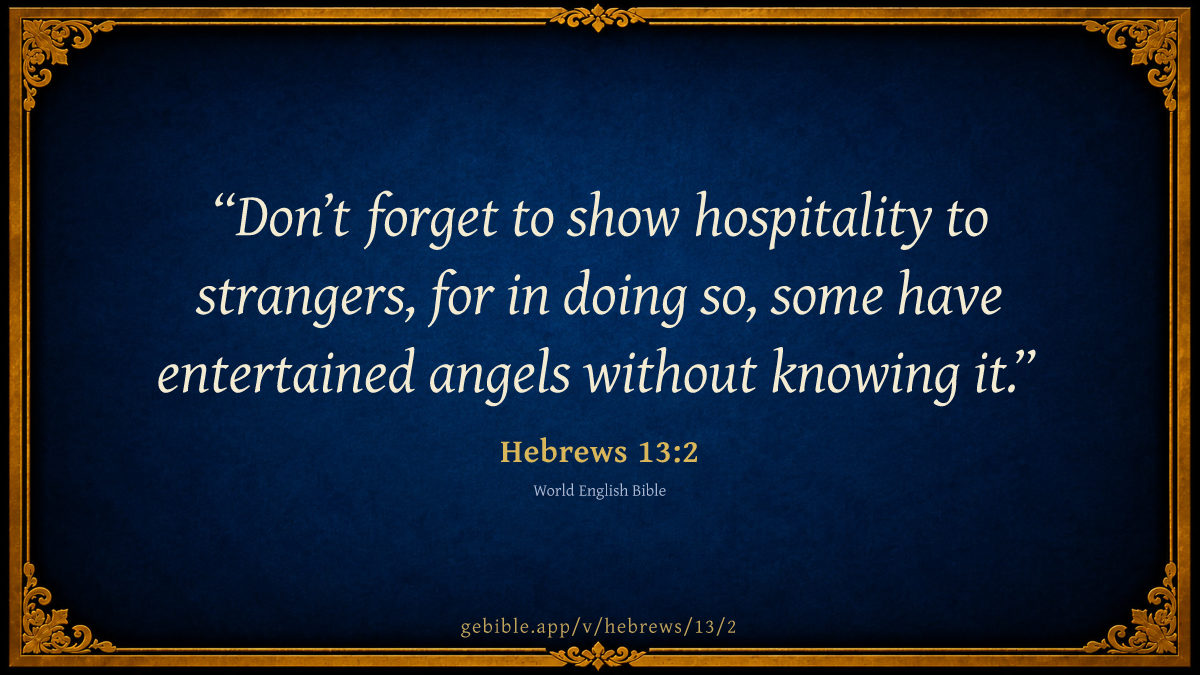
Don’t forget to show hospitality to strangers, for in doing so, some have entertained angels without knowing it.
Parallel Translations
-
Don’t forget to show hospitality to strangers, for in doing so, some have entertained angels without knowing it.
-
Be not forgetfull to lodge straungers. For therby have dyvers receaved angels into their houses vnwares.
-
Be not forgetfull to intertaine strangers: for thereby some haue receiued Angels into their houses vnwares.
Cross-references (19)
Passages linked to Hebrews 13:2 in the Treasury of Scripture Knowledge, ordered by reader-vote popularity; verse text shown in World English Bible.
- Matthew 25:35 for I was hungry, and you gave me food to eat. I was thirsty, and you gave me drink. I was a stranger, and you took me in.
- Genesis 18:1–19:3 Yahweh appeared to him by the oaks of Mamre, as he sat in the tent door in the heat of the day. He lifted up his eyes and looked, and saw that three men stood near him. When he saw them, he ran to meet them from the tent door, and bowed himself to the earth, and said, “My lord, if now I have found favor in your sight, please don’t go away from your servant. Now let a little water be fetched, wash your feet, and rest yourselves under the tree. I will get a piece of bread so you can refresh your heart. After that you may go your way, now that you have come to your servant.” They said, “Very well, do as you have said.” Abraham hurried into the tent to Sarah, and said, “Quickly prepare three seahs of fine meal, knead it, and make cakes.” Abraham ran to the herd, and fetched a tender and good calf, and gave it to the servant. He hurried to dress it. He took butter, milk, and the calf which he had dressed, and set it before them. He stood by them under the tree, and they ate. They asked him, “Where is Sarah, your wife?” He said, “There, in the tent.” He said, “I will certainly return to you at about this time next year; and behold, Sarah your wife will have a son.” Sarah heard in the tent door, which was behind him. Now Abraham and Sarah were old, well advanced in age. Sarah had passed the age of childbearing. Sarah laughed within herself, saying, “After I have grown old will I have pleasure, my lord being old also?” Yahweh said to Abraham, “Why did Sarah laugh, saying, ‘Will I really bear a child when I am old?’ Is anything too hard for Yahweh? At the set time I will return to you, when the season comes round, and Sarah will have a son.” Then Sarah denied it, saying, “I didn’t laugh,” for she was afraid. He said, “No, but you did laugh.” The men rose up from there, and looked toward Sodom. Abraham went with them to see them on their way. Yahweh said, “Will I hide from Abraham what I do, since Abraham will surely become a great and mighty nation, and all the nations of the earth will be blessed in him? For I have known him, to the end that he may command his children and his household after him, that they may keep the way of Yahweh, to do righteousness and justice; to the end that Yahweh may bring on Abraham that which he has spoken of him.” Yahweh said, “Because the cry of Sodom and Gomorrah is great, and because their sin is very grievous, I will go down now, and see whether their deeds are as bad as the reports which have come to me. If not, I will know.” The men turned from there, and went toward Sodom, but Abraham stood yet before Yahweh. Abraham came near, and said, “Will you consume the righteous with the wicked? What if there are fifty righteous within the city? Will you consume and not spare the place for the fifty righteous who are in it? May it be far from you to do things like that, to kill the righteous with the wicked, so that the righteous should be like the wicked. May that be far from you. Shouldn’t the Judge of all the earth do right?” Yahweh said, “If I find in Sodom fifty righteous within the city, then I will spare the whole place for their sake.” Abraham answered, “See now, I have taken it on myself to speak to the Lord, although I am dust and ashes. What if there will lack five of the fifty righteous? Will you destroy all the city for lack of five?” He said, “I will not destroy it if I find forty-five there.” He spoke to him yet again, and said, “What if there are forty found there?” He said, “I will not do it for the forty’s sake.” He said, “Oh don’t let the Lord be angry, and I will speak. What if there are thirty found there?” He said, “I will not do it if I find thirty there.” He said, “See now, I have taken it on myself to speak to the Lord. What if there are twenty found there?” He said, “I will not destroy it for the twenty’s sake.” He said, “Oh don’t let the Lord be angry, and I will speak just once more. What if ten are found there?” He said, “I will not destroy it for the ten’s sake.” Yahweh went his way, as soon as he had finished communing with Abraham, and Abraham returned to his place. The two angels came to Sodom at evening. Lot sat in the gate of Sodom. Lot saw them, and rose up to meet them. He bowed himself with his face to the earth, and he said, “See now, my lords, please come into your servant’s house, stay all night, wash your feet, and you can rise up early, and go on your way.” They said, “No, but we will stay in the street all night.” He urged them greatly, and they came in with him, and entered into his house. He made them a feast, and baked unleavened bread, and they ate.
- 1 Peter 4:9 Be hospitable to one another without grumbling.
- Romans 12:13 contributing to the needs of the saints; given to hospitality.
- Matthew 25:43 I was a stranger, and you didn’t take me in; naked, and you didn’t clothe me; sick, and in prison, and you didn’t visit me.’
- Matthew 25:40 “The King will answer them, ‘Most certainly I tell you, because you did it to one of the least of these my brothers, you did it to me.’
- Leviticus 19:34 The stranger who lives as a foreigner with you shall be to you as the native-born among you, and you shall love him as yourself; for you lived as foreigners in the land of Egypt. I am Yahweh your God.
- Deuteronomy 10:18-19 He executes justice for the fatherless and widow and loves the foreigner in giving him food and clothing. Therefore love the foreigner, for you were foreigners in the land of Egypt.
- 1 Kings 17:10-16 So he arose and went to Zarephath; and when he came to the gate of the city, behold, a widow was there gathering sticks. He called to her, and said, “Please get me a little water in a jar, that I may drink.” As she was going to get it, he called to her, and said, “Please bring me a morsel of bread in your hand.” She said, “As Yahweh your God lives, I don’t have a cake, but a handful of meal in a jar, and a little oil in a jar. Behold, I am gathering two sticks, that I may go in and bake it for me and my son, that we may eat it, and die.” Elijah said to her, “Don’t be afraid. Go and do as you have said; but make me a little cake from it first, and bring it out to me, and afterward make some for you and for your son. For Yahweh, the God of Israel says, ‘The jar of meal will not run out, and the jar of oil will not fail, until the day that Yahweh sends rain on the earth.’ ” She went and did according to the saying of Elijah; and she, and he, and her house, ate many days. The jar of meal didn’t run out, and the jar of oil didn’t fail, according to Yahweh’s word, which he spoke by Elijah.
- Titus 1:8 but given to hospitality, a lover of good, sober minded, fair, holy, self-controlled,
- Judges 13:15-25 Manoah said to Yahweh’s angel, “Please stay with us, that we may make a young goat ready for you.” Yahweh’s angel said to Manoah, “Though you detain me, I won’t eat your bread. If you will prepare a burnt offering, you must offer it to Yahweh.” For Manoah didn’t know that he was Yahweh’s angel. Manoah said to Yahweh’s angel, “What is your name, that when your words happen, we may honor you?” Yahweh’s angel said to him, “Why do you ask about my name, since it is incomprehensible?” So Manoah took the young goat with the meal offering, and offered it on the rock to Yahweh. Then the angel did an amazing thing as Manoah and his wife watched. For when the flame went up toward the sky from off the altar, Yahweh’s angel ascended in the flame of the altar. Manoah and his wife watched; and they fell on their faces to the ground. But Yahweh’s angel didn’t appear to Manoah or to his wife any more. Then Manoah knew that he was Yahweh’s angel. Manoah said to his wife, “We shall surely die, because we have seen God.” But his wife said to him, “If Yahweh were pleased to kill us, he wouldn’t have received a burnt offering and a meal offering at our hand, and he wouldn’t have shown us all these things, nor would he have told us such things as these at this time.” The woman bore a son and named him Samson. The child grew, and Yahweh blessed him. Yahweh’s Spirit began to move him in Mahaneh Dan, between Zorah and Eshtaol.
- Job 31:32 (the foreigner has not camped in the street, but I have opened my doors to the traveler);
- Isaiah 58:7 Isn’t it to distribute your bread to the hungry, and that you bring the poor who are cast out to your house? When you see the naked, that you cover him; and that you not hide yourself from your own flesh?
- 1 Timothy 5:10 being approved by good works, if she has brought up children, if she has been hospitable to strangers, if she has washed the saints’ feet, if she has relieved the afflicted, and if she has diligently followed every good work.
- Romans 16:23 Gaius, my host and host of the whole assembly, greets you. Erastus, the treasurer of the city, greets you, as does Quartus, the brother.
- 1 Timothy 3:2 The overseer therefore must be without reproach, the husband of one wife, temperate, sensible, modest, hospitable, good at teaching;
- Job 31:19 if I have seen any perish for want of clothing, or that the needy had no covering;
- Acts 16:15 When she and her household were baptized, she begged us, saying, “If you have judged me to be faithful to the Lord, come into my house and stay.” So she persuaded us.
- 2 Kings 4:8 One day Elisha went to Shunem, where there was a prominent woman; and she persuaded him to eat bread. So it was, that as often as he passed by, he turned in there to eat bread.
Cross-references from openbible.info (CC BY 4.0)
Explain this verse (15 sources)
Historical commentary, presented as a primary source — not an endorsement.
Private notes
Saved on this device only — never synced or sent anywhere.
John Calvin 1540 · Public Domain 2. Be not forgetful to entertain strangers, etc. This…
2. Be not forgetful to entertain strangers, etc. This office of humanity has also nearly ceased to be properly observed among men; for the ancient hospitality, celebrated in histories, is unknown to us, and Inns now supply the place of accommodations for strangers. But he speaks not so much of the practice of hospitality as observed then by the rich; but he rather commends the miserable and the needy to be entertained, as at that time many were fugitives who left their homes for the name of Christ.
And that he might commend this duty the more, he adds, that angels had sometimes been entertained by those who thought that they received only men. I doubt not but that this is to be understood of Abraham and Lot; for having been in the habit of showing hospitality, they without knowing and thinking of any such thing, entertained angels; thus their houses were in no common way honored. And doubtless God proved that hospitality was especially acceptable to him, when he rendered such a reward to Abraham and to Lot. Were any one to object and say, that this rarely happened; to this the obvious answer is, — That not mere angels are received, but Christ himself, when we receive the poor in his name. In the words in Greek there is a beautiful alliteration which cannot be set forth in Latin.
John Calvin's Commentaries (1540-1563) — public domain. Text from the Calvin Translation Society English edition (1840s-50s) via the Christian Classics Ethereal Library (ccel.org). Calvin's coverage is partial (roughly two-thirds of the Bible); uncommented books and verses are honest gaps, never fabricated. The 19th-century editor's footnotes and remarks are omitted so the notes are faithfully Calvin's own voice.
John Trapp 1656 · Public Domain 2 Be not forgetful to entertain strangers: for thereby…
2 Be not forgetful to entertain strangers: for thereby some have entertained angels unawares.
Ver. 2. Have entertained angels] As Abraham and Lot, who pursued hospitality, as the apostle speaketh, Rom 12:13, and had such guests as they hoped not for. The Galatians received St Paul as an angel; so did Cornelius entertain Peter. Every child of God is an earthly angel; and by entertaining them, angels also (which are their guardians) are entertained. The philosopher told his friends when they came into his little low cottage, εντευθεν ουκ απεισι Θεοι, the gods are here with me. God and his angels are the place where the saints are.
John Trapp, A Commentary or Exposition upon All the Books of the Old and New Testament (1647–1656) — public domain. Text from a community e-Sword module.
Matthew Poole 1685 · Public Domain The next duty suitable to Christ’s kingdom, is hospitality…
The next duty suitable to Christ’s kingdom, is hospitality to Christian strangers.
Be not forgetful to entertain strangers; be neither ignorant nor unmindful: by which charge they are bound strongly and always not to have this out of mind, though it may be out of hand; and the negative confirms the positive duty, removing hinderances, and enjoining it strictly, that they have a love and desire to the duty, bearing affection to the person of a Christian brother though a stranger, unknown and brought by Providence to them, Mat 22:39; 25:35; and to the work of being an host, of entertaining such Christians; ξενος signifying an host as well as a stranger or guest. It is a love to be an hospitable person that is here required, Tit 1:8; (such was Gaius to Paul and the church, Rom 16:23); importing a kind, courteous reception of Christians into their houses, being harbourless, which Christ promiseth them, Luk 18:29; 1Ti 5:10; a free and cheerful provision for their necessary refreshing, Gen 18:4-6; with a careful furtherance and assistance of them in the work of God, and helping them to persevere in the same, 3Jo 1:6-8.
Read full note →
For thereby some have entertained angels unawares; the advantage that accrues to such hosts of the Christian church and its members is great; for in the exercise of this duty, Abraham and Lot, being strangers, and waiting to entertain such, received angels into their tabernacle and house, Gen 18:2,3, and had sweet discoveries of God in the Messiah made to them; were delivered by them from judgment, as Lot, Gen 19:10,15-17. And now the general guard of angels goeth along with the saints, and are entertained in them, who never come without a blessing, they attending them in their way, defending them against evil spirits, and offensive ones and places where they are, though their ministry be little observed or acknowledged as it ought, Heb 1:14. Not only angels, but Christ himself accompanieth his pilgrim members, and is entertained, fed, comforted, and lodged in and with them, Mat 10:40-42; 25:34-36; and for this will he reward them in both worlds.
Matthew Poole's English Annotations on the Holy Bible (1683–1685) — public domain. Text from a community e-Sword/MySword module.
William Burkitt 1703 · Public Domain The second duty here exhorted to is hospitality, especially…
The second duty here exhorted to is hospitality, especially towards strangers, which consisted in receiving them into their houses, and furnishing them with all needful accommodations. In those eastern countries inns were not so ready as with us, and Christians were generally poor, not able to bear their own charges in their travelling from place to place. Strangers, even amongst Heathens, were accounted sacred, and under the peculiar protection of God.
And a punishment was appointed for those that were inhospitable towards them. Hospitality is a prescribed duty, but this part of it, to wit, the entertaining of strangers, which was so great a virtue in ancient times, is now driven out of the world by the wickedness of some, and the covetousness of others; few strangers are worthy to receive entertainment, and as few have hearts to give it.
Read full note →
Observe farther, the manner of prescribing this duty. Be not forgetful to entertain strangers; no doubt a positive command is included in the prohibition, forget not; that is, remember to do it, be always in a readiness for the discharge of this duty; our hearts ought to be always in a gracious disposition towards such duties as are attended with difficulty or charge; the liberal mind deviseth liberal things.
Observe lastly, The reason enforcing the duty, hereby some have entertained angels unawares: so did Abraham and Lot entertain three angels, in the appearance of men, not knowing who or what they were. By receiving strangers, out of faith in Christ, and love to God, we may receive precious saints, and (which is more) some blessed angels sent to keep them, and (which is most of all) Jesus Christ himself, who at present represents, and will hereafter acknowledge and reward, such kindnesses shown to his members as done to himself, Matthew 25.
William Burkitt's Expository Notes on the New Testament (1700–1703) — public domain. Text from a community e-Sword module.
John Gill 1763 · Public Domain Be not forgetful to entertain strangers,.... By whom are…
Be not forgetful to entertain strangers,.... By whom are meant, not unconverted men, who are strangers to God and Christ, and the covenants of promise; nor saints, who are as pilgrims and strangers in this world; but such as are of another country, and are unknown; and even though wicked men, they are not excluded; though such as are obliged to quit their own country for righteousness sake are chiefly designed; all strangers in distress are meant, and hospitality is to be exercised towards them; which lies negatively in doing nothing to distress them, and positively in providing food, raiment, lodging, &c. for them, and in comforting, counselling, and directing them in all matters in which they may stand in need thereof: and that this is a duty, appears from the light of nature, and practices of the Heathens, Act 28:2, from the express law of God, Deu 10:19 and many others made in favour of strangers, binding on the Jews; from the sundry exhortations to it in the New Testament, Rom 12:13 and from the exhortation here not to forget it; and from the great regard which Christ will show to such as mind it, and his disregard to others at the last day: the persons who are to exercise it are not only the ministers of the Gospel, who should be given to hospitality; but all the saints, even the meaner sort are not exempted, but should use it according to their ability; though it is chiefly binding on those that are rich. And this should not be forgot, but pursued and followed after; it should be frequently performed; men should be given, and used to it; it should be done without grudging, and in a friendly and loving manner:
for thereby some have entertained angels unawares; as Abraham, Gen 18:1, he knew them not to be angels at first; they appeared as men, and he treated them as such; but they were angels, yea, one of them was Jehovah himself; and hereby he received many favours, Gen 18:10, and Lot, Gen 19:1 who knew not that they were angels he took into his house; but they were, and he was delivered by them from the burning of Sodom; yea, some have unawares, this way, entertained Christ himself, Luk 24:15 and indeed, entertaining of his members is entertaining him, Mat 25:38. It is an observation of a Jewish writer (r) upon the first of these instances;
Read full note →
"from hence we learn (says he) how great is the strength (or virtue) of the reception of travellers (or hospitality), as the Rabbins of blessed memory say, greater is , "hospitality", than the reception of the face of the Shechinah.''
And this is said to be one of the six things which a man enjoys the fruit of in this world, and for which there remains a reward in the world to come (s).
(r) R. Abraham Seba in Tzeror Hammor, fol. 18, 4. (s) T. Bab. Sabbat, fol. 127. 1.
John Gill's Exposition of the Whole Bible (1746–1763) — public domain (CC PDM 1.0). Text via the HelloAO Bible API.
John Wesley 1765 · Public Domain Some - Abraham and Lot. Have entertained angels unawares…
Some - Abraham and Lot. Have entertained angels unawares - So may an unknown guest, even now, be of more worth than he appears, and may have angels attending him, though unseen. Gen. xviii, 2; Gen. xix, 1.
John Wesley, Explanatory Notes Upon the Whole Bible (1754–1765) — public domain. Text via the GEBible commentary corpus.
Adam Clarke 1810 · Public Domain Verse 2. To entertain strangers] In those early times,…
Verse 2. To entertain strangers] In those early times, when there were scarcely any public inns or houses of entertainment, it was an office of charity and mercy to receive, lodge, and entertain travellers; and this is what the apostle particularly recommends.
Entertained angels] Abraham and Lot are the persons particularly referred to. Their history, the angels whom they entertained, not knowing them to be such, and the good they derived from exercising their hospitality on these occasions, are well known; and have been particularly referred to in the notes on Gen 18:3; Gen 19:2.
Adam Clarke's Commentary on the Bible (1810–1826) — public domain. Text from a community e-Sword/MySword module.
Albert Barnes 1834 · Public Domain Be not forgetful to entertain strangers - On the…
Be not forgetful to entertain strangers - On the duty of hospitality, see a full explanation in the notes on Rom 12:13.
For thereby some have entertained angels unawares - Without knowing that they were angels. As Abraham (Gen 18:2 ff), and Lot did; Gen. 19. The motive here urged for doing it is, that by entertaining the stranger we may perhaps be honored with the presence of those whose society will be to us an honor and a blessing. It is not well for us to miss the opportunity of the presence, the conversation, and the prayers of the good. The influence of such guests in a family is worth more than it costs to entertain them. If there is danger that we may sometimes receive those of an opposite character. yet it is not wise on account of such possible danger, to lose the opportunity of entertaining those whose presence would be a blessing. Many a parent owes the conversion of a child to the influence of a pious stranger in his family; and the hope that this may occur, or that our own souls may be blessed, should make us ready, at all proper times, to welcome the feet of the stranger to our doors. Many a man, if, he had been accosted as Abraham was at the door of his tent by strangers, would have turned them rudely away; many a one in the situation of Lot would have sent the unknown guests rudely from his door; but who can estimate what would have been the results of such a course on the destiny of those good people and their families? For a great number of instances in which the pagan were supposed to have entertained the gods, though unknown to them, see Wetstein in loc.
Albert Barnes' Notes on the Bible (1834–1885) — public domain. Text from a community e-Sword/MySword module.
Haydock's Catholic Bible Commentary 1859 · Public Domain And hospitality do not forget,...some being not aware [1]…
And hospitality do not forget,...some being not aware [1] of it, have entertained Angels. They imagined they received men, when they were Angels. The Latin interpreter followed exactly the Greek, though the expression be unusual in both languages. It is meant of Abraham, (Genesis xviii. 2.) and of Lot, Genesis xix. 1. (Witham)
===============================
Read full note →
[BIBLIOGRAPHY]
Per hanc enim latuerunt quidam Angelis hospitio receptis, Greek: dia tautes gar elathon tines xenisantes Aggelous, i.e. hospitio recepiendo Angelos. The Latin has exactly followed the Greek.
George Leo Haydock (1774–1849), Haydock's Catholic Family Bible and Commentary, 1859 edition — public domain. Excludes Psalms (Douay-Rheims chapter numbering differs from Protestant) and Deuterocanonical books (Catholic canon only).
The Cambridge Bible for Schools and Colleges 1878 · Public Domain 2. to entertain strangers] The hospitality of Christians (what…
2. to entertain strangers] The hospitality of Christians (what Julian calls ἡ περὶ ξένους φιλανθρωπία) was naturally exercised chiefly towards the brethren. The absence of places of public entertainment except in the larger towns, and the constant interchange of letters and messages between Christian communities—a happy practice which also prevailed among the Jewish Synagogues—made “hospitality” a very necessary and blessed practice. St Peter tells Christians to be hospitable to one another ungrudgingly, and unmurmuringly, though it must sometimes have been burdensome (1Pe_4:9; comp. Rom_12:13; Tit_1:8; 1Ti_3:2). We find similar exhortations in the Talmud (Berachoth f. 63. 2; Shabbath f. 27. 1). Lucian (De Mort. Peregr. 16) and the Emperor Julian (Ep. 49) notice the unwonted kindness and hospitality of Christians.
have entertained angels unawares] Abraham (Gen_18:2-22. Lot (Gen_19:1-2). Manoah (Jdg_13:2-14). Gideon (Jdg_6:11-20). Our Lord taught that we may even entertain Him—the King of Angels—unawares. “I was a stranger, and ye took Me in” (Mat_25:35-40). There is an allusion to this “entertaining of angels” in Philo, De Abrahamo (Opp. ii. 17). The classic verb rendered “unawares” (elathon) is not found elsewhere in the N.T. in this sense, and forms a happy paronomasia with “forget not.”
The Cambridge Bible for Schools and Colleges (gen. ed. J. J. S. Perowne; Cambridge University Press, 1878–1918) — public domain. Text from a community e-Sword module.
Ellicott's Commentary for English Readers 1878 · Public Domain (2) To entertain strangers.—Hospitality to Christian brethren at a…
(2) To entertain strangers.—Hospitality to Christian brethren at a distance from their homes is especially intended (1Pe_4:9): this was one manifestation of the “love of the brethren” (Heb_13:1). The prominence assigned to this duty in the exhortations of the Epistles of the New Testament was faithfully reflected in the practice of the early Church.
Thereby some have entertained angels unawares.—See Genesis 18, 19. The Greek word for “angels”—messengers—of itself would serve to remind these Christians that, though the strangers whom they welcomed were but men, they might be special messengers of God. Clement of Rome, in his Epistle to the Corinthians (A.D. 95), appeals to the same examples (and also to Rahab): “For his faith and hospitality a son was given to Abraham in his old age. For his hospitality and godliness Lot was saved from Sodom.”
A Bible Commentary for English Readers, edited by Charles John Ellicott (1878–1897) — public domain. Text from a community e-Sword module.
The Pulpit Commentary 1880 · Public Domain Be not forgetful to entertain strangers (or, of hospitality):…
Be not forgetful to entertain strangers (or, of hospitality): for thereby some have entertained angels unawares. Allusions to this duty are frequent in the Epistles; its exercise would be of especial importance, in those days of persecution, towards scattered and destitute brethren as well as towards missionaries, though it by no means appears that it was meant to be confined to "them that are of the household of faith." Possibly some of the wavering Hebrew Christians might be becoming less ready to open their doors to the persecuted from fear of "reproach" in Jewish circles. The allusion of the latter part of the verse is evidently to Abraham and Lot. (Ge 18 and Ge 19) At any time the visits even of our fellow-men may be to us as visits of angels, as being messengers of God"s purposes for good when least expected. And especially to be noted are our Lord"s own words, "He that receiveth you receiveth me," etc., and "Inasmuch as ye have done it unto one of the least of these my brethren, ye have done it unto me". (Mat_25:40)
Hospitality.
Read full note →
Note the connection of vers. 1 and 2. First filadelfia is enjoined, then filoxenia . The stranger as well as the brother must have a proper place in our consideration. Brotherliness must not lead to exclusiveness. We must go by the golden rule. If we came to a strange place at nightfall, footsore with a long day"s walking, we should be very grateful to any who would open the door and give us shelter and food. The injunction to hospitality very needful in times when facilities of travel were not what they are now. Hospitable feelings are strong in many who have not yet attained to Christian virtues; let the Christian, then, be in no way behind. He will be prudent and cautious in his treatment of strangers, he will be wise as the serpent; but he will remember, too, that he is under the protection of God. Now and then he will be deceived and robbed, but this is a little matter compared with the maintenance of hospitable duties. It may seem at first as if a low motive for hospitality were here introduced; but if it be considered, we shall see that it is not so much a motive to hospitality as to unremitting watchfulness in hospitality. Let the stranger be ever in your mind. Let not one slip past your gates, or go away knocking in vain. What will it avail to admit a thousand who bring you nothing but their needs, if you let the one go who will bring you blessings far more than anything you can do for him? Y.
The Pulpit Commentary (1880–1919), ed. H.D.M. Spence-Jones & Joseph S. Exell — public domain. Text from a community e-Sword module.
The Biblical Illustrator 1887 · Public Domain Entertain strangers
Heb_13:2
Entertain strangers
Read full note →
Entertaining strangers:
The text derives much of its importance from the times in which it was written.
They were perilous times for Christians. The disciples of Christ had often to flee to strange cities, and in entertaining some stranger, a man might find he had entertained a Christian, or had given shelter and food to a messenger or angel of the Church, and he would be more than repaid by the discourse and benediction of the wayfarer.
I. SMALL DUTIES ARE OFTEN ENFORCED BY GREAT PROMISES. Small duties, like small mercies, are often overlooked. God has scattered His gifts over lifes pathway, we mistake them for wild flowers or mere weeds; but they yield fragrance when pressed by our worn and weary feet. Life is made up, to a great extent, of small things,--they give symmetry and beauty to character, and make up the proportions of life; they are necessary to the order of the family and the harmony of the home; their absence would soon be detected in the irregular movements of the simple machinery, or in the note of dissonance which would mar the music of life. There are numerous instances in the past, in which pity to the oppressed and the captive, kindness to the stranger, and charity to man, were enforced by great promises; by the promise oftentimes of living long in the land which the Lord their God had given them. And so in the text men are to entertain strangers because some have entertained angels unawares.
II. OUR MINISTRATIONS MAY BE AS IMPORTANT FOR OUR SAKE AS FOR THE SAKE OF THOSE TO WHOM THEY ARE RENDERED. We get, in one sense, as much good by giving, as we confer on those who receive our gifts. We are to be merciful, that thus we may imitate God. Hospitality is of importance, because it involves a genial nature,--a large, loving heart, consideration and care for man. A man who is not a lover of hospitality is in danger of living to himself, shutting up life within himself, being separate and divided from his fellows. Man is a social being, and he who would have friends must show himself friendly. Apparently incidental circumstances often lead to great and unexpected results. An introduction to a stranger--an act of courtesty--a few passing words, have led to results which have influenced all the future. Men have only thought of entertaining a stranger, and they have entertained an angel. We are to do lifes duties; we are to be generous and hospitable if no angel ever enters our tent; we are to entertain strangers, though they may never turn out to be angels.
III. THE PRECEPT ENJOINS ON US BENEVOLENCE AND LARGENESS OF HEART. Men are too much accustomed to live with men of their own class, with men who read the same books, think the same thoughts, and live the same kind of life; they do not know men out of their circle, they do not receive the benefit which results from freshness of thought, and interchange of sentiment, and deeper and warmer feeling. (H. J. Boris.)
Hospitality:
In hospitality these things are required:
1. That we do it frequently. One swallow makes not a spring. The receiving of a stranger once makes not a hospitable man. We must make a daily use and occupation of it. It was the continual practice of Lot and Abraham, as may appear by their behaviour.
2. It must be willingly. We must not tarry till strangers offer themselves. We must pull them in, as Abraham and Lot did. We must constrain them, as Lydia did St. Paul and Silas.
3. Cheerfully without grudging (1Pe_4:9), we must not repine at it, speak hardly of them when they be gone.
4. Meekly; not receive them after a stately and lord-like manner; but after a meek manner, as if we were rather beholden to them, than they to us. They be the brethren of Christ, the sons of God; we are not worthy of such guests.
5. Abundantly; according to that ability wherewith God hath blessed us. If we have but a little, let them have a little, as the widow of Sarepta dealt with Elias. If we have a great portion of Gods blessings, let them taste of them.
6. We must do it perseveringly: be not weary of well doing. Hospitality is a good thing, be not weary of it. Let thy house be open to good men all the days of thy life. But alas, this is a hard doctrine, who can abide it; we are too much wedded to the world: yea, they that make a great show of Christianity, are ready to say with Nabal, Shall I take my bread and my water, and my flesh, and give it unto men whom I know not whence they be? Oh forget not this duty. Here he means such strangers especially as are compelled to forsake their country for the gospels sake; but it is to be extended to all.
It is an excellent duty, and we have many spurs to prick us to it.
1. God requires it (Isa_58:7).
2. We have many ensamples for it.
3. We ourselves may be strangers, therefore do as ye would be done to.
4. The want of it hath been grievously punished, it was the overthrow of the whole tribe (Jdg_20:1-48.).
5. In receiving men that are strangers, we may receive angels. Preachers which be Gods angels, nay, Christ Himself (Mat_25:6).
6. It is gainful for this life, and that which is to come. (W. Jones, D. D.)
A gracious disposition unexpectedly rewarded
I. ESPECIAL SEASONS ARE DIRECTIONS, AND CONSTRAINING MOTIVES UNTO ESPECIAL DUTIES. And he who on such occasions will forget to receive strangers, will not long remember to retain anything of Christian religion.
II. OUR HEARTS ARE NOT TO BE TRUSTED UNTO IN OCCASIONAL DUTIES, IF WE PRESERVE THEM NOT IN A CONTINUAL DISPOSITION TOWARDS THEM. If that be lost, no arguments will be prevalent to engage them unto present occasions.
III. THAT THE MIND OUGHT CONTINUALLY TO BE ON ITS WATCH, AND IN A GRACIOUS DISPOSITION TOWARDS SUCH DUTIES AS ARE ATTENDED WITH DIFFICULTIES AND CHARGE. Such as that here commanded to us, without which, we shall fail in what is required of us.
IV. EXAMPLES OF PRIVILEGES ANNEXED TO DUTIES, WHEREOF THE SCRIPTURE IS FULL, ARE GREAT MOTIVES AND INCENTIVES TO THE SAME, OR THE LIKE DUTIES.
V. FAITH WILL MAKE USE OF THE HIGHEST PRIVILEGES THAT EVER WERE ENJOYED ON THE PERFORMANCE OF DUTIES, TO ENCOURAGE UNTO OBEDIENCE, THOUGH IT EXPECTS NOT ANYTHING OF THE SAME KIND ON THE PERFORMANCE OF THE SAME DUTIES.
VI. WHEN MEN DESIGNING THAT WHICH IS GOOD, DO MORE GOOD THAN THEY INTENDED, SHALL OR MAY REAP MORE BENEFIT THEREBY THAN THEY EXPECTED. (John. Owen, D. D.)
Kindness to stranger:
Even in later ages of the Church, there have been fine exemplifications, personal and public, of kindness to Christian strangers. Some of the most remarkable of these belong to the age of the Reformation. The heart warms towards Frankfort and Geneva, in the memory of the hospitable shelter which those venerable cities gave at that eventful epoch, to so many of our English and Scottish exiles. And not a few evangelical Protestants on the Continent of Europe now delight to extend their humble hospitality to British Christians whom an interest in the common faith, or even a less sacred motive, may have carried to their shores. (D. S. Patterson.)
A genius for kindness:
There is a man, said his neighbour, speaking of a village carpenter, who has done more good, I really believe, in this community than any other person who ever lived in it. He cannot talk very well in prayer-meetings, and he doesnt very often try. He isnt worth two thousand dollars, and its very little that he can put down on subscription papers for any good object. But a new family never moves into the village that he does not find them out, to give them a neighbourly welcome and offer any little service he can render. He is usually on the lookout to give strangers a seat in his pew at church. He is always ready to watch with a sick neighbour, and look after his affairs for him; and Ive sometimes thought he and his wife keep house plants in winter just for the sake of being able to send little bouquets to invalids. He finds time for a pleasant word for every child he meets, and youll always see them climbing into his one-horse waggon when he has no other load. He really seems to have a genius for helping folks in all sorts of common ways, and it does me good every day just to meet him on the streets. (Baxendales Anecdotes.)
Entertained angels unawares
Strangers may be angels
I. Strange PERSONS may often turn out to be angels.
1. It may be so with the stranger who enters our household.
2. It may be so with the stranger in our neighbourhood.
3. It may be so with the stranger in our church.
4. It may be so with the stranger in our country. Treat all men with generousness and goodwill, and you may perhaps find angelic things within them.
II. Strange THINGS may often turn out to be angels.
1. A strange truth may turn out to be an angel, solving difficulties, enfranchising the intellect, and making the horizon of the soul beam brightly with unearthly stars.
2. A strange trial may turn out to be an angel. Adversity, disease, bereavement, may prove blessings in disguise.
3. A strange charity may turn out to be an angel. It is more blessed to give than to receive. (Homilist.)
Angel visits:
There is no reason for thinking that under the Christian dispensation angelic beings ever assume a visible form, though we have nevertheless the comforting assurance that they are all ministering spirits sent forth to minister to them that shall be the heirs of salvation. But the visit might be like that of an angel, inasmuch as the visitor might bring rich intelligence as to the glorious things of the invisible world. What is there to prevent God from enabling one of our fellow-men to discourse to us so exquisitely on the deep things of our faith and the beautiful and harmonious things of heaven, that the effect shall be literally the same as though He had commissioned a cherub or a seraph to take human form and speak in human speech? We will give you as nearly as we may the scene which was likely to occur in the early days of the Church, and which, with due allowance made for change in circumstances, might occur in our own. We suppose a Christian family gathered round their fireside in times when the profession of Christianity exposed to persecution. They are themselves almost dreading the coming of the inquisitor, and they are startled by that knock at their door, fancying that it may proceed from some minister of cruelty; but there is only an aged wanderer who solicits admission, and the storm pleads for him as eloquently as his grey hairs. Shall he be refused? It is not unlikely that he is some poor victim whom the dogs of persecution are hunting down. If we admit him, he may be tracked to this house, and then, without being able to shield him, we shall be ruined ourselves. But the master of that house is too staunch a character to be deterred from duty by the fear of consequences. Simply reminding his family of the precept--Be not forgetful to entertain strangers, he opens his door, and bids the old man welcome in the name of the Lord; and the stranger, whilst partaking the proffered hospitality, enters into conversation, and, finding that they are Christians who have so kindly received him, seeks to recompense the kindness by discoursing on Christianity, and he pours forth all the treasures of his experience, and enlarges on the mysteries of redemption. He is one who has thought deeply and felt deeply; and as he dilates on the love of God in sending His own dear Son, and explains the blessed and marvellous manner in which the provisions of the gospel meet the wants of fallen creatures, or speaks thrillingly of the exceeding and eternal weight of glory, for which the trials of life are only a preparation, every eye is fast rivetted upon him, and his voice falls on every ear as some unearthly sound; but most sweet and most musical in its unearthliness. Is there any reason whatsoever why this might not occur, why it might not happen in any age of the Church, though more likely when persecution had caused the excellent of the earth, like the Master whom they served, to have not where to lay the head? And when the old man, wearied by his own high stretchings into mysteries and glories, had sunk to repose, would not the amazed and delighted family say, one to another, as the disciples who had journeyed to Emmaus, Did not our heart burn within us while He talked with us by the way, and while He opened to us the Scriptures? Would not their feeling be as though they had received into their circle the inhabitant of a better world, known, not indeed by the wing of light and the eye of fire; but by wisdom drawn from gazing upon God; and would they not exclaim, Oh! well hath the apostle followed up his precept, Be not forgetful to entertain strangers, by saying, for thereby some have entertained angels unawares? (H. Melvill, B. D.)
Angels as strangers:
We often mistake the dispensations of Gods providence. They come to us as angels veiled in sadness, or in strange forms; we think they are enemies, and wrestle with them; in the darkness, the struggle goes on,--we want our way, it is not till they touch us and teach us their Divine character; it is not till the day begins to break, that we find we are in the presence of Gods messengers. We learn that we have wrestled with an angel, and then we seek to detain him, and earnestly ask for a blessing. Sorrow comes unbidden, unwelcomed; it takes its place at our fireside, sits at our table; its presence casts a shadow on us; but when we allow it to commune with us, when it touches us, our life seems changed, our thoughts and affections are transfigured. Death comes over our threshold, into our home; and life is never more the same. It reads us some lesson out of the black-letter book of Gods providence. The lesson we bear in tears, but we never more forget it. We confess that we are strangers and sojourners here. We begin to think of leaving this tent. We declare plainly that we seek a better country. Death, so dreaded by us, acts in his ministrations only as an angel, who takes our loved ones into the everlasting home of the heavens. (H. J. Bevis.)
Hospitality rewarded
Jupiter and Mercury once visited a village, and, disguised in human form, sought entertainment, but in vain, till they came to the thatched cottage of the aged Baucis and Philemon. Before the strangers was spread the best the place afforded, with careful attention. The unwasted wine revealed to them the gods to whom they would have sacrificed. This inhospitable village shall pay the penalty of its impiety. You shall be free. Come with us to the top of yonder hill, said the gods. They obeyed, and beheld the country around sink into a lake, while their own house grew into a magnificent temple, in which they served as priests until transformed together. (New Cyclopedia of Illustrations.)
Entertaining a prince unawares:
During the Prince of Waless stay at Torquay he has walked or driven to many of the numerous points of beauty or interest with which the coast abounds. It is related that on Friday the Prince landed at Babbicombe Bay, and after exploring its charms, in company with Captain Stephcnson and Lord Hastings, the trio betook themselves to an adjacent tea garden, and ordered refreshment. The establishment, however, is chiefly frequented by visitors who bring their own provisions, and was unprovided with any but very homely fare. A lady who was taking tea with friends in an adjoining arbour, overheard the colloquy to which the request gave rise, and courteously placed at the disposal of the gentlemen a portion of her provisions, including, of course, Devonshire cream, tea and cakes. The offer was accepted, and, the ladys creature comforts having been freely partaken of, the recipients, the Prince especially, were warm in their acknowledgments of this display of courtesy to strangers. It was not until after they had departed that the lady became aware that she had entertained a prince unawares. (Western Times.)
The Biblical Illustrator, edited by Joseph S. Exell (c. 1880s–1900s) — public domain. Text from a community e-Sword module.
B. W. Johnson 1891 · Public Domain 2. Be not forgetful to entertain strangers. Hospitality is…
2. Be not forgetful to entertain strangers. Hospitality is a duty often emphasized in the New Testament. Here it assumes the form of receiving stranger saints. Often they were driven from their homes by persecution, and the church elsewhere was wont to open its homes to them. Some have entertained angels unawares. See Gen. 18:1–3. Also Matt. 25:35.
B. W. Johnson's The People's New Testament with Notes (1889–1891) — public domain. Electronic text from the Christian Classics Ethereal Library (CCEL) ThML edition.
Tyndale Open Study Notes 2022 · CC BY-SA 4.0 13:2 Hospitality is another foundational principle in Jewish and…
13:2 Hospitality is another foundational principle in Jewish and Christian ethics (1 Pet 4:9; see also Matt 10:11; Acts 16:15; Titus 3:13; Phlm 1:22; 3 Jn 1:5-8). In the first century, most people did not stay at inns when traveling. • Some . . . have entertained angels: See Gen 18:2-15; Judg 13:2-23.
Tyndale Open Study Notes — © Tyndale Open Resources, licensed CC BY-SA 4.0. Text via the HelloAO Bible API.