
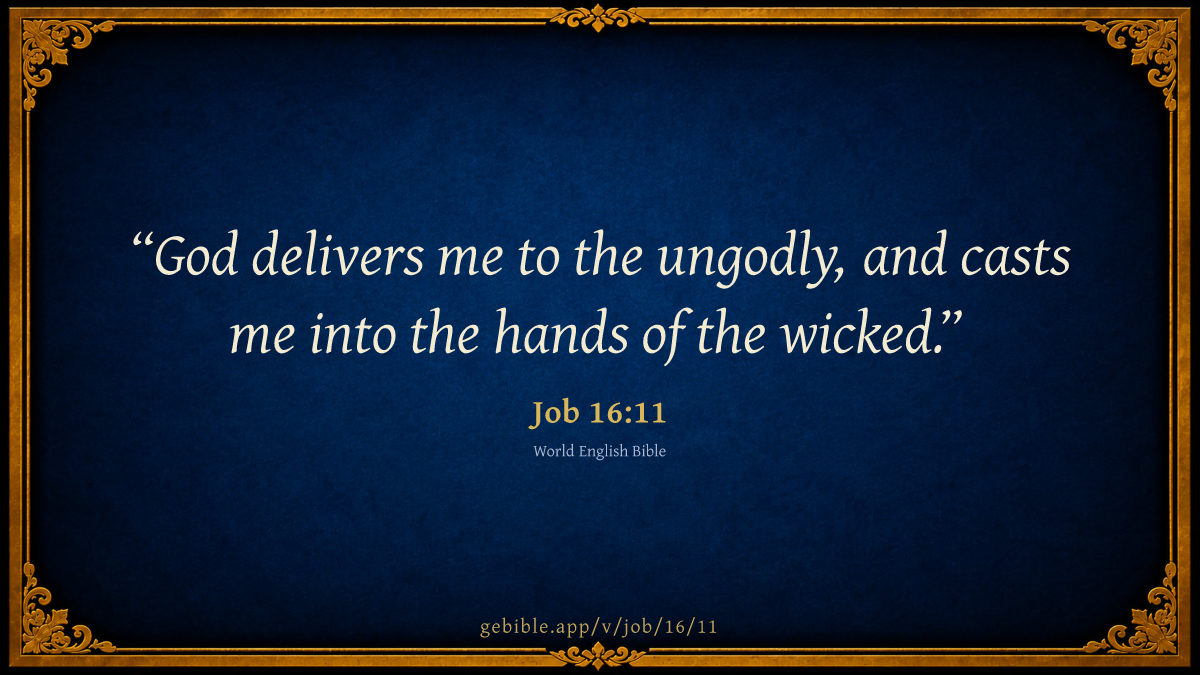
God delivers me to the ungodly, and casts me into the hands of the wicked.
Parallel Translations
-
God delivers me to the ungodly, and casts me into the hands of the wicked.
-
God hath delivered me to the ungodly, and turned me over into the hands of the wicked.
-
God delivereth me to the ungodly, and casteth me into the hands of the wicked.
Cross-references (9)
Passages linked to Job 16:11 in the Treasury of Scripture Knowledge, ordered by reader-vote popularity; verse text shown in World English Bible.
- Psalms 27:12 Don’t deliver me over to the desire of my adversaries, for false witnesses have risen up against me, such as breathe out cruelty.
- Psalms 7:14 Behold, he travails with iniquity. Yes, he has conceived mischief, and brought out falsehood.
- Psalms 31:8 You have not shut me up into the hand of the enemy. You have set my feet in a large place.
- 1 Samuel 24:18 You have declared today how you have dealt well with me, because when Yahweh had delivered me up into your hand, you didn’t kill me.
- Job 1:13-19 It fell on a day when his sons and his daughters were eating and drinking wine in their oldest brother’s house, that there came a messenger to Job, and said, “The oxen were plowing, and the donkeys feeding beside them, and the Sabeans attacked, and took them away. Yes, they have killed the servants with the edge of the sword, and I alone have escaped to tell you.” While he was still speaking, there also came another, and said, “The fire of God has fallen from the sky, and has burned up the sheep and the servants, and consumed them, and I alone have escaped to tell you.” While he was still speaking, there came also another, and said, “The Chaldeans made three bands, and swept down on the camels, and have taken them away, yes, and killed the servants with the edge of the sword; and I alone have escaped to tell you.” While he was still speaking, there came also another, and said, “Your sons and your daughters were eating and drinking wine in their oldest brother’s house, and behold, there came a great wind from the wilderness, and struck the four corners of the house, and it fell on the young men, and they are dead. I alone have escaped to tell you.”
- Job 2:7 So Satan went out from the presence of Yahweh, and struck Job with painful sores from the sole of his foot to his head.
- John 19:16 So then he delivered him to them to be crucified. So they took Jesus and led him away.
- Romans 11:32 For God has bound all to disobedience, that he might have mercy on all.
- 2 Corinthians 12:7 By reason of the exceeding greatness of the revelations, that I should not be exalted excessively, a thorn in the flesh was given to me: a messenger of Satan to torment me, that I should not be exalted excessively.
Cross-references from openbible.info (CC BY 4.0)
Explain this verse (15 sources)
Historical commentary, presented as a primary source — not an endorsement.
Private notes
Saved on this device only — never synced or sent anywhere.
Geneva Bible translators 1599 · Public Domain They have led me whither they would.
They have led me whither they would.
Geneva Bible (1599) marginal notes — public domain.
John Trapp 1656 · Public Domain Job 16:11 God hath delivered me to the ungodly,…
Job 16:11 God hath delivered me to the ungodly, and turned me over into the hands of the wicked.
Ver. 11. God hath delivered me to the ungodly] i.e. To the devil and his instruments, those Chaldean and Sabean robbers, Job 1:15; Job 1:17, together with his hard hearted friends, who, for want of the true fear of God, added to his afflictions, Job 6:14. {See Trapp on "Job 6:14"}
Read full note →
And turned me over, &c.] As a magistrate doth a malefactor to the executioner. It is a sore affliction to be under the rule of wicked men; much more to be under the rage, which yet was the case of that noble army of martyrs, ancient and modern. The comfort is, that although the Lord turn his servants over into the hands of the wicked, whose tender mercies are mere cruelties, yet he never turns them out of his own hand, neither will he suffer the rod of the wicked to rest upon the lot of the righteous, Psa 125:3. His constant care is, that the choice spirits of his afflicted people fail not before him, and, therefore, he numbereth out their strokes, and if their enemies over do and go beyond their commission, so as to help forward the before appointed affliction, he is sore displeased, and jealous with a great jealousy against them, Zec 1:15.
John Trapp, A Commentary or Exposition upon All the Books of the Old and New Testament (1647–1656) — public domain. Text from a community e-Sword module.
Matthew Poole 1685 · Public Domain To the ungodly; either,
To the ungodly; either,
1. To my friends, who act the part of the wicked, in censuring and condemning the righteous, whom God approveth, and in pleading for a false and wicked cause. Or rather,
Read full note →
2. To the Chaldeans and Sabeans, who were a most wicked people, living in gross contempt of God, and injuriousness to all sorts of men. For this best suits both with the first clause of the next verse, which showeth that he speaketh of Job’s first afflictions, which befell him when he was at ease; and with Job’s principal scope, which was to prove that both eminent prosperity and affliction did indifferently happen to good and bad men; and this was evident from this example, because holy Job was ruined, when these wicked people were most victorious and successful.
Matthew Poole's English Annotations on the Holy Bible (1683–1685) — public domain. Text from a community e-Sword/MySword module.
John Gill 1763 · Public Domain I was at ease, but he hath broken me…
I was at ease, but he hath broken me asunder,.... He was in easy and affluent circumstances, abounding with the good things of this life, lay in his nest, as his expression is, Job 29:18; quietly and peaceably, where he expected he should have died; and he was easy in his mind, had peace of conscience, being a good man that feared God, and trusted in his living Redeemer, enjoying the presence of God, the light of his countenance, and the discoveries of his love, see Job 39:2; but now he was broken to pieces, he was stripped of his worldly substance; his family was broken up, and not a child left him; his body broken, and full of ruptures through boils and ulcers; and his spirits were broken with his afflictions, and a sense of divine displeasure; the arrows of God's wrath, in his apprehension, stuck in him, and the poison thereof drank up his spirits. Mr. Broughton renders it, "I was wealthy, and he hath undone me"; though once so opulent, he was now broken, and become a bankrupt. It may be applied to Christ, his antitype, who, though rich, became poor to make his people rich, Co2 8:9; and whose body was broken for them; and he was wounded and bruised for their transgressions, and whose heart was broken with reproach:
he hath also taken me by the neck, and shaken me to pieces; as a combatant in wrestling, who is stronger than his antagonist, uses him; or as a giant, who takes a dwarf by his neck or collar, and shakes him, as if he would shake him to pieces, limb from limb; or "hath dashed" or "broken me to pieces" (f); or to shivers; as glass or earthen vessels dashed against a wall, or struck with a hammer, fly into a thousand pieces, can never be put together again; so Job reckoned of his state and condition as irrecoverable, that his health, his substance, his family, could never be restored as they had been:
Read full note →
and set me up for his mark; to shoot at, of which he complains Job 7:20; a like expression is used by the church in Lam 3:12; and a phrase similar to this is used of Christ, Luk 2:34; and in consequence of this are what follow.
(f) "confregit me", V. L. Pagninus; "minutatim confregit me", Tigurine version; so Schultens, Jarchi, & Ben Gersom.
John Gill's Exposition of the Whole Bible (1746–1763) — public domain (CC PDM 1.0). Text via the HelloAO Bible API.
John Wesley 1765 · Public Domain The wicked - And thus Christ was delivered into…
The wicked - And thus Christ was delivered into wicked hands, by the determinate counsel of God.
John Wesley, Explanatory Notes Upon the Whole Bible (1754–1765) — public domain. Text via the GEBible commentary corpus.
Joseph Benson 1811 · Public Domain Job 16:11. God hath delivered me to the ungodly…
Job 16:11. God hath delivered me to the ungodly — Either, 1st, To my friends, who act the part of the wicked in censuring and condemning the righteous, whom God approveth, and in pleading for a false and wicked cause. Or, rather, to the Chaldeans and Sabeans, who were a most ungodly and wicked people, living in gross contempt of God, and injurious to all sorts of men. This seems best to suit both with the first clause of the next verse, which shows that Job speaks of his first afflictions which befell him when he was at ease, and with his principal design, which was to prove that both eminent prosperity and affliction did indifferently happen both to good and bad men, which indeed was evident from this example: because holy Job was ruined at the very time when this wicked people were most victorious and successful.
Joseph Benson's Commentary on the Old and New Testaments (1811–1818) — public domain. Text from a community e-Sword module.
Albert Barnes 1834 · Public Domain God hath delivered me - Margin “shut me up.”…
God hath delivered me - Margin “shut me up.” The meaning is, that God had committed him to their hands as a prisoner or captive. They had power over him to do as they pleased.
To the ungodly - Into the hands of wicked people - meaning undoubtedly his professed friends.
Read full note →
And turned me over - The word used here (from ירט yârat) means to throw head long, to precipitate, to cast down. Here it means, “he has thrown me headlong into the hands of the wicked.”
Albert Barnes' Notes on the Bible (1834–1885) — public domain. Text from a community e-Sword/MySword module.
Haydock's Catholic Bible Commentary 1859 · Public Domain Cheek. His friends seemed so enraged, as to be…
Cheek. His friends seemed so enraged, as to be disposed to do so. (Calmet) --- These expressions were strikingly verified in Christ. (Menochius) --- The outrages may also be attributed to the devil; (Calmet) or, by personification, to the malady of Job. (Menochius)
George Leo Haydock (1774–1849), Haydock's Catholic Family Bible and Commentary, 1859 edition — public domain. Excludes Psalms (Douay-Rheims chapter numbering differs from Protestant) and Deuterocanonical books (Catholic canon only).
Robert Jamieson, A. R. Fausset & David Brown 1871 · Public Domain the ungodly--namely, his professed friends, who persecuted him with…
the ungodly--namely, his professed friends, who persecuted him with unkind speeches.
turned me over--literally, "cast me headlong into the hands of the wicked."
Jamieson, Fausset & Brown — Commentary Critical and Explanatory on the Whole Bible (1871) — public domain (CC PDM 1.0). Text via the HelloAO Bible API.
Daniel D. Whedon 1874 · Public Domain 11. Delivered — Hurled, cast head-long.
11. Delivered — Hurled, cast head-long.
The ungodly — עויל, the evil one, ο πονηρος, Mat_13:19. The word is in the singular number, and seems to denote the same being of whom mention is made in chaps. 1, 2.
Daniel D. Whedon (gen. ed.), Commentary on the Old and New Testaments (1874–1909) — public domain. Text from a community e-Sword module.
The Cambridge Bible for Schools and Colleges 1878 · Public Domain 11. hath delivered] delivereth. Similarly, turneth or casteth me…
11. hath delivered] delivereth. Similarly, turneth or casteth me into. By the “ungodly” Job does not mean his friends, but the low rabble of men, such as are described in ch. 30.
The Cambridge Bible for Schools and Colleges (gen. ed. J. J. S. Perowne; Cambridge University Press, 1878–1918) — public domain. Text from a community e-Sword module.
Ellicott's Commentary for English Readers 1878 · Public Domain (11) The ungodly and the wicked are the terms…
(11) The ungodly and the wicked are the terms he retorts upon his friends, and they have certainly earned them. Now follows—
A Bible Commentary for English Readers, edited by Charles John Ellicott (1878–1897) — public domain. Text from a community e-Sword module.
The Pulpit Commentary 1880 · Public Domain God hath delivered me to the ungodly. All that…
God hath delivered me to the ungodly. All that Job had suffered at the hands of wicked men, the gibes of his "comforters," the insults and "derision" of "base men", (Job_30:1, Job_30:8-10) the desertion of many who might have been expected to have come to his aid, being by God"s per-minion, is attributed by Job to God himself, who has "delivered" him up to these "ungodly" ones, and permits them to add to and intensify his sufferings. He was not so ruthlessly treated as his great Anti-type; he was not bound with thongs, or crowned with thorns, or smitten with a reed, or scourged, or crucified even the smiting on the cheek, spoken of in ver. 10, was probably metaphorical; but he suffered, no doubt, grievously, through the scorn and contumely that assailed him, through his friends" unkindness, and his enemies" insolent triumph, and the rude jeers of the abjects" who made him their "song" and their "byword". (Job_30:9) And turned me over into the hands of the wicked. Job speaks as if God had wholly given him up, made him over to the wicked, to deal with him exactly as they chose. This, of course, was not so. If the malevolence of Satan was limited by the Divine will; (Job_1:12 Job_2:6) so, much more, would the malevolence of man be limited.
Vers. 11-17. The severity of the Divine judgments.
Read full note →
The mystery of the Divine dealings is revealed in this book. The view from a human standpoint is given. Job and his friends see not the spiritual side of the whole transaction. The Divine purpose is hidden. Job knows not that it is "Satan" that has instigated all these afflictions. He knows not that God has given permission for his trial. Nor does he know the limitations put upon that trial, nor the final issue. The severity of the Divine judgments (so are they in Job"s view) is represented in striking language.
I AS A DELIVERING OVER TO THE UNGODLY. He is cast into the hands of the evil-doer.
II As A DESTRUCTION OF EXTERNAL PROSPERITY. "I was at ease, but he hath broken me asunder.
III As AN INFLICTION OF SEVERE PAINS. "He cleaveth my reins asunder.
IV As A SUCCESSION OF REPEATED INFLICTIONS. "He breaketh me with breach upon breach." These judgments evoke from Job:
1. The lowliest humiliation. He bows in "sackcloth," and lays his "horn in the dust.
2. He pours out his soul in penitence, and his face is even "foul with weeping.
3. Over him hangs the gloom "the shadow death.
4. In the consciousness of integrity he makes his "pure" prayer to God. The interest of these few lines is very great in the general working out of the plot of the history. Happy he who in the midst of his sorrows can bow in lowly penitence under the severities of the Divine judgments, still retaining the assurance of his sincerity, and waiting the final award. R.G.
The Pulpit Commentary (1880–1919), ed. H.D.M. Spence-Jones & Joseph S. Exell — public domain. Text from a community e-Sword module.
The Biblical Illustrator 1887 · Public Domain God hath delivered me to the ungodly.
Job_16:11
God hath delivered me to the ungodly.
Read full note →
Tracing all to God
But Job gets some notion of the reality of things when he traces all to God, saving, God hath delivered me to the ungodly, and turned me over into the hands of the wicked. I begin to feel that even the devil is but a black servant in Gods house. There is a sense, perhaps hardly open to a definition in words, in which the devil belongs to God as certainly as does the first archangel. There is no separate province of Gods universe: hell burns at the very footstool of His throne. We must not allow ourselves to believe that there are rival powers and competing dynasties in any sense which diminishes the almightiness of God. If you say, as some distinguished philosophers have lately said, God cannot be almighty because there is evil in the world, you are limiting the discussion within too narrow a boundary. We must await the explanation. Give God time. Let Him work in His eternity. We are not called upon now to answer questions. Oh! could we hold our peace, and say, We do not know; do not press us for answers; let patience have her perfect work: this is the time for labour, for education, for study, for prayer, for sacrifice: this poor twilight scene is neither fair enough nor large enough to admit the whole of Gods explanation: we must carry forward our study to the place which is as lofty as heaven, to the time which is as endless as eternity. We all have suffering. Every man is struck at some point. Let not him who is capable of using some strength speak contemptuously of his weak brother. It is easy for a man who has no temptation in a certain direction to lecture another upon going in that direction. What we want is a juster comprehension of one another. We should say, This, my brother, cannot stand such and such a fire; therefore we try to come between him and the flame: this other brother can stand that fire perfectly well, but there is another fire which he dare not approach; therefore we should interpose ourselves between him and the dread furnace, knowing that we all have some weakness, some point of failure, some signature of the dust. Blessed are they who have great, generous, royal, Divine hearts! The more a man can forgive, the more does he resemble God. (Joseph Parker, D. D.)
The Biblical Illustrator, edited by Joseph S. Exell (c. 1880s–1900s) — public domain. Text from a community e-Sword module.
unfoldingWord translationNotes 2017 · CC BY-SA 4.0 hands me over to ungodly people, and throws me…
hands me over to ungodly people, and throws me into the hands of wicked people
These two lines mean basically the same thing. Together they emphasize Job's feeling of having been betrayed by God. (See: Parallelism)
Read full note →
hands me over to
This is an idiom. AT: "puts me under the control of" (See: Idiom)
throws me into the hands
Here a person's "hands" refer to his "control." AT: "delivers me to the control" (See: Metonymy)
and he broke me apart
Job speaks of his pain and despair as if he himself were something that was broken into pieces. AT: "but then it felt as though he broke me apart" (See: Metaphor)
dashed me to pieces
Job speaks of God causing him pain and despair as if he were something that God had taken and smashed into pieces. AT: "it is as though he has taken me by the neck and smashed me to pieces" (See: Metaphor)
he has also set me up as his target
Job speaks of himself being the focus of God's attacks as if God has set him up as a target to shoot arrows at. AT: "it is as though he set me up like a target" (See: Metaphor)
translationWords
hand
godly
evil
unfoldingWord translationNotes — © Distant Shores Media and the Door43 World Missions Community, licensed CC BY-SA 4.0. Source: git.door43.org/Door43/en_tn.