
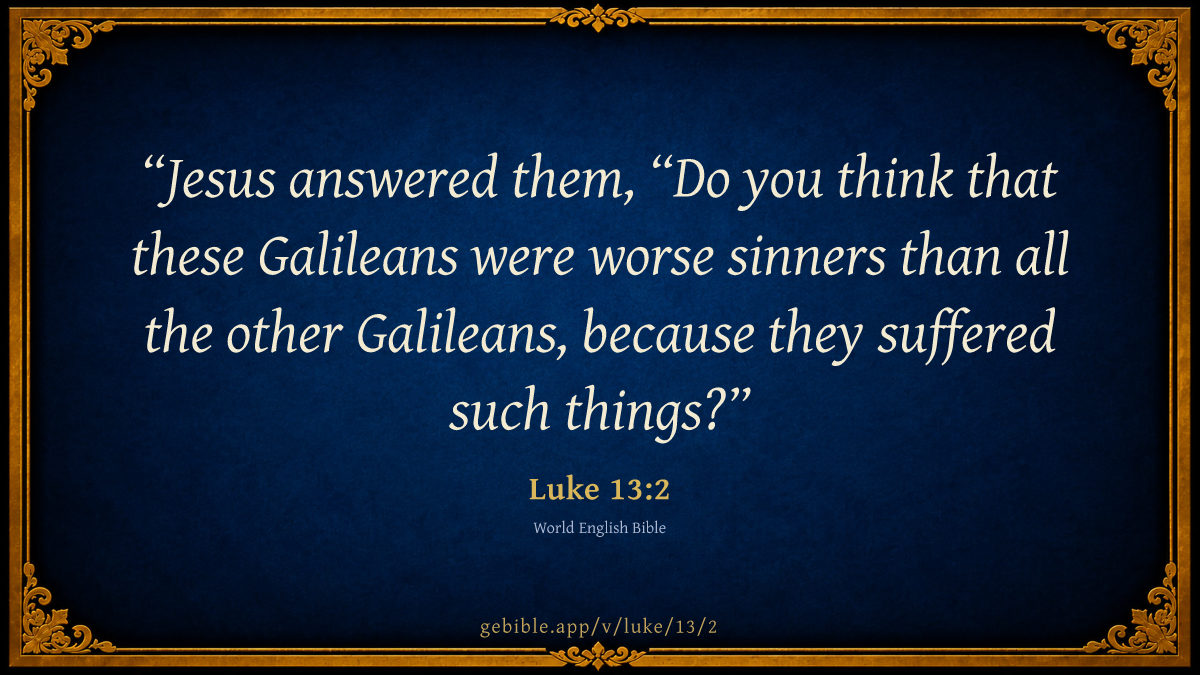
Jesus answered them, “Do you think that these Galileans were worse sinners than all the other Galileans, because they suffered such things?
Parallel Translations
-
Jesus answered them, “Do you think that these Galileans were worse sinners than all the other Galileans, because they suffered such things?
-
And Iesus answered and sayde vnto them: Suppose ye that these Galileans were greater synners then all the other Galileas because they suffred suche punisshment?
-
And Iesus answered, and saide vnto them, Suppose ye, that these Galileans were greater sinners then al the other Galileans, because they haue suffered such things?
Cross-references (4)
Passages linked to Luke 13:2 in the Treasury of Scripture Knowledge, ordered by reader-vote popularity; verse text shown in World English Bible.
- John 9:2 His disciples asked him, “Rabbi, who sinned, this man or his parents, that he was born blind?”
- Acts 28:4 When the natives saw the creature hanging from his hand, they said to one another, “No doubt this man is a murderer, whom, though he has escaped from the sea, yet Justice has not allowed to live.”
- Job 22:5-16 Isn’t your wickedness great? Neither is there any end to your iniquities. For you have taken pledges from your brother for nothing, and stripped the naked of their clothing. You haven’t given water to the weary to drink, and you have withheld bread from the hungry. But as for the mighty man, he had the earth. The honorable man, he lived in it. You have sent widows away empty, and the arms of the fatherless have been broken. Therefore snares are around you. Sudden fear troubles you, or darkness, so that you can not see, and floods of waters cover you. “Isn’t God in the heights of heaven? See the height of the stars, how high they are! You say, ‘What does God know? Can he judge through the thick darkness? Thick clouds are a covering to him, so that he doesn’t see. He walks on the vault of the sky.’ Will you keep the old way, which wicked men have trodden, who were snatched away before their time, whose foundation was poured out as a stream,
- Luke 13:4 Or those eighteen, on whom the tower in Siloam fell and killed them; do you think that they were worse offenders than all the men who dwell in Jerusalem?
Cross-references from openbible.info (CC BY 4.0)
Explain this verse (9 sources)
Historical commentary, presented as a primary source — not an endorsement.
Private notes
Saved on this device only — never synced or sent anywhere.
John Trapp 1656 · Public Domain 2 And Jesus answering said unto them, Suppose ye…
2 And Jesus answering said unto them, Suppose ye that these Galilaeans were sinners above all the Galilaeans, because they suffered such things?
Ver. 2. Because they suffered such things] None out of hell ever suffered more than those worthies, Heb 11:1-40. Shall any therefore condemn that generation of God’s children? Psa 73:15. See Lam 4:6; Dan 9:12.
John Trapp, A Commentary or Exposition upon All the Books of the Old and New Testament (1647–1656) — public domain. Text from a community e-Sword module.
John Gill 1763 · Public Domain And Jesus answering, said unto them,.... Neither approving, nor…
And Jesus answering, said unto them,.... Neither approving, nor condemning Pilate's action; and though he allowed the Galileans to be sinners, which could not be denied, he does not bear hard upon them, but improves the instance for the conviction of his hearers, and in order to show them the necessity of repentance, and to bring them to it:
suppose ye that these Galileans were sinners above all the Galileans, because they suffered such things? such a supposition they seem to have made, by their speaking to Christ concerning this matter; and concluded from their violent and untimely deaths, that they had been notorious and uncommon sinners, and guilty of the most enormous crimes, which had brought upon them the just judgments of God: whereas this is not a rule of judging; oftentimes the best of men suffer exceedingly in this life; God's judgments are a great deep, and not to be fathomed by us, nor is it to be easily known, when any thing befalls persons in a way of judgment; there is nothing comes by chance, but every thing by the wise disposal of divine providence, to answer some end or another; nor are persons that are punished, either immediately by the hand of God, or by the civil magistrate, to be insulted, but rather to be pitied; besides, love and hatred, the characters and states of men, are not to be known by these effects in providence.
John Gill's Exposition of the Whole Bible (1746–1763) — public domain (CC PDM 1.0). Text via the HelloAO Bible API.
Albert Barnes 1834 · Public Domain Suppose ye ... - From this answer it would…
Suppose ye ... - From this answer it would appear that they supposed that the fact that these men had been slain in this manner proved that they were very great sinners.
I tell you, Nay - Jesus assured them that it was not right to draw such a conclusion respecting these men. The fact that men come to a sudden and violent death is not proof that they are especially wicked.
Read full note →
Except ye repent - Except you forsake your sins and turn to God. Jesus took occasion, contrary to their expectation, to make a practical use of that fact, and to warn them of their own danger. He never suffered a suitable occasion to pass without warning the wicked, and entreating them to forsake their evil ways. The subject of religion was always present to his mind. He introduced it easily, freely, fully. In this he showed his love for the souls of people, and in this he set us an example that we should walk in his steps.
Ye shall all likewise perish - You shall all be destroyed in a similar manner. Here he had reference, no doubt, to the calamities that were coming upon them, when thousands of the people perished. Perhaps there was never any reproof more delicate and yet more severe than this. They came to him believing that these men who had perished were especially wicked. He did not tell them that “they” were as bad as the Galileans, but left them to “infer” it, for if they did not repent, they must soon likewise be destroyed. This was remarkably fulfilled. Many of the Jews were slain in the temple; many while offering sacrifice; thousands perished in a way very similar to the Galileans. Compare the notes at Matt. 24. From this account of the Galileans we may learn:
(1) That people are very prone to infer, when any great calamity happens to others, that they are especially guilty. See the Book of Job, and the reasonings of his three “friends.”
(2) That that conclusion, in the way in which it is usually drawn, is erroneous. If we see a man bloated, and haggard, and poor, who is in the habit of intoxication, we may infer properly that he is guilty, and that God hates his sin and punishes it. So we may infer of the effects of licentiousness. But we should not thus infer when a man’s house is burned down, or when his children die, or when he is visited with a loss of health; nor should we infer it of the nations that are afflicted with famine, or the plague, or with the ravages of war; nor should we infer it when a man is killed by lightning, or when he perishes by the blowing up of a steamboat. Those who thus perish may be far more virtuous than many that live.
(3) This is not a world of retribution. Good and evil are mingled; the good and the bad suffer, and all are exposed here to calamity.
(4) There is another world a future state - a world where the good will be happy and the wicked punished. There all that is irregular on earth will be regulated; all that appears unequal will be made equal; all that is chaotic will be reduced to order.
(5) When people are disposed to speak about the great guilt of others, and the calamities that come upon them, they should inquire about “themselves.” What is “their” character? What is “their” condition? It “may” be that they are in quite as much danger of perishing as those are whom they regard as so wicked.
(6) We must repent. We must all repent or we shall perish. No matter what befalls others, “we” are sinners; “we” are to die; “we” shall be lost unless we repent. Let us, then, think of “ourselves” rather than of “others;” and when we hear of any signal calamity happening to others, let us remember that there is calamity in another world as well as here; and that while our fellow-sinners are exposed to trials “here,” we may be exposed to more awful woes “there.” Woe “there” is eternal; here, a calamity like that produced by a falling tower is soon over.
Albert Barnes' Notes on the Bible (1834–1885) — public domain. Text from a community e-Sword/MySword module.
Haydock's Catholic Bible Commentary 1859 · Public Domain Sinners, &c. People are naturally inclined to believe, that…
Sinners, &c. People are naturally inclined to believe, that those who are unfortunate, and afflicted with calamities, must likewise be culpable and impious. The Jews were very much given to these sentiments, as we see in many places in Scripture; John ix. 2 and 3. Our Saviour wishes to do away with this prejudice, by telling them that the Galileans, who are here spoken of, were not the most culpable among the inhabitants of that country; shewing by this, that God often spares the most wicked, and sends upon the good the most apparent signs of vengeance, that he may exercise the patience, and crown the merit of the latter, and give to the former an example of the severity which they must expect, if they continue in their disorders. Neither can it be said, that in this God commits any injustice. He uses his absolute dominion over his creatures, when he afflicts the just; he procures them real good, when he strikes them; and his indulgence towards the wicked, is generally an effect of his mercy, which waits for their repentance, or sometimes the consequences of his great anger, when he abandons them to the hardness of their reprobate hearts, and says, "I will rest, and by angry with you no longer." (Ezechiel, Chap. xvi. 42.) This is the most terrible mark of his final fury. (Calmet)
George Leo Haydock (1774–1849), Haydock's Catholic Family Bible and Commentary, 1859 edition — public domain. Excludes Psalms (Douay-Rheims chapter numbering differs from Protestant) and Deuterocanonical books (Catholic canon only).
Daniel D. Whedon 1874 · Public Domain 2. Jesus answering—The two parts of Jesus’s answer at…
2. Jesus answering—The two parts of Jesus’s answer at once neutralize their sneer and rebuke the false theology of these informants. These Galileans were not proved by their sad fate to be worse than other Galileans, or than people in Jerusalem, Luk_13:4 For special misfortunes are no proof of special guilt; and the same perdition which these sinners may have incurred will be the fate of all who repent not.
Because they suffered these things—Our Lord does not deny that even temporary suffering is a penalty for wickedness; or that all mankind are sufferers because they are sinners. But he denies that the greater sufferings are proof of the greater guilt. Such are the sins of all that they might suffer these same calamities without injustice being done them.
Daniel D. Whedon (gen. ed.), Commentary on the Old and New Testaments (1874–1909) — public domain. Text from a community e-Sword module.
The Cambridge Bible for Schools and Colleges 1878 · Public Domain 2. were sinners above all the Galileans] The ‘were’…
2. were sinners above all the Galileans] The ‘were’ is literally, ‘became,’ i.e. ‘stamped themselves as,’ ‘proved themselves to be.’ We trace a similar mistaken ‘supposition’ in the question of the disciples about the blind man (Joh_9:2). It was indeed deeply engrained in the Jewish mind, although the Book of Job had been expressly levelled at the uncharitable error of assuming that individual misfortune could only be the consequence of individual crime. Such is sometimes the case (Gen_42:21; Jdg_1:7), but although all human sorrow has its ultimate cause in human sin, it is wrong to assume in individual cases the connexion of calamity with crime.
suffered such things] Rather, have suffered these things.
The Cambridge Bible for Schools and Colleges (gen. ed. J. J. S. Perowne; Cambridge University Press, 1878–1918) — public domain. Text from a community e-Sword module.
Ellicott's Commentary for English Readers 1878 · Public Domain (2) Suppose ye that these Galilæans . . .?—The…
(2) Suppose ye that these Galilæans . . .?—The tale had probably been told with a conviction, expressed or implied, that the massacre had been a special judgment for some special and exceptional guilt. Our Lord at once, here as in Joh_9:7, sweeps away all their rash interpretations of the divine government, and declares that all, unless they repented, were under the sentence of a like destruction. The “likewise,” however, is hardly to be taken, as some have taken it, in a literal sense. Some, it may be of those who heard the words, perished by the sword of Titus, as the Galileans had done by the sword of Pilate, but hardly all who were impenitent. Still less could this be said of the form of death referred to in the verse that follows.
A Bible Commentary for English Readers, edited by Charles John Ellicott (1878–1897) — public domain. Text from a community e-Sword module.
The Pulpit Commentary 1880 · Public Domain Vers. 2, 3. And Jesus answering said unto them,…
Vers. 2, 3. And Jesus answering said unto them, Suppose ye that these Galilaeans were sinners above all the Galilaeans, because they suffered such things! I tell you, Nay: but, except ye repent, ye shall all likewise perish. "Yes," answered the Master," these, you are right, are among the dread signs of the times I spoke of; but do not dream that the doom fell on those poor victims because they were special sinners. What happened to them will soon be the doom of the whole nation, unless a great change in the life of Israel takes place."
The Pulpit Commentary (1880–1919), ed. H.D.M. Spence-Jones & Joseph S. Exell — public domain. Text from a community e-Sword module.
C. I. Scofield 1917 · Public Domain Sin. (See Scofield "Rom 3:23").
sinners
Sin. (See Scofield "Rom 3:23").
The Scofield Reference Bible (1917 edition), notes by C. I. Scofield — public domain. Text from a community e-Sword module.