
Praise Yah! Praise God in his sanctuary! Praise him in his heavens for his acts of power!
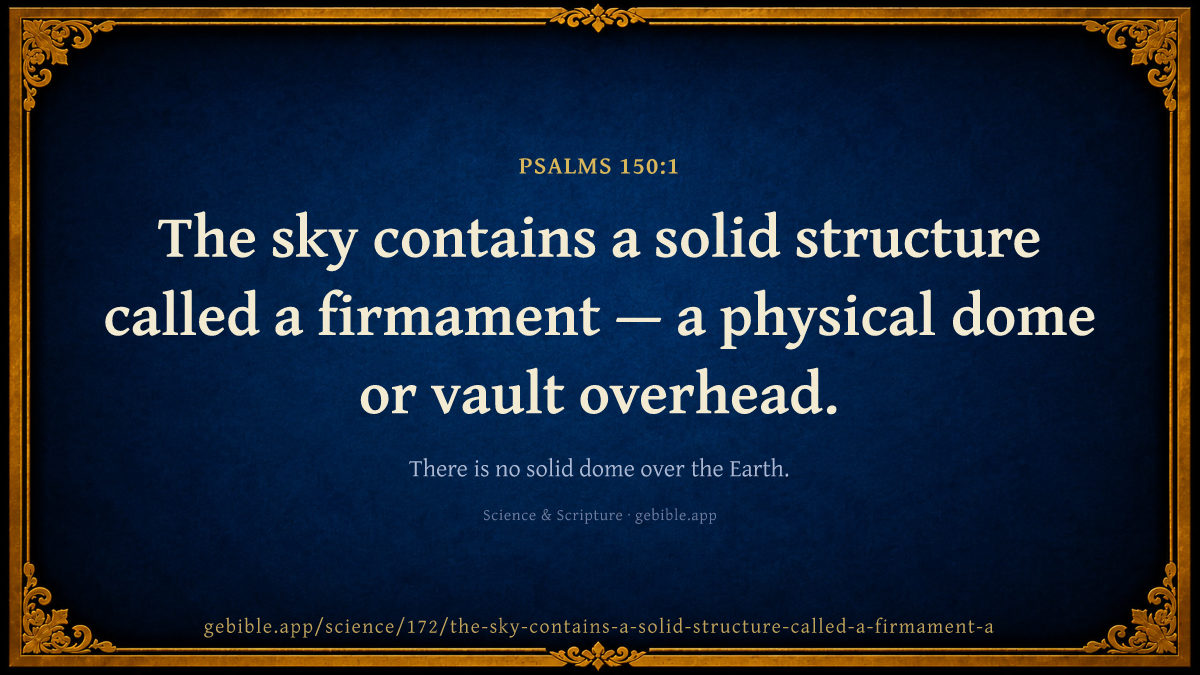
The sky contains a solid structure called a firmament — a physical dome or vault overhead.
Astronomy
47
passages in this field
Show this passage in
The cited passage
What current science says
There is no solid dome over the Earth. The atmosphere is a gradient of gases that thins exponentially with altitude — sea-level air pressure is about 101 kPa, but by 100 km up (the Kármán line, where 'space' begins), it's essentially zero. Beyond that is the vacuum of space. The concept of a 'firmament' comes from ancient Near Eastern cosmology shared by Babylonians, Egyptians, and Hebrews, who all imagined a solid sky-dome holding back cosmic waters. We've launched over 6,000 rockets through the sky. Not one has bumped into a ceiling.
What the text says
This comes from Psalms 150:1. 'Praise him in the firmament of his power' — yet another reference to the solid dome that ancient Hebrews believed separated the waters above from the waters below.
Three honest ways to read this passage
-
As history
The text records how its authors understood the world with the knowledge they had. Read this way, a difference from modern science is a window into the ancient mind, not a failure.
-
As accommodation
The text speaks to its first audience in their own terms, to make a point that isn't mainly about physics or biology. Read this way, the scientific detail is the vehicle, not the cargo.
-
As contradiction
The text makes a claim about the physical world that modern findings dispute. Read this way, the difference is a genuine factual disagreement worth naming.
GEBible doesn't pick one of these for you. Each entry shows the passage, what it says, and what current science says — nothing more.