
In those days Hezekiah was sick and dying. Isaiah the prophet the son of Amoz came to him, and said to him, “Yahweh says, ‘Set your house in order; for you will die, and not live.’ ” Then he turned his face to the wall, and prayed to Yahweh, saying, “Remember now, Yahweh, I beg you, how I have walked before you in truth and with a perfect heart, and have done that which is good in your sight.” And Hezekiah wept bitterly. Before Isaiah had gone out into the middle part of the city, Yahweh’s word came to him, saying, “Turn back, and tell Hezekiah the prince of my people, ‘Yahweh, the God of David your father, says, “I have heard your prayer. I have seen your tears. Behold, I will heal you. On the third day, you will go up to Yahweh’s house. I will add to your days fifteen years. I will deliver you and this city out of the hand of the king of Assyria. I will defend this city for my own sake, and for my servant David’s sake.” ’ ”
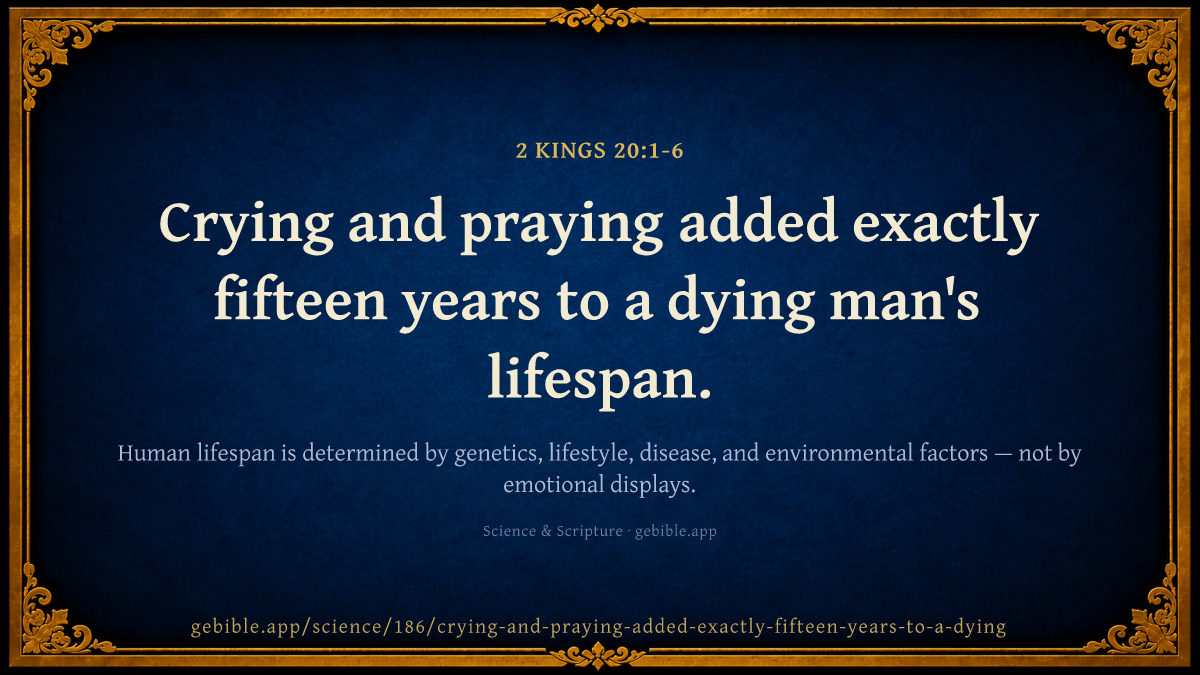
Crying and praying added exactly fifteen years to a dying man's lifespan.
Medicine
97
passages in this field
Show this passage in
The cited passage
In those days Hezekiah was sick and near death. Isaiah the prophet, the son of Amoz, came to him, and said to him, “Yahweh says, ‘Set your house in order, for you will die, and not live.’ ” Then Hezekiah turned his face to the wall and prayed to Yahweh, and said, “Remember now, Yahweh, I beg you, how I have walked before you in truth and with a perfect heart, and have done that which is good in your sight.” Then Hezekiah wept bitterly. Then Yahweh’s word came to Isaiah, saying, “Go, and tell Hezekiah, ‘Yahweh, the God of David your father, says, “I have heard your prayer. I have seen your tears. Behold, I will add fifteen years to your life.
What current science says
Human lifespan is determined by genetics, lifestyle, disease, and environmental factors — not by emotional displays. No clinical study has ever shown that crying or prayer adds a specific, predetermined number of years to life. The 2006 STEP study (the largest study on intercessory prayer and health outcomes) found zero measurable benefit. Meanwhile, actual life-extending interventions — like controlling blood pressure, quitting smoking, and exercising — add 5-10 years on average and are backed by decades of randomized controlled trials. Tears: 0 extra years. Statins: several.
What the text says
This comes from 2 Kings 20:1-6 (also Isaiah 38:1-5). After King Hezekiah wept and prayed on his deathbed, a prophet returned to announce that exactly 15 years had been added to his life.
Three honest ways to read this passage
-
As history
The text records how its authors understood the world with the knowledge they had. Read this way, a difference from modern science is a window into the ancient mind, not a failure.
-
As accommodation
The text speaks to its first audience in their own terms, to make a point that isn't mainly about physics or biology. Read this way, the scientific detail is the vehicle, not the cargo.
-
As contradiction
The text makes a claim about the physical world that modern findings dispute. Read this way, the difference is a genuine factual disagreement worth naming.
GEBible doesn't pick one of these for you. Each entry shows the passage, what it says, and what current science says — nothing more.