
seek him who made the Pleiades and Orion, and turns the shadow of death into the morning, and makes the day dark with night; who calls for the waters of the sea, and pours them out on the surface of the earth, Yahweh is his name,
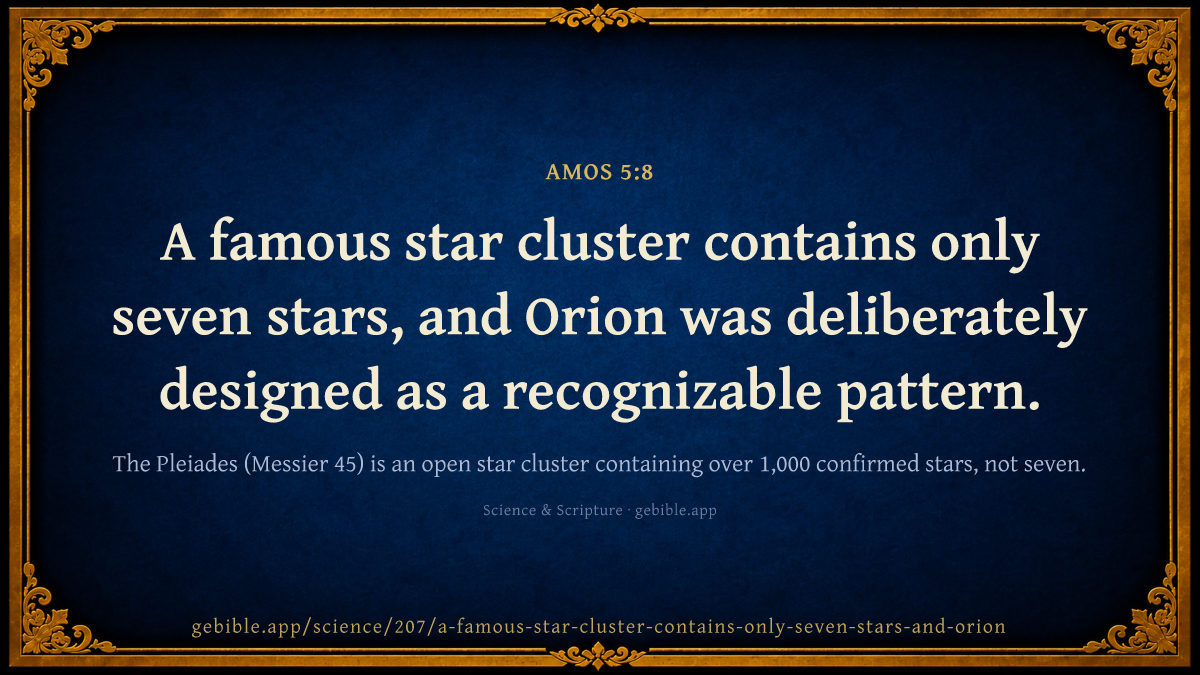
A famous star cluster contains only seven stars, and Orion was deliberately designed as a recognizable pattern.
Astronomy
47
passages in this field
Show this passage in
The cited passage
What current science says
The Pleiades (Messier 45) is an open star cluster containing over 1,000 confirmed stars, not seven. Only six to seven are visible to the naked eye, which is why ancient observers counted seven — but telescopes reveal a sprawling cluster about 13 light-years across. As for Orion: its stars are at vastly different distances from Earth (Betelgeuse is ~700 light-years away; Rigel is ~860). The 'hunter' pattern only exists from our specific viewpoint — from another star system, those same stars form an entirely different shape. Constellations are cosmic pareidolia, not architecture.
What the text says
This comes from Amos 5:8. 'Seek him that maketh the seven stars and Orion' — the Pleiades reduced to just seven stars, and the constellation Orion presented as an intentionally crafted design.
Three honest ways to read this passage
-
As history
The text records how its authors understood the world with the knowledge they had. Read this way, a difference from modern science is a window into the ancient mind, not a failure.
-
As accommodation
The text speaks to its first audience in their own terms, to make a point that isn't mainly about physics or biology. Read this way, the scientific detail is the vehicle, not the cargo.
-
As contradiction
The text makes a claim about the physical world that modern findings dispute. Read this way, the difference is a genuine factual disagreement worth naming.
GEBible doesn't pick one of these for you. Each entry shows the passage, what it says, and what current science says — nothing more.