
A certain man was there who had been sick for thirty-eight years. When Jesus saw him lying there, and knew that he had been sick for a long time, he asked him, “Do you want to be made well?” The sick man answered him, “Sir, I have no one to put me into the pool when the water is stirred up, but while I’m coming, another steps down before me.” Jesus said to him, “Arise, take up your mat, and walk.” Immediately, the man was made well, and took up his mat and walked. Now it was the Sabbath on that day.
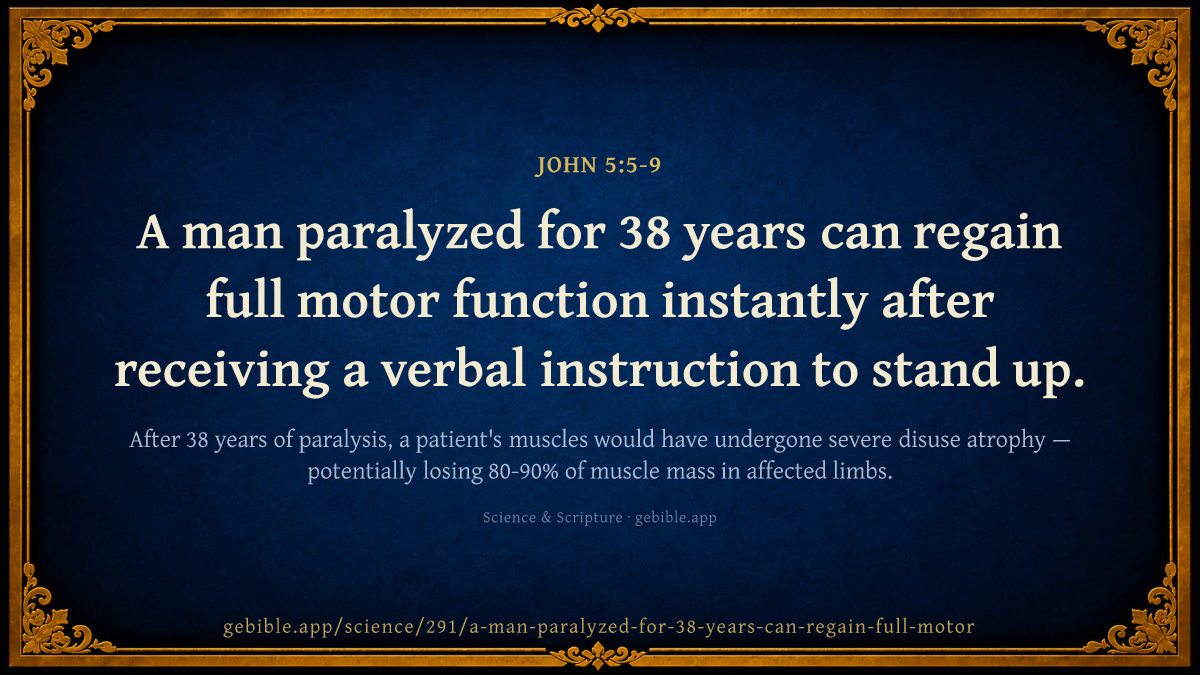
A man paralyzed for 38 years can regain full motor function instantly after receiving a verbal instruction to stand up.
Medicine
97
passages in this field
Show this passage in
The cited passage
What current science says
After 38 years of paralysis, a patient's muscles would have undergone severe disuse atrophy — potentially losing 80-90% of muscle mass in affected limbs. Bones would have lost density from decades without weight-bearing (astronauts lose 1-2% bone density per month in zero gravity — imagine 38 years). Joints would be contracted and stiff. Cardiovascular fitness would be minimal. Even if the neural damage were magically fixed, the patient would need months of intensive physical therapy just to stand, let alone walk and carry a bed. The body doesn't maintain what it doesn't use.
What the text says
This comes from John 5:5-9. A man 'which had an infirmity thirty and eight years' is told 'Rise, take up thy bed, and walk' — and immediately does so. Nearly four decades of paralysis reversed by a sentence.
Three honest ways to read this passage
-
As history
The text records how its authors understood the world with the knowledge they had. Read this way, a difference from modern science is a window into the ancient mind, not a failure.
-
As accommodation
The text speaks to its first audience in their own terms, to make a point that isn't mainly about physics or biology. Read this way, the scientific detail is the vehicle, not the cargo.
-
As contradiction
The text makes a claim about the physical world that modern findings dispute. Read this way, the difference is a genuine factual disagreement worth naming.
GEBible doesn't pick one of these for you. Each entry shows the passage, what it says, and what current science says — nothing more.