
Afterward Jesus found him in the temple, and said to him, “Behold, you are made well. Sin no more, so that nothing worse happens to you.”
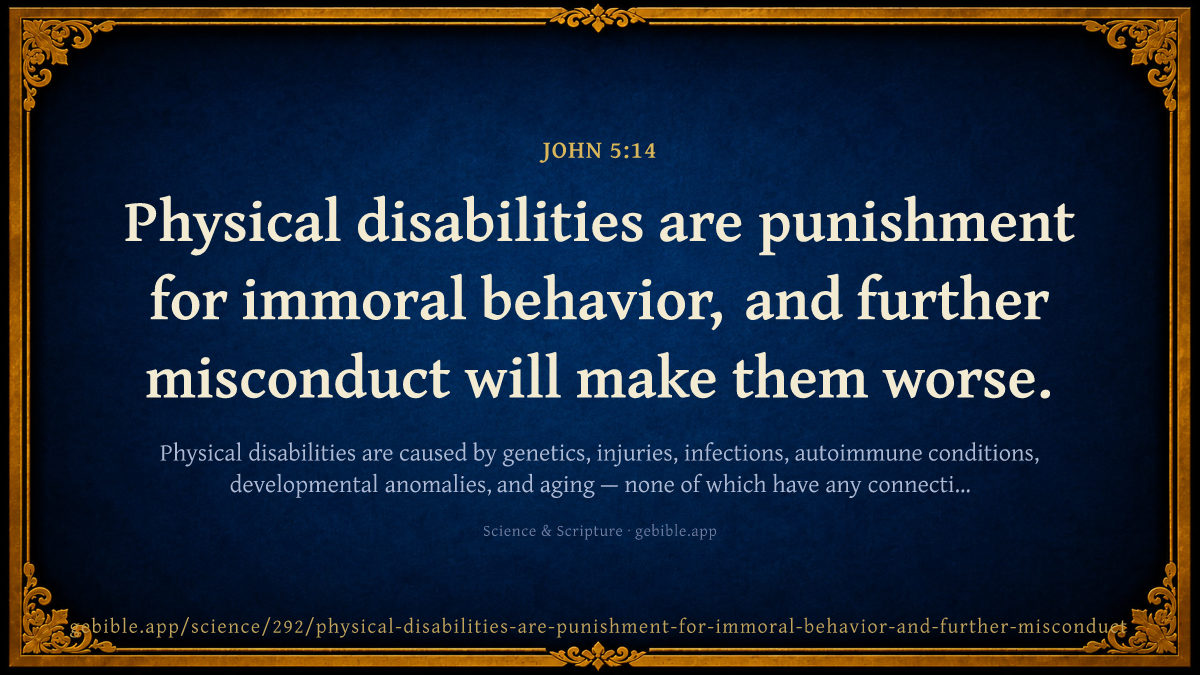
Physical disabilities are punishment for immoral behavior, and further misconduct will make them worse.
Medicine
97
passages in this field
Show this passage in
The cited passage
What current science says
Physical disabilities are caused by genetics, injuries, infections, autoimmune conditions, developmental anomalies, and aging — none of which have any connection to moral behavior. A child born with cerebral palsy hasn't 'sinned.' A person paralyzed in a car accident isn't being punished. This framework is not only scientifically wrong — it's actively harmful. Studies show that 'disability as punishment' beliefs increase stigma, reduce willingness to seek treatment, and cause psychological harm to disabled individuals who internalize the blame. The disability rights movement has spent decades fighting exactly this kind of thinking.
What the text says
This comes from John 5:14. After healing a crippled man, the text records the warning 'sin no more, lest a worse thing come unto thee' — explicitly framing disability as divine punishment and threatening escalation for continued misbehavior.
Three honest ways to read this passage
-
As history
The text records how its authors understood the world with the knowledge they had. Read this way, a difference from modern science is a window into the ancient mind, not a failure.
-
As accommodation
The text speaks to its first audience in their own terms, to make a point that isn't mainly about physics or biology. Read this way, the scientific detail is the vehicle, not the cargo.
-
As contradiction
The text makes a claim about the physical world that modern findings dispute. Read this way, the difference is a genuine factual disagreement worth naming.
GEBible doesn't pick one of these for you. Each entry shows the passage, what it says, and what current science says — nothing more.