
When they had prayed, the place was shaken where they were gathered together. They were all filled with the Holy Spirit, and they spoke the word of God with boldness.
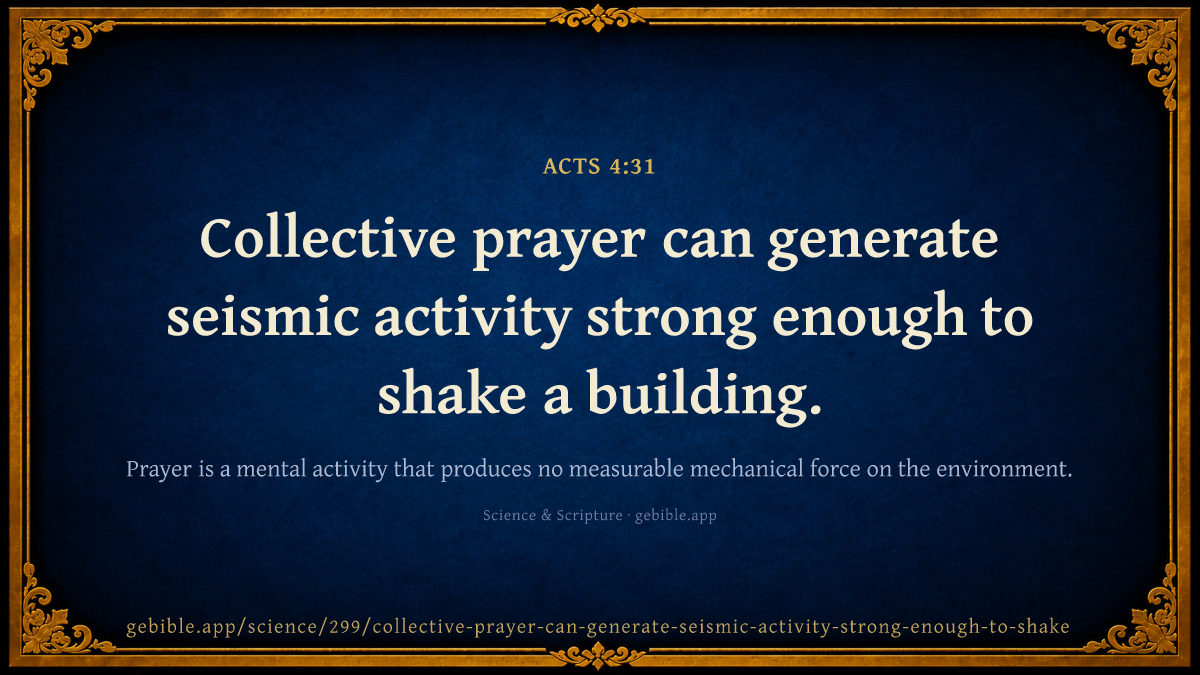
Collective prayer can generate seismic activity strong enough to shake a building.
Geology
25
passages in this field
Show this passage in
The cited passage
What current science says
Prayer is a mental activity that produces no measurable mechanical force on the environment. The brain uses about 20 watts of power — roughly enough to light a dim LED bulb. Even if a room of 100 people were all concentrating at maximum brain activity, the total output would be 2,000 watts — less than a hair dryer. Meanwhile, even a minor earthquake (magnitude 2.0) releases energy equivalent to about 63 kilograms of TNT. The energy gap between prayer and seismic activity is roughly a factor of a billion. Your thoughts cannot shake the ground because neural electrical signals don't become mechanical waves.
What the text says
This comes from Acts 4:31. The text says 'when they had prayed, the place was shaken' — presenting group prayer as generating enough physical force to cause earthquake-like shaking of a structure.
Three honest ways to read this passage
-
As history
The text records how its authors understood the world with the knowledge they had. Read this way, a difference from modern science is a window into the ancient mind, not a failure.
-
As accommodation
The text speaks to its first audience in their own terms, to make a point that isn't mainly about physics or biology. Read this way, the scientific detail is the vehicle, not the cargo.
-
As contradiction
The text makes a claim about the physical world that modern findings dispute. Read this way, the difference is a genuine factual disagreement worth naming.
GEBible doesn't pick one of these for you. Each entry shows the passage, what it says, and what current science says — nothing more.