
Their voice has gone out through all the earth, their words to the end of the world. In them he has set a tent for the sun, which is as a bridegroom coming out of his room, like a strong man rejoicing to run his course. His going out is from the end of the heavens, his circuit to its ends. There is nothing hidden from its heat.
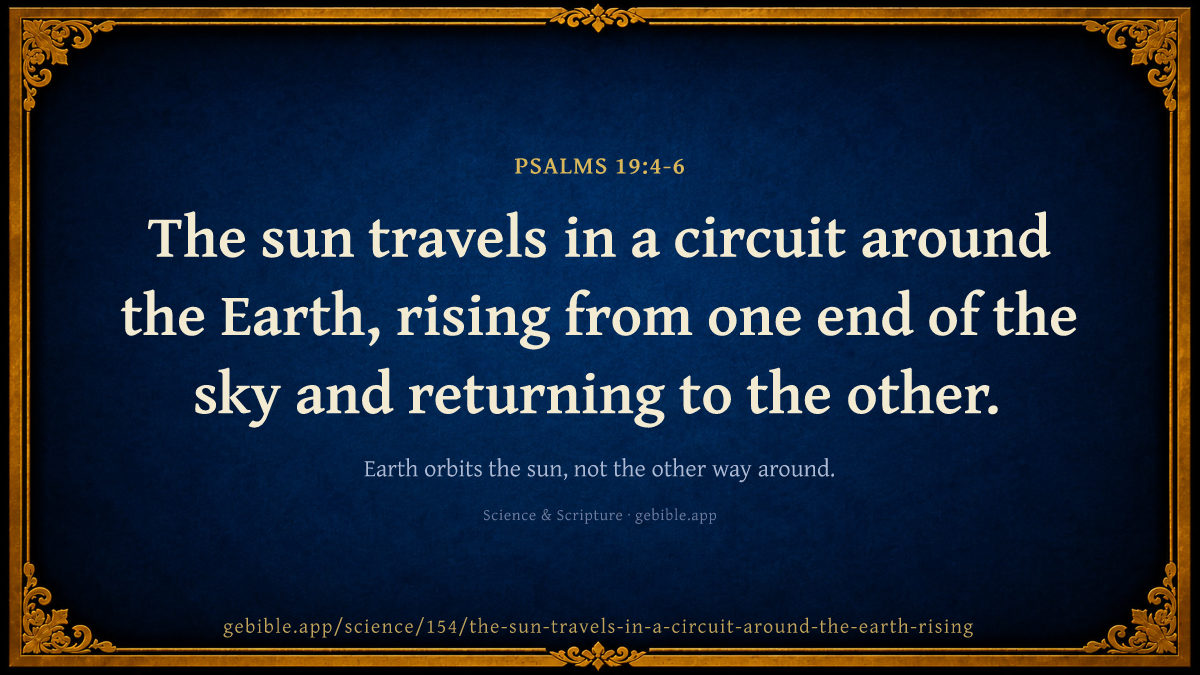
The sun travels in a circuit around the Earth, rising from one end of the sky and returning to the other.
Astronomy
47
passages in this field
Show this passage in
The cited passage
What current science says
Earth orbits the sun, not the other way around. We've known this since Copernicus published his heliocentric model in 1543, and Galileo confirmed it with telescope observations. Earth travels around the sun at about 107,000 km/h (67,000 mph), completing one full orbit every 365.25 days. The sun does appear to move across the sky, but that's because Earth is rotating on its axis at about 1,670 km/h at the equator — you're on a spinning ball, and the 'moving sun' is an optical illusion.
What the text says
This comes from Psalms 19:4-6. The text describes the sun as emerging 'from the end of the heaven, and his circuit unto the ends of it' — a geocentric model where the sun orbits the Earth.
Three honest ways to read this passage
-
As history
The text records how its authors understood the world with the knowledge they had. Read this way, a difference from modern science is a window into the ancient mind, not a failure.
-
As accommodation
The text speaks to its first audience in their own terms, to make a point that isn't mainly about physics or biology. Read this way, the scientific detail is the vehicle, not the cargo.
-
As contradiction
The text makes a claim about the physical world that modern findings dispute. Read this way, the difference is a genuine factual disagreement worth naming.
GEBible doesn't pick one of these for you. Each entry shows the passage, what it says, and what current science says — nothing more.